

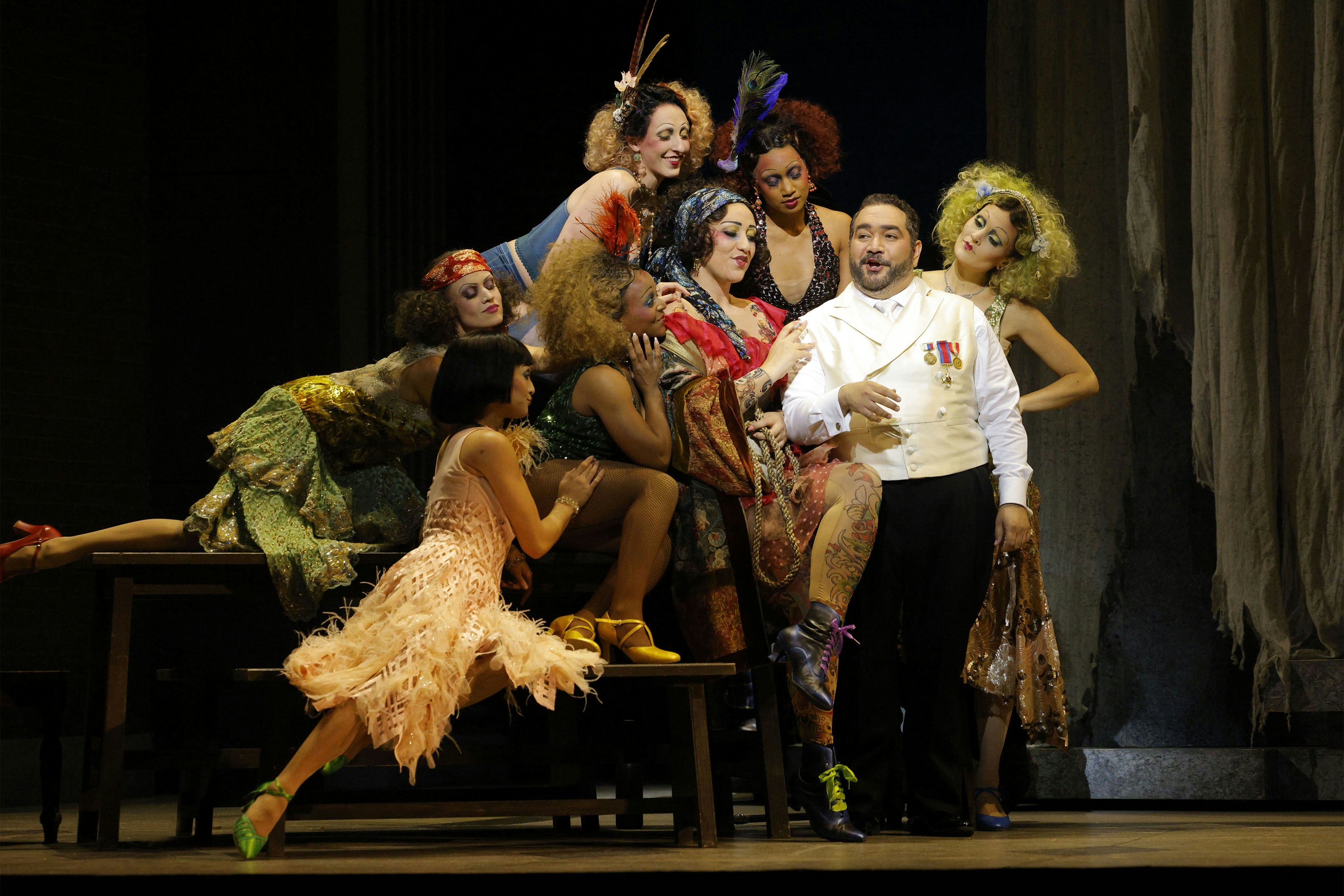


Verdi delivers on the Sturm und Drang with this gloom and doom saga about the title character, a tormented hunchbacked court jester.
From the moment that maestro James Conlon’s majestic baton twirls and LA Opera Orchestra lets loose with the opening strains of Giuseppe Verdi’s 1851 masterpiece Rigoletto, the brass and timpani strike ominous sounds, announcing that the audience is in for a helluva operatic tragedy – and we are not disappointed. Verdi delivers on the Sturm und Drang with this gloom and doom saga about the title character, a tormented hunchbacked court jester, who personifies the smiling yet sad clown, who cries beneath his makeup and masks.
Tasked with entertaining the capricious, womanizing Duke of Mantua (Texan tenor Rene Barbera) and his courtiers at the Ducal Palace in Lombardy, which was built during the Renaissance by the Gonzagas, the humpbacked harlequin who endlessly diverts his hated social “betters” with his ribaldry and witticisms really has only one joy in life: his young daughter Gilda (Nawlins soprano Lisette Oropesa and on June 18 and 21, played by Connecticut soprano Kathryn Lewek). Well-aware of the licentious perfidy of the Duke and his blithe, haughty hangers-on, who live to mount Gatsby-like parties and the wives of others, Rigoletto (Hawaiian baritone Quinn Kamakanalani Kelsey from Honolulu) seeks to shield Gilda from their wicked, wicked ways.
But Verdi’s tragedy, with a libretto by Lorenzo Da Ponte, is a cautionary tale about overprotection, and how zealots often destroy those they too overzealously strive to defend. (Think Oliver North and the contras.) In doing so, Rigoletto causes the curse placed upon his head by Count Monterone (Kentucky baritone Blake Denson) for mocking him after the Duke dishonored the Count’s daughter to come about. File Rigoletto as Exhibit A in the “What Goes Around Comes Around” department. If the Elon-Trump breakup is Opera Buffa, Rigoletto is high tragedy of ancient Greek and Shakespearean proportion.
Sarah Saturnino as Maddalena (left) • Lisette Oropesa as Gilda and Quinn Kelsey as Rigoletto (right)
Rigoletto was based on Victor Hugo’s 1832 play The King Amuses Himself, which was set in Paris in the 1520s and immediately banned for half a century for allegedly insulting King Louis- Philippe. It’s interesting to note that the novelist who gave the world that immortal classic The Hunchback of Notre Dame also created another unforgettable humpbacked character, who Hugo named Triboulet. Twenty years after the one-night run of The King Amuses Himself, Verdi and Da Ponte reset Hugo’s play in Mantua in what is now northern Italy, with the action taking place during the 16th century. (The opera is sung in Italian, with English supertitles.)
For some reason this LA Opera production directed by Israeli Tomer Zvulun, with costumes designed by Seattle’s Jessica Jahn, eschews the period apparel of Italians during the 1500s, and seems to be set in the late 19th or early 20th century. (Hugo knows?) In some scenes, males are clad in tuxedos (with hideous masks reminiscent of commedia dell’arte) and many of the, shall we say, “chorus girl” type females are dressed (or rather, undressed) in sexy lingerie at the court of the Diddy-like Duke’s “freak-offs,” complete with lots of salacious leg spreading.
To top things off, beneath his jester costume Kelsey sports a barely visible hump and an even less pronounced limps, which are traditionally two trademarks of the Rigoletto character. This quasi-letto is no Quasimodo! I don’t have a hunch why all of these changes were made (minus the consent of Mssrs. Hugo, Verdi and Da Ponte); all this tampering and tinkering certainly doesn’t improve the period piece. But having said that, the story, acting and music shines through, and Kelsey’s singing and thespianism are gripping (even without much of a hump!).
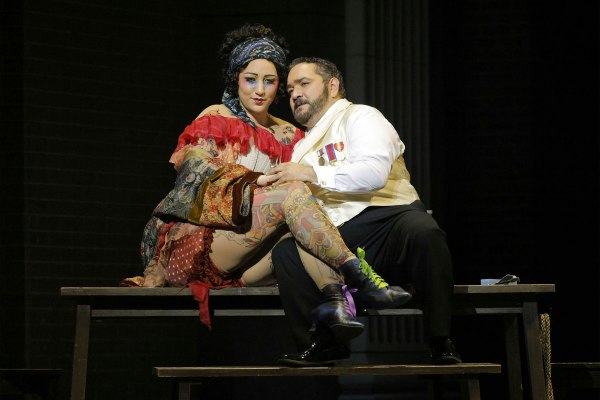 Sarah Saturnino as Maddalena and René Barbera as the Duke of Mantua (Photo Cory Weaver)
Lighting director Robert Wierzel, a New Yorker, renders a murder that plays out like a scene from the silent screen, as the fight and intimacy director, Corning, NY’s Andrew Kenneth Moss, gets to both make love and make war with this rather gloriously large cast. There’s also a kinky vignette with the assassin Sparafucile’s (cunningly, comically played by Chinese bass Peixin Chen) sister, zaftig Maddalena (Californian mezzo-soprano Sarah Saturnino), who indulges in some shibari, or rope play, with the Duke. (BTW, there’s absolutely no truth to the rumor that the assassin Sparafucile, whose knife sharpening is a telling, chilling aural refrain throughout the opera, is actually an ICE-tapo agent.)
Seattle scenic designer’s Erhard Rom’s versatile, mobile set captures the monumental architecture of the Gonzagas, who were to Mantua what the Medicis were to Florence or the Borgias to Naples, an elite Renaissance era family. Venezuelan Ricardo Aponte’s choreography is lively during the Duke’s orgiastic Gatsby style raves.
Peixin Chen as Sparafucile (left) • Quinn Kelsey as Rigoletto and Lisette Oropesa as Gilda (right)
The music in the final act is quite bouncy in this tragic Rigoletto, which doesn’t pull any punches in its relentless tale about sexism, infidelity, murder, what may be incestuous desire and the ultimate helicopter parent. Although the virtuoso Renee Fleming performs June 14, Rigoletto is the LA Op’s last opera of the 2024/25 season to be performed at the Dorothy Chandler. But if you see only one opera this season, you can’t go wrong with this bone-chilling tragedy about revenge gone off the rails. But until the next season starts in September with Leonard Bernstein’s West Side Story, after the final curtain falls for Rigoletto, we’ll just have to say: Bye Bye Verdi!
Rigoletto is being presented June 12, June 18 and June 21 at 7:30 p.m. and June 15 at 2:00 p.m. at the Dorothy Chandler Pavilion, 135 N Grand Avenue, Los Angeles CA, 90012. For tickets: go here; (213)972-8001.
For info about LA Opera’s upcoming season see here.
ALOHA OE (farewell to thee), the funkadelic SLY STONE, truly one of 20th century music’s greats.
