

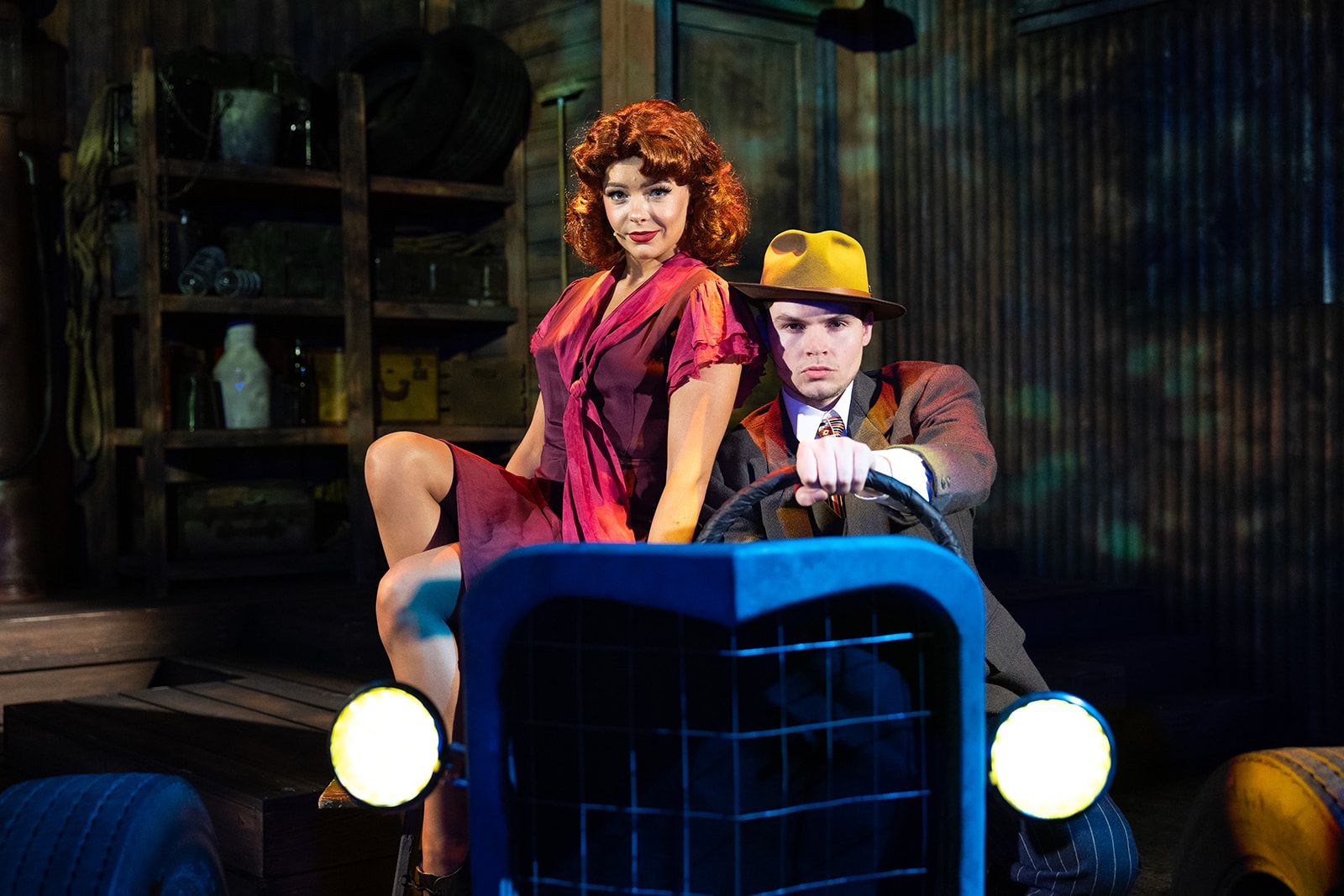


The hard times of the 1930s reduce Parker and Barrow’s modest circumstances to poverty, and when they hook up the only path open to them is a life of crime.
BONNIE & CLYDE, THE MUSICAL: Theater Review
Let’s start with what this production is not and how it is different: Although there is some plot overlap because both works deal with historical personages, Bonnie & Clyde is not a live stage adaptation of Bonnie and Clyde, the 1967 classic movie directed by Arthur Penn, which received two Academy Awards and was nominated for another eight (including for co-writers Robert Benton and David Newman). Although the film’s soundtrack included some outstanding Blue Grass instrumental music (including Flatt and Scruggs’ “Foggy Mountain Breakdown”), Bonnie & Clyde is a musical with about 21 Broadway-like songs accompanied by a live five-piece band, conducted by keyboardist Lisa Lemay.
While the play’s stars, Ellie Smith as Bonnie Parker and Russell Muzyczka as Clyde Barrow, are on the young and attractive side, they don’t have the glamour and beauty of Faye Dunaway and Warren Beatty. On the other hand, in the 58-year-old movie, Beatty’s Barrow is sexually impotent throughout much of their onscreen killing spree, while in the musical the twenty-something outlaws are lusty lovers. Indeed, libidinous urges are the main reason why Parker and Barrow couple up (due to this play’s sex and violence, leave the tykes at home).
A key character from the movie does not appear in this stage version of the Barrow Gang’s bloody reign of crime across the mid-West and West. In the movie, a quirky Michael J. Pollard was Oscar-nommed for playing C.W. Moss, who was a composite character based on two actual accomplices. But this confederate(s) is missing in action onstage, although it’s interesting to see Leland Burnett tackle the role of Clyde’s older brother, Buck – the part that rocketed the recently deceased Gene Hackman to fame, earning him his first Oscar nom. (Interestingly, one of the movie’s Academy Awards was won by the similarly named Burnett Guffey, the renowned cinematographer.)
The motion picture’s other Oscar was given to Estelle Parsons for Best Supporting Actress, as Buck’s reluctant, ditzy wife Blanche, who was along for the ride (much against her will). Amanda Dayhoff acquits herself well as a Bible-thumping Blanche, unsuccessfully trying to convince her husband to surrender his life of crime – and to stay away from his baby brother, clearly a bad influence.
In terms of historical fidelity, the book by Ivan Menchell includes a scene wherein Bonnie tries to help Clyde escape from prison, which I suspected – based mostly on the movie – was inaccurate, as this plot point did not appear onscreen in the 1967 recounting of the Barrow Gang’s bloody deeds. However, after doing a deep dive researching whether or not this was true (translation: I Googled it), I found out that not only was Menchell correct in this assertion, but how Parker is portrayed assisting Barrow was indeed historically accurate.
The curtain lifts with child actors Harper Ham as Young Bonnie and Chance Challen as Young Clyde depicted as children growing up in humble families at Texas. Both are portrayed as yearning for their own peculiar versions of the American Dream, for fame and fortune. Bonnie longs to become a Hollywood sensation like Clara Bow, the silent screen’s so-called “It Girl.” (Later she is thrilled to become a published writer and to be called by newspapers a “ravishing redhead” – the rather obvious wigs are by Danielle White and Lexi Quolas.) Clyde’s role models who, he fantasizes, serve as his ticket to the big time are gunslinger Billy the Kid and gangster Al Capone.
The hard times of the 1930s reduce Parker and Barrow’s modest circumstances to poverty, and when they hook up – with Clyde promising the waitress Bonnie a way out of her dreary existence – the only path open to them is a life of crime. The musical is at its most powerful when it accentuates the desperation generated by economic hardship, which alas remains all-too-relevant relevant as the contemporary economy flounders under Herbert Hoover Trump. As director J. Scott Lapp points out in press notes:
“In many ways, we still live in a world where inequality breeds frustration. Bonnie and Clyde weren’t just criminals. They were symbols—products of the Great Depression, born out of despair, love, and defiance... We still live in a world where people feel left behind. Bonnie and Clyde tapped into a powerful narrative — the underdogs fighting against a broken system. Their story, however tragic, resonates with generations who question authority and challenge the status quo.”
The book includes a scene where the would-be bank robbers are thwarted by bank failures. Clever projections (rendered by Matthew Herman and Mike Billings) of Depression era National Association of Manufacturers’ propagandistic billboards ballyhooing the American Dream and the “WORLD’S HIGHEST STANDARD OF LIVING, There’s no way like the American Way” provide counterpoint, driving home the irony as the Barrow Gang rampages across a stretch of the West and South during their bloody, grubby crime spree. The real-life desperadoes never scored more than $1,500 in any of their heists – small potatoes for two-bit thugs with their pathetic delusions of grandeur fueled by the desperation of the collapse of capitalism.
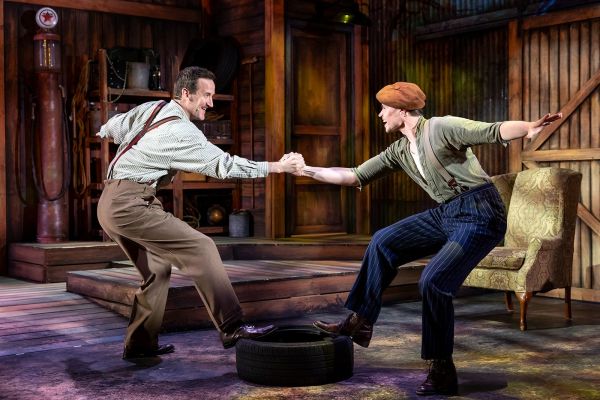
The two-act musical’s most creative and imaginative moment occurs when little Chance Challen joins Muzyczka’s grown-up Clyde onstage during a chilling shootout. It’s as if Barrow’s childhood fantasies of Billy the Kid or Capone have become all-too-adult nightmares. As Bonnie wrote in one of her ill-fated, folksy, prophetic poems:
“Some day they’ll go down together;
They’ll bury them side by side;
To few it’ll be grief--
To the law a relief--
But it’s death for Bonnie and Clyde.”
Costume designer Pamela J. Shaw’s keen eye actually dresses Bonnie in garb similar to what the real outlaw wore in historical photos. The music is by Tony/Emmy/Grammy- nominated composer Frank Wildhorn, whose Broadway credits include Jekyll & Hyde, The Scarlet Pimpernel, Dracula, and Victor/Victoria. Lyricist Don Black won two Tony Awards for Sunset Boulevard, with, as said, Menchell as the bookwriter. While the music is enjoyable plus sung and played well, at times movingly, I didn’t leave the Rubicon Theatre tapping my tootsies to any of the ditties. The acting is good and convincing in terms of the desperation for attention and wealth by members of the harrowing Barrow Gang, with director Lapp bringing it all together into a holistic (if not harmonious, given the violent subject matter!) whole.
This was the first time I crossed L.A. County to experience the Rubicon, originally a 1920s church converted into a 185-pew – uh, I mean seat – renovated theater, and it was well worth the trek. I enjoyed myself very much. The Tony-nominated musical Bonnie & Clyde ran for only a month on Broadway in 2011. This is the U.S. premiere of the revamped West End version of the play, which has one intermission.
During the late 1960s, some likened the ultra-left Weatherman action faction of domestic terrorists to the Barrow Gang. In an interview with the director of The Weather Underground, Sam Green stated: “When they went underground, they tapped into some very deep American archetypes–the ‘Bonnie and Clyde’ outlaw. This kind of narrative was in the air at that time. Incidentally, a lot of the W. U. [Weather Underground] people were very into movies and mentioned some of that era’s movies as being influential–Bonnie and Clyde, Butch Cassidy and the Sundance Kid, The Wild Bunch. I think that they were surprised that this had happened, and to some extent, embraced it. They probably thought that if they could make revolution cool, so be it .”
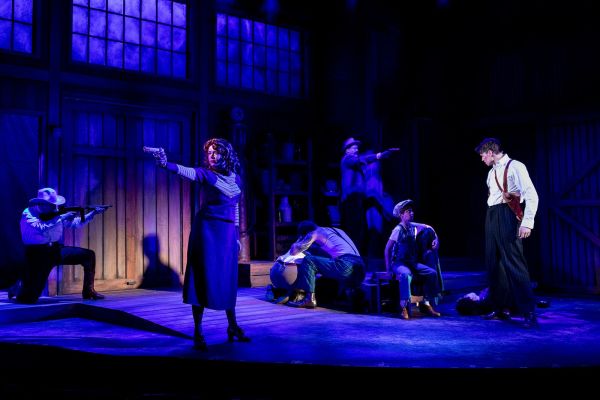
Be that as it may, it’s worth remembering that unlike Che Guevara’s, Bonnie’s beret had no red star on it. As the Trump regime roils the economy with revived fears of another Depression, and more and more people turn to acts of desperation, it’s important to remember that gangsterism is not the solution. Crime doesn’t pay – but Revolution does.
Bonnie & Clyde, The Musical is being presented through May 18 on Wednesdays at 2:00 p.m. and 7:00 p.m., Thursdays and Fridays at 7:00 p.m., Saturdays at 2:00 p.m. and 7:00 p.m., and Sundays at 2:00 p.m. by the Rubicon Theatre Company at The Karyn Jackson Theatre, 1006 E. Main Street, Ventura, CA 93001 in Ventura’s Downtown Cultural District.
For tickets: go here and (805)667-2900.
Ed Rampell’s novel about the Native Hawaiian Sovereignty Movement for Indigenous rights, The Disinherited: Blood Blalahs, is being published this year. For info and to pre-order see: https://www.intpubnyc.com/browse/the-disinherited-blood-blalahs/.
