

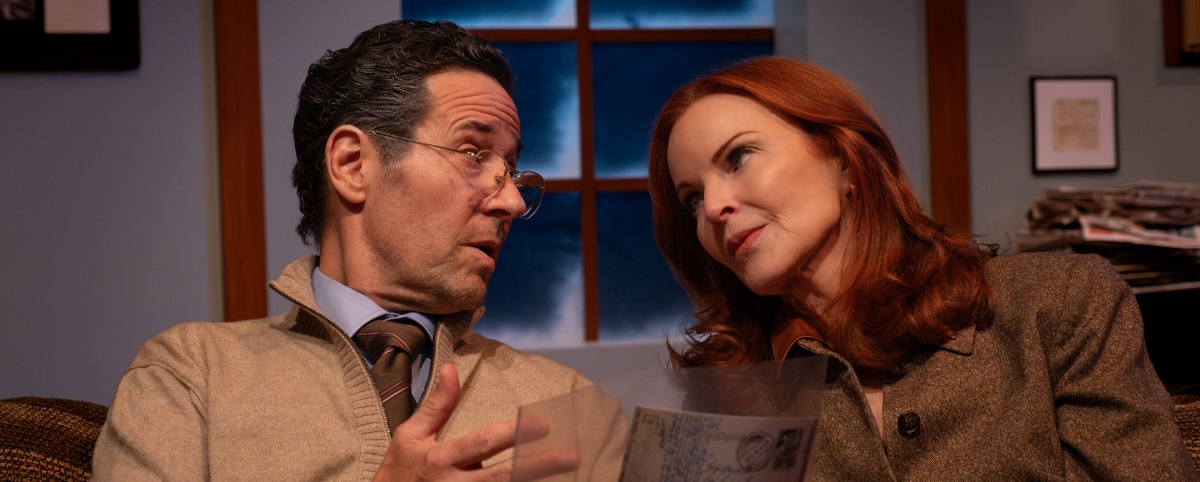


Baitz dramatizes how survivors of fascism can, through a sort of Stockholm Syndrome-like osmosis, internalize and inherit attributes of their persecutors and turn into oppressors themselves.
THE SUBSTANCE OF FIRE: Theater Review
The Ruskin Group Theatre’s production of two-time Pulitzer Prize finalist Jon Robin Baitz’s The Substance of Fire is an engrossing family drama set against the backdrop of New York’s rarefied publishing world. As America is menaced by the MAGA maggots, what makes this two-act play particularly timely is Fire’s subtext: Fascism and how historical trauma persists and is generationally transmitted. And as Netanyahu turns Gaza into a 21st century version of the Warsaw Ghetto on steroids, Baitz dramatizes how survivors of fascism can, through a sort of Stockholm Syndrome-like osmosis, internalize and inherit attributes of their persecutors and turn into oppressors themselves.
Act I opens circa 1989 at the offices (realistically designed by Ryan Wilson) of the Geldhart publishing firm in Manhattan, where publisher and prideful patriarch Isaac (two-time Emmy nominee Rob Morrow of Northern Exposure), an immigrant, presides over a family gathering he has called regarding the fate of their troubled if onetime prestigious publishing house. The business-minded, 20-something Aaron (Emmitt Butler) who works with his father lives in or near NYC, but his older siblings Martin (Barret T. Lewis), a kind of botanist, has traveled down from Upstate New York, while sister Sarah (Fiona Dorn), an aspiring actress, has flown cross-country for the publisher’s powwow.
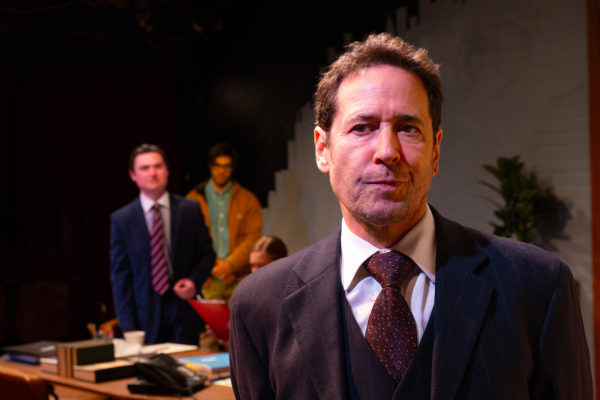 Emmitt Butler, Barret T. Lewis, Fiona Dorn, Rob Morrow
To make a long story short, Isaac is resisting what he perceives to be a very hostile takeover of the company by a Japanese corporation. (In the late eighties this was a prominent business trend, epitomized by Sony’s acquisition of Columbia Pictures. Since the advent of the Internet, from Amazon to e-books to AI and beyond, the publishing world has been shaken by seismic shifts in how and what the public reads—perhaps some future Fire revival will update the challenges currently confronting the struggling publishing industry, but that’s another story.)
Isaac is holding out against what he clearly perceives as “the barbarians at the gates,” steadfastly—or, some might say, stupidly—insisting on continuing to acquire and publish musty, scholarly tomes fewer and fewer readers buy. To stave off a looming bankruptcy and/or acquisition, his children urge Isaac to pursue a more pragmatic path, to publish popular fiction so a bestseller could perhaps stave off the creditors knocking at the door of the family business. (God forbid Isaac publishes a book readers might actually, like you know, read!)
But Isaac, a Holocaust survivor, will have none of that, bullheadedly publishing obscure, multi-volume works about the Nazis few, if anyone, will buy. Ironically, in this postwar Jewish immigrant’s stubborn quest to continue to chronicle Hitler’s horrors, he has acquired some of fascists’ characteristics: He is autocratic and abusively belittles Aaron as a “bookkeeper” (as opposed to being a Talmudic scholar of books), wannabe thesp Sarah as “a children’s clown,” outdoorsy Martin for dressing like “Paul Bunyon” (costumes designed by Michael Mullen), etc. In microcosm, and in light of the havoc currently being wreaked upon Gaza, it’s similar to Netanyahu’s Nazi-like ultra-nationalist, militaristic minions blowing babies to bits in Gaza’s “Guernica-like” rubble (of course, in the name of “defense"—and so Bebe-in-the-bunker can avoid facing criminal charges looming against him and stay in power).
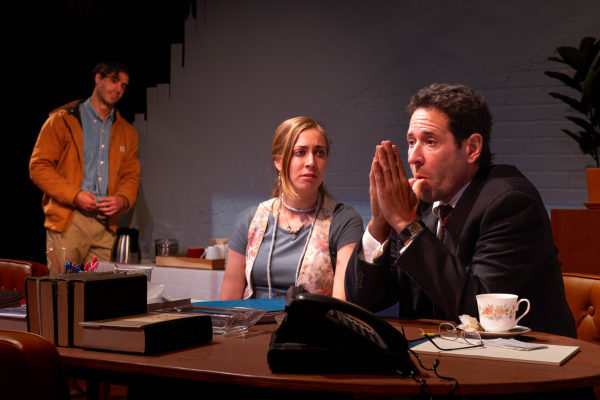 Barret T. Lewis, Fiona Dorn, Rob Morrow
The acting in this production of Fire helmed by Mike Reilly is top notch. There are plot twists and turns plus character quirks I didn’t see coming. As Aaron, Butler reveals a multi-layered depth to his character that I didn’t suspect, and pulls it off convincingly, evincing talent as a thespian. Martin, too, has something in his past, which shows that like his beleaguered father, he also knows a thing or two about being a survivor. Perhaps this is why after the intermission, Lewis’ Martin is the only sibling to return onstage in Act II.
Now, Baitz does indeed set up the first act so that Act II logically continues the production’s action, as well as the drama’s trend of thought. However, I did not see which direction the play would go in the second act, and unpredictability is a hallmark of originality. When the proverbial curtain lifted after the intermission, Mr. Wilson’s set had been altered into Isaac’s apartment at Gramercy Park, that gated private park perched near 20th street on Manhattan’s eastside. On a shelf I spied an old-fashioned radio, and knowing that Emmy nominee Marcia Cross of TV’s Desperate Housewives was in Fire’s cast of complex characters, I assumed that she was going to portray Isaac’s late wife in a flashback.
But boy, was I way wrong, by miles—not even close. The redhaired beauty portrays Marge Hackett, who has been dispatched on a wintry day by social services to make a house call in order to observe and get info about the aging Isaac’s state of mind (in other words, instead of going back in time, Fire flashes forward in Act II). Their interaction starts out smoothly enough, but soon Isaac’s mind seems to wander; perhaps he mistakes the social worker for an assessor from Sotheby’s there to examine the worth of his collection. This is quite clever as Hackett is assessing Isaac’s acuity (paging Mr. Biden!). And Like Aaron, Hackett, too, discloses a plot twist I couldn’t see coming from a mile away.
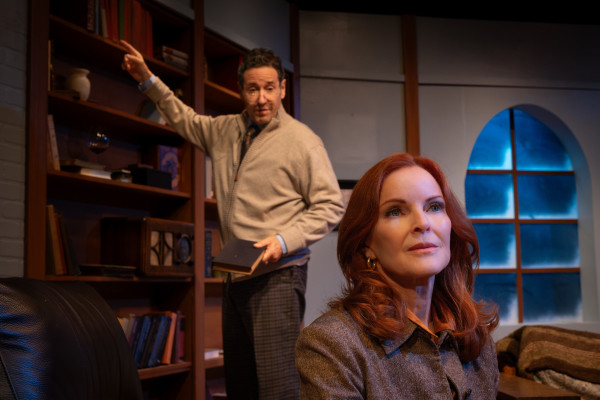 Rob Morrow and Marcia Cross
Among Isaac’s collected artifacts is a prized possession which I won’t ruin for you here with a plot spoiler. It is presumably worth lots of money but Isaac has held onto it for decades for an altogether other reason. As to what it is and what Isaac does with this memento—if you want to find out, Dear Reader, see Fire and find out for yourself. This surprise alone is worth the price of admission—as if first class writing and acting isn’t enough to lure you to this intimate theater.
Throughout Fire, the various characters ask one another to dinner—Isaac even proposes taking Hackett to a restaurant—but for some reason or other, everyone is too busy to dine out. (This droll tidbit reminded me of Luis Bunuel’s 1972 surreal masterpiece, The Discreet Charm of the Bourgeoisie, where none of the characters ever get to complete a meal.) However, after Isaac deals once and for all with his relic, again, without disclosing details, this play about troubled people may end on a note of reconciliation.
In setting Fire against the backdrop of fascism, Baitz has cleverly merged a family drama with a political play format. As I wrote when Baitz’s Other Desert Cities was staged at the Mark Taper Forum in 2012: “The great thing about Jon Robin Baitz’s Other Desert Cities is how the playwright adroitly interweaves the play’s political background and subtext with a very realistic family drama, with all the agility of a playwriting Spiderman, who spins tales as well as webs. Traversing a tightrope between two genres, it’s as if Other Desert Cities’ dramatist has found a happy medium between, or even perhaps united, the best of the Clifford Odets of Waiting for Lefty with the Eugene O’Neill of The Iceman Cometh. Baitz combines the generation gap, antiwar protest from Vietnam to Iraq, the Reagan era and more with a conflict between a daughter and her parents that would not have been unfamiliar to ancient audiences attending Greek amphitheaters.” (See here.)
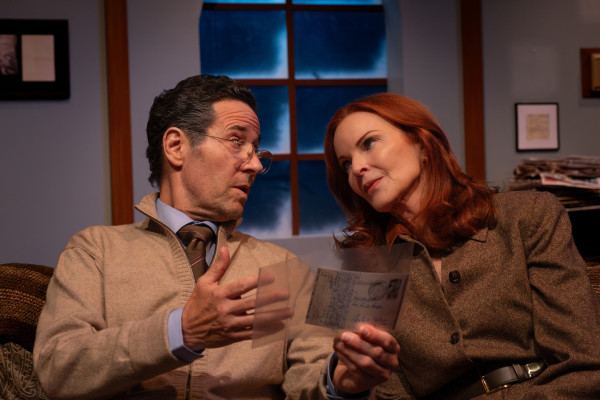 Rob Morrow and Marcia Cross
That recipe serves Baitz—and theatergoers—well again in this highly recommended production currently on the boards of the Ruskin, where I have never gone wrong when viewing and reviewing high caliber theater of substance—fiery and otherwise. Fire is for ticket buyers who relish stellar acting, writing, family dramas, Holocaust sagas, anti-fascist subject matter plus not to mention watching TV stars up close and personal working their magic for you in the flesh.
The Ruskin Group Theatre’s The Substance of Fire is being presented until September 1 at 8:00 p.m. on Fridays and Saturdays, and 2:00 p.m. on Sundays at Ruskin Group Theatre, 3000 Airport Avenue, Santa Monica, CA 90405. For reservations or call (310)397-3244.
