


There hasn’t been this much mustache waggling, twitching and twirling since comedian Ben Turpin graced the silent screen.
COSI FAN TUTTE: Opera Review
Mozart’s 1790 Cosi Fan Tutte gives the lie to opera pooh-poohers who dismiss the operatic medium as unbearably old-fashioned, square and stuffy. In fact, Cosi Fan Tutte, which translates as So Do They All, is all about sexuality (although there’s no onstage graphic nudity or sex acts per se). Indeed, it focuses on infidelity – mainly on the faithfulness of the female of the species, whereas three years earlier, Mozart and his librettist Lorenzo da Ponte had explored the theme of males and monogamy in 1787’s Don Giovanni.
LA Opera’s current version of Michael Cavanagh’s production of Mozart’s Cosi Fan Tutte has for some reason relocated the action from 18th century Naples to a posh country club (sets and projections designed by Seattle’s Erhard Rom) for the horsey set in or near Virginia during what I guess is the Roaring Twenties (the time period is never specified). The plot revolves around the question of whether or not women can stay true to their men. In the locker room of the exclusive country club that Don Alfonso (baritone Rod Gilfry of Rancho Cucamonga, California) is the manager of, the jaded older man argues that it’s female nature to cheat on their male partners.
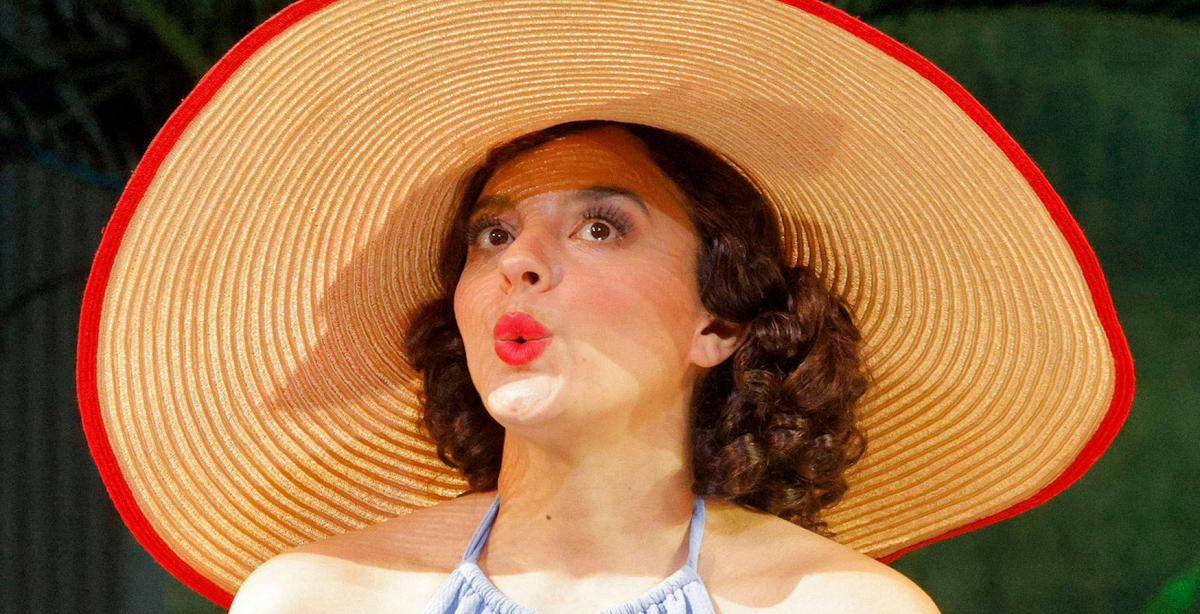
Erica Petrocelli as Fiordiligi (left) Anthony León as Ferrando (right) (photo: Cory Weaver / LAO)
Two younger club members, Guglielmo (baritone Justin Austin of Stuttgart, Germany) and Ferrando (tenor Anthony Leon of Riverside, California), take great exception to this assertion, vehemently disagreeing. They insist that their sweethearts, the adorable Dorabella (mezzo-soprano Rihab Chaieb of Montreal, Canada) and fetching Fiordiligi (soprano Erica Petrocelli of East Greenwich, Rhode Island), would never betray them in affairs of the heart.
To settle the matter, Guglielmo and Ferrando make an expensive bet with the worldly-wise Don Alfonso, wagering that Dorabella and Fiordiligi will not stray. To prove their point, the trio engineer an elaborate ruse which your reviewer won’t reveal here – although Mozart’s opera was concocted 235 years ago, this may be too soon for some newbie operagoers, and I wouldn’t want to spoil their surprise. Suffice it to say that there’s lots of that old saw of mistaken identities that go all the way back to ancient Greek and Shakespearean theater.
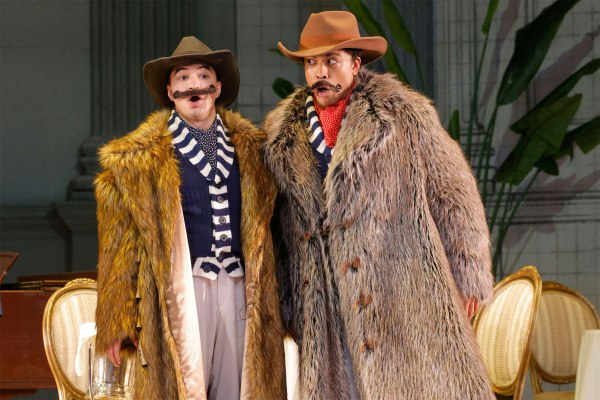 Anthony León as Ferrando and Justin Austin as Guglielmo (photo: Cory Weaver / LAO)
Allow your humble scribe to give the operagoer a word to the wise: In the opening scenes when the beaus appear onstage together, pay close attention to who is paired with whom. Dorabella and Fiordiligi, who are sisters, resemble one another and are garbed similarly (by costume designer Brooklynite Constance Hoffman) and the performers playing them are hard to tell apart from afar (although one is plumper than the other). Because the talents portraying Guglielmo and Ferrando are of different races and heights, these characters are much easier to discern. In any case, who is romantically linked to who is key to the story and important for understanding what happens as the opera unfolds.
During this overlong, three-and-a-half-hour tale of tomfoolery, there is lots of physical comedy, slapstick and sight gags. There hasn’t been this much mustache waggling, twitching and twirling since comedian Ben Turpin graced the silent screen. As the much put upon, resentful maid Despina (soprano Ana Maria Martinez of San Juan, Puerto Rico) when she assumes male roles, Martinez also resembles Charlie Chaplin’s tramp. Mozart’s servants often expressed an 18th century class struggle sensibility, chafing at the servitude forced upon them by unjust, class stratified monarchies, especially in 1786’s merry The Marriage of Figaro, the third of Mozart and da Ponte’s trilogy about sex. Echoes of these characters, including Despina’s, can be glimpsed in the wisecracking, much put out Black maids in movies made during the Hollywood’s Golden (not Ebony) Age. The world-weary Despina laments the adultery she contends all men commit and seeks to counsel her “superiors,” Dorabella and Fiordiligi, in the realities of romance. Ms. Martinez is the best thing about this show, stealing every scene she’s in, and her hilarious portrayal alone is worth the price of admission.
Justin Austin as Guglielmo and Rihab Chaieb as Dorabella (left) • Rihab Chaieb as Dorabella (photo: Cory Weaver / LAO)
It can be said that Cosi Fan Tutte is more about the so-called “game of love” than it is about “the war between the sexes.” This is a comedy, not a drama or tragedy (like, say, Don Giovanni or the 1989 film The War of the Roses). Unlike The Marriage of Figaro, Cosi seems more story-centered and plot dependent, instead of relying upon the music per se to enchant the audience. As The Victor Book of Operas by Louis Biancolli and Robert Bagar put it, Cosi has a “substantially good and occasionally brilliant score,” which is here conducted by LA Opera’s beloved James Conlon.
The opera’s message is that while monogamy may not be female (and human?) nature, in order to be happy, we should be tolerant and go with the flow, since So Do They All.
Cosi Fan Tutte is sung in Italian with English supertitles and being presented Sundays March 16 and 30 at 2:00 p.m.; March 19, 22 and 27 at 7:30 p.m. at the Dorothy Chandler Pavilion, 135 N. Grand Avenue, Los Angeles CA, 90012. For tickets; (213)972-8001.
Ed Rampell’s novel about the Native Hawaiian Sovereignty Movement for Indigenous rights, The Disinherited: Blood Blalahs, will be published this Spring.
