



At a time when the Allies were hailing the “V for Victory” sign “over aggression, slavery and tyranny,” Jimmy boldly argued for a “double V.”
THE DOUBLE V: Theater Review
Playwright Carole Eglash-Kosoff’s The Double V is an entertaining history lesson about an overlooked, if not entirely forgotten, cause that is arguably a forerunner to the Civil Rights movement. While Rosa Parks’ refusal to give up her public bus seat to a white passenger in 1955 is common knowledge, how many of us know about James G. Thompson (an actual historical personage who is here called “Jimmy” and portrayed by K.J. Powell) and his letter that set off a chain of events which, like Rosa’s world historical act of civil disobedience, helped change the status of African Americans?
In early 1942, the influential Pittsburgh Courier–America’s most widely circulated Black newspaper—published the young man’s letter, triggering a cause celebre. It may be hard to believe now—given the military careers of Gen. Colin Powell, who was chairman of the Joint Chiefs of Staff, and Gen. Lloyd Austin, the current Secretary of Defense—but during the Jim Crow era, when much of the U.S. had an apartheid-like segregated system, the role of Blacks in the armed forces was extremely limited (if at all). Racism was so deeply ingrained in the American psyche that this remained true even after Imperial Japan’s sneak attack on Pearl Harbor and America went to war with the Axis powers.
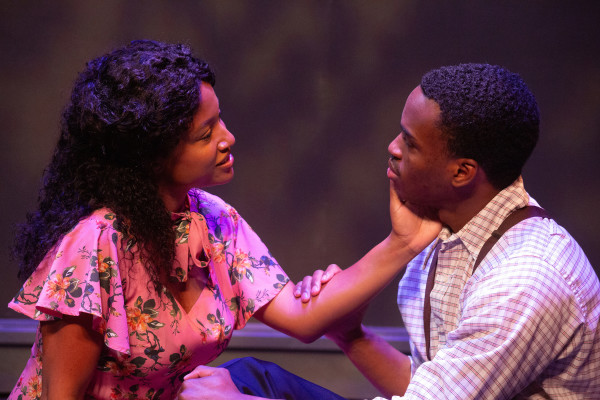 Nicolette Ellis and KJ Powell (Photo by Kayte Deioma)
In his letter to the editor, Jimmy not only argued in favor of Blacks serving in the military but, more importantly, for what the letter writer called “for true democracy at home.” At a time when the Allies were hailing the “V for Victory” sign “over aggression, slavery and tyranny,” Jimmy boldly argued for a “double V.” This would be “a double victory—the first V for victory over enemies from without, the second V for victory over our enemies within,” that is, the perpetrators of domestic racism, according to Jimmy’s epistle.
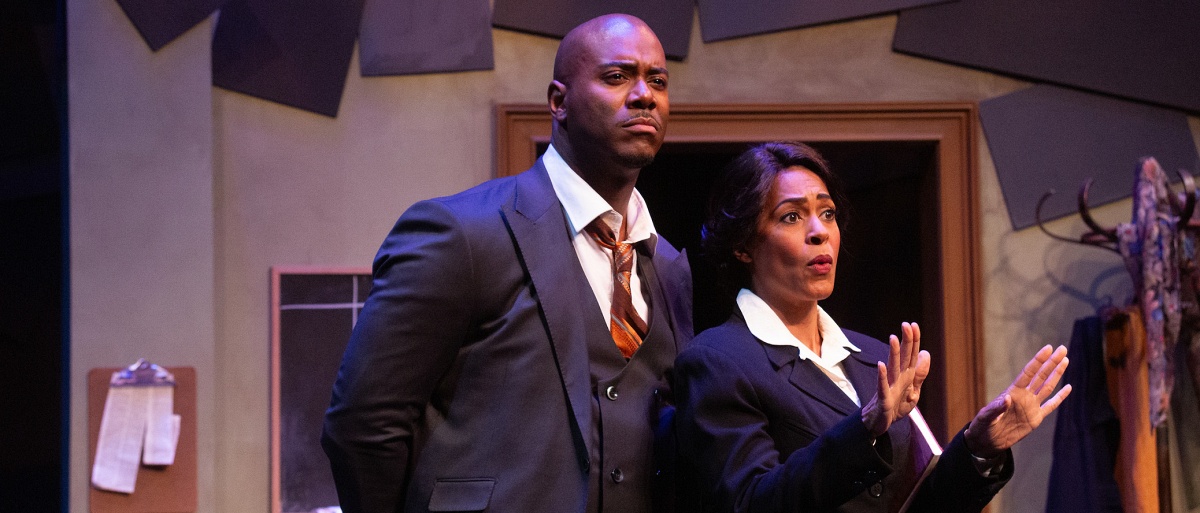
In Act I, Madge Evans (a character inspired by real-life journalist Evelyn Cunningham, portrayed by Jennifer Shelton) brings Jimmy’s letter to the attention of Pittsburgh Courier editor Ira Lewis (an actual historical figure depicted by Nic Few, who won 2024’s NAACP Best Supporting Actor award). He is also Madge’s beau, and at first Ira is dismissive of her effort to pursue this letter, which Evans regards as a clarion call, but Ira tries to relegate the aspiring journalist to bake sales and other “women’s” stories. To make a long story short, upon her own initiative and without informing Ira, Madge travels all the way to Wichita to meet Jimmy, and ultimately the insistent Evans wins the editor over and the Courier publishes Jimmy’s letter, which goes viral and has a big impact on the war effort and anti-racist cause.
In essence, Eglash-Kosoff’s The Double V is a dramatization of politics, inspired by real life events and some actual characters. The two-act play is politically sharpest when it depicts the reaction of J. Edgar Hoover (who is an offstage presence) and the Federal Bureau of Investigation, which predictably views the Double V campaign as racial troublemaking causing division on the home front at a time of war. FBI agent William Taylor (Lee James in a dual role) harasses Ira in an effort to censor the free press by pressuring the Pittsburgh Courier to stop publishing news stories and editorials about the Double V. So, this play about Civil Rights also scores civil liberties points as it defends the First Amendment.
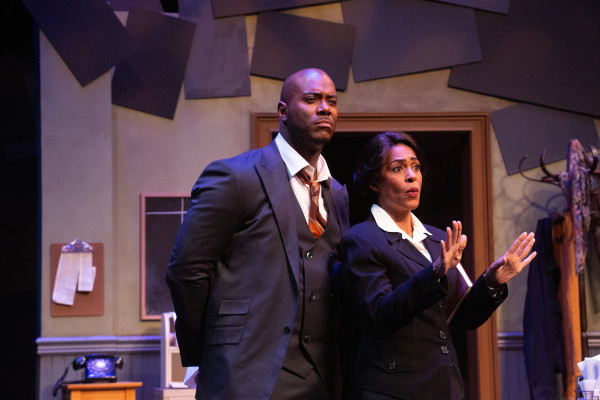 Nic Few and Jennifer Shelton (Photo by Kayte Deioma)
As in Salt of the Earth, the 1954 movie about a strike by Latino miners, the role of women vis-à-vis the Double V is also tackled and personified by Madge and Jimmy’s sweetheart, Annie Culver (the charming Nicolette Ellis). While Ira crusades for Black equality, he still wants Madge to remain a homemaker, instead of an equal partner in the workplace (and bedroom). To its credit, Eglash-Kosoff’s play argues in favor of not only Black rights, but for equal rights for women, as well.
However, in terms of the international implications of the Double V initiative, the play falls short. Fascism is an extreme form of racism, and in the European Theater, this meant white supremacy on steroids. The play should have made a stronger connection between Jim Crow and segregation and Nazism and their forced labor camps, and that during WWII Blacks had to resist both forms of oppression. (In fact, the Nazis studied how the Southern states practiced apartheid and incorporated those lessons into their Nuremberg Laws, which separated Jews from the Aryans and persecuted them.) This interrelatedness may not have been explicitly made by the Double V advocates back in the 1940s, but the relationship between KKK and Nazi types is inherent and could have been made sharper by the playwright. Furthermore, in the drama’s denouement, the scathing critique of the FBI is mitigated.
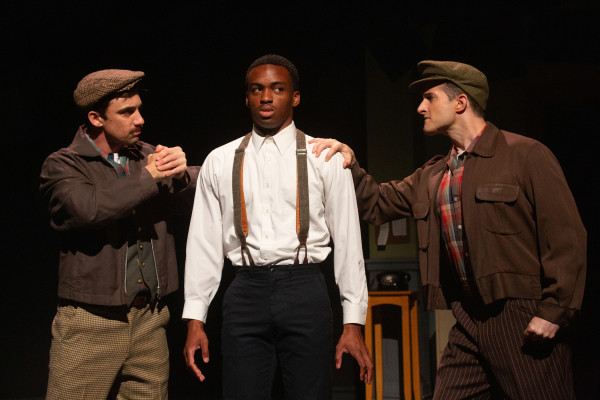 John E. Phillips, KJ Powell, Lee James (Photo by Kayte Deioma)
The Double V’s dialogue includes some racial slurs. It’s this critic’s opinion that ethnic insults and obscenities should not be entirely banned from the stage and screen (which are not “safe spaces”) because sometimes plots and characters realistically require the use of words that many theatergoers may consider to be offensive—but they should be deployed sparingly, with care and never gratuitously. Verbal insensitivity is unnecessary and audience members should not unnecessarily be exposed to harm.
For instance, this drama uses a racist pejorative for Blacks that actually seems to be appropriate in terms of the context of those scenes that depict bigotry. On the other hand, characters also use a derogatory word for people of Japanese ancestry in passing; while it’s certainly true that this aspersion was widely used in the 1940s, particularly in the overheated days following the Pearl Harbor attack, The Double V’s characters did not have to utter this word and it’s unfortunate that they did. By saying “Japanese” instead, the play would have lost none of its meaning. So, if you are easily triggered by derogatory ethnic language, you might want to skip this otherwise fine play.
 John E. Phillips and KJ Powell (Photo by Kayte Deioma)
Scenic designer Tim Mueller’s versatile sets on wheels agilely evoke a newspaper office, Wichita home and defense plant. Award-winning veteran director Michael A. Shepperd ably helms the ensemble, with some of the thesps playing more than one part, such as Idrees Degas, who turns in convincing performances as both Jimmy’s father Clem, a defense plant worker, and as Frank, one of the Courier’s staff reporters. (I’m endlessly amazed at chameleon-like actors who seem to effortlessly switch from one character to another. How do they do it? I suppose there’s a, uh, Method to their madness…)
As Madge, Jennifer Shelton, who has a distinguished stage and screen career, personifies and oozes spunk. She and Nicolette Ellis have surprise plot twists that testify to their characters’ commitment to the struggle against fascism and for human rights. (BTW, insisting on being able to join the armed forces in order to combat the Nazis and Japanese militarists isn’t the same as volunteering and enlisting to fight for U.S. imperialism. There’s no honor in being a tool and cannon fodder for Uncle Sam’s endless invasions of and attacks on Third World nations. Muhammad Ali put it best when he rather gallantly refused to be drafted during the Vietnam War, boldly proclaiming: “No Viet Cong ever called me –”)
Despite some quibbles, Carole Eglash-Kosoff has thankfully rescued an important chapter in human rights history from obscurity and crafted an enjoyable anti-racist, antifascist, feminist drama about Blacks joining the crusade to make the world safe for democracy—at home and abroad .
The Double V is being performed Thursdays, Fridays and Saturdays at 7:30 p.m., and Sundays at 2:00 p.m., through Sept. 8 at INTERNATIONAL CITY THEATRE, Beverly O’Neill Theater, Long Beach Convention & Entertainment Center, 330 East Seaside Way, Long Beach, CA 90802. Info: (562)436-4610 or here.
On October 25 Will Geer Theatricum Botanicum presents a 70th anniversary commemoration and screening of the movie Salt of the Earth, with personal appearances by children of the talents who made this pro-union, pro-Hispanic, pro-woman 1954 classic. For details see here.
