


World premiere puts human emotion to the tragedy of First American women who go missing every year by the thousands.
The woke among us have all heard news of the many Native American women who are murdered, trafficked, assaulted, or simply disappeared every year. Nearly 6,000 of them gone annually? Ten times as likely murdered as other women? One in three sexually assaulted in their lifetime?
Yes, yes, we’ve heard the reports, even if they’ve usually been hidden well below the fold. The lack of media coverage of this travesty is a major contributor to its perpetuation and to the greater society’s ignorance of the magnitude of the problem.
Several systemic issues contribute to these alarming statistics. Aside from the jurisdictional complexities driven by the relationship between federal, state, and tribal authorities that often hinder effective law enforcement responses, other factors help to perpetuate this cycle of violence, including the fact that the lives of these women have historically been ignored.
Crimes committed against Indigenous women typically go unreported in mainstream media. Moreover, the historical context of colonization has ingrained patterns of violence and marginalization against Native America women, further exacerbating the problem.
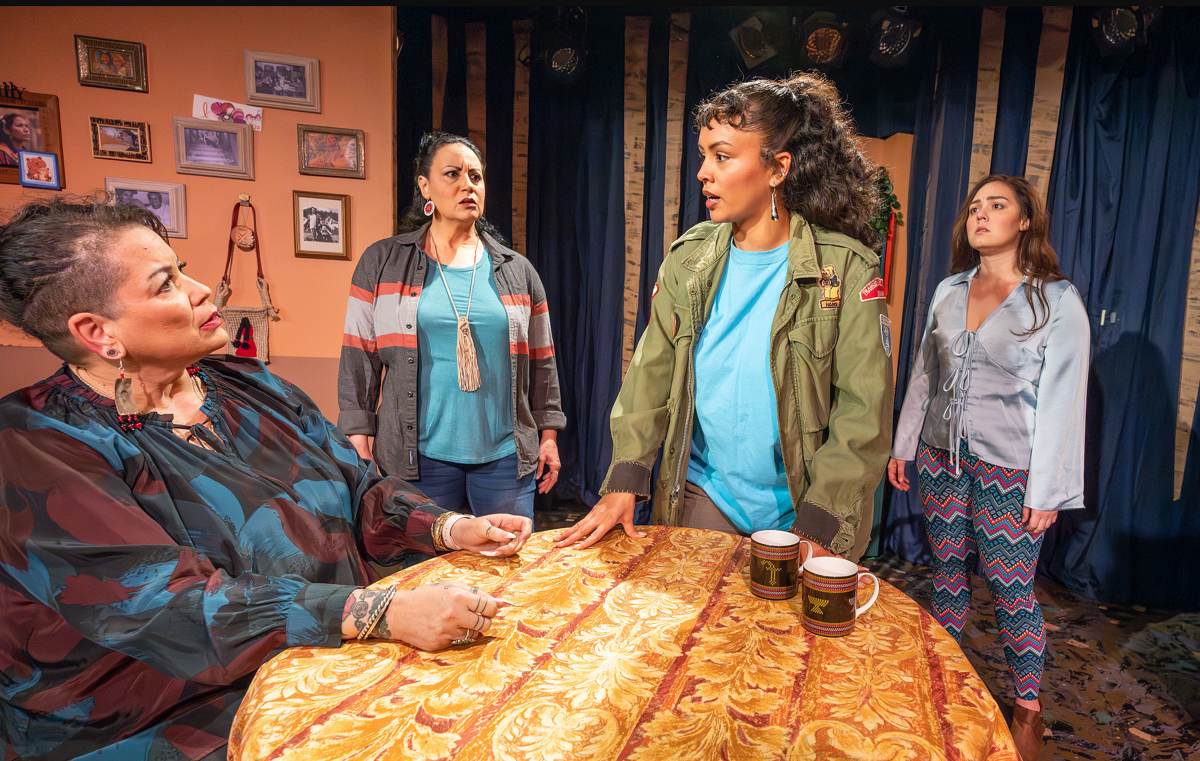
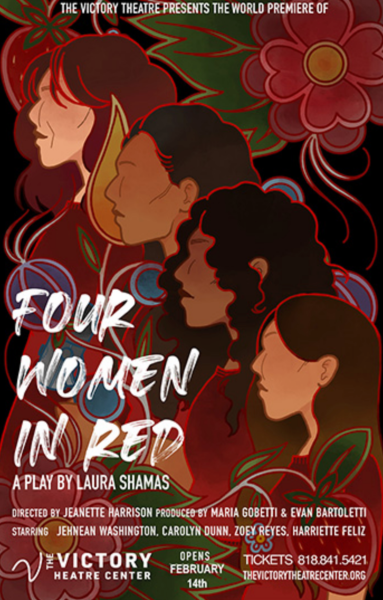
“Four Women in Red,” the powerful new play written by Laura Shamas and directed by Jeanette Harrison, puts a heart-breaking human face on this cold data, showing what it’s like to lose a loved one to such brutalities.
 Carolyn Dunn, Jehnean Washington,Zoey Reyes and Harriette Feliz (Photo: Tim Sullens)
The four women—all Native Americans but strangers to each other—find themselves thrown together in the waiting room of a sheriff’s office in Indian Country, anxious to learn what they can from the usually disinterested officers but not yet willing to work together. There are no leads, no evidence, the women hear. Their loved ones have run off to the big city, or are hiding out, or will come home when they’re ready, they’re told. There’s nothing more the officers can do, it’s said.
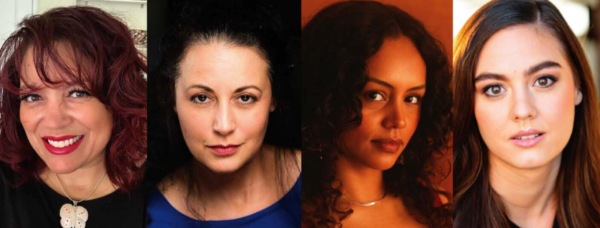 Carolyn Dunn, Jehnean Washington, Zoey Reyes and Harriette Feliz
 "Sadie, played by Zoey Reyes, has feared the worst after her partner disappeared two months earlier. Marie, played by Jehnean Washington, stubbornly holds on to hope even six years after her daughter has gone missing. Lynda and Jo, mother and daughter played by Carolyn Dunn and Harriette Feliz, refuse to believe that harm has come to Jo’s sister."
Hoping for the best, but fearing the worst, they work their pain alone. In time they’re persuaded to pull together into a community, giving themselves strength in numbers. United, they organize, reach out, support each other, share their pain and eventually their secrets. In time, the sheriffs finally agree to help a bit and the women get news–not all good news, but news.
With a cast, director, playwright, as well as many crew members representing Native tribes from coast to coast, the performance has special emotional pull, which was appreciated by the largely Native audience the afternoon we attended.
During her just-ended tenure, Deb Haaland, the outgoing Secretary of the Interior–and the first Native woman ever appointed to a cabinet position–started the Missing and Murdered Unit (MMU) in her department. May 5th has also been designated a national day of awareness for the plight of native women. Haaland recently announced her run for governor of New Mexico.
We’ve all seen that the disappearance of a Native woman–and a Black woman, too, for that matter–barely causes a media ripple. Not just below the fold, oftentimes nothing more than a passing mention.
Contrast that with the round-the-clock coverage when white women disappear. Famed news anchor Gwen Ifill coined the term “Missing White Woman Syndrome” to describe the uproar when a young, attractive, white, upper-middle-class woman goes missing. The disparity says volumes about racism in America. Maybe “Four Women” will open a few eyes.
“Four Women in Red” runs Fridays at 8 p.m. and Saturdays at 8 p.m. and Sundays at 4 p.m. through March 23. Tickets range from $20 to $41. For information and to purchase tickets, call 818.841.5421 or go to thevictorytheatrecenter.org.
