

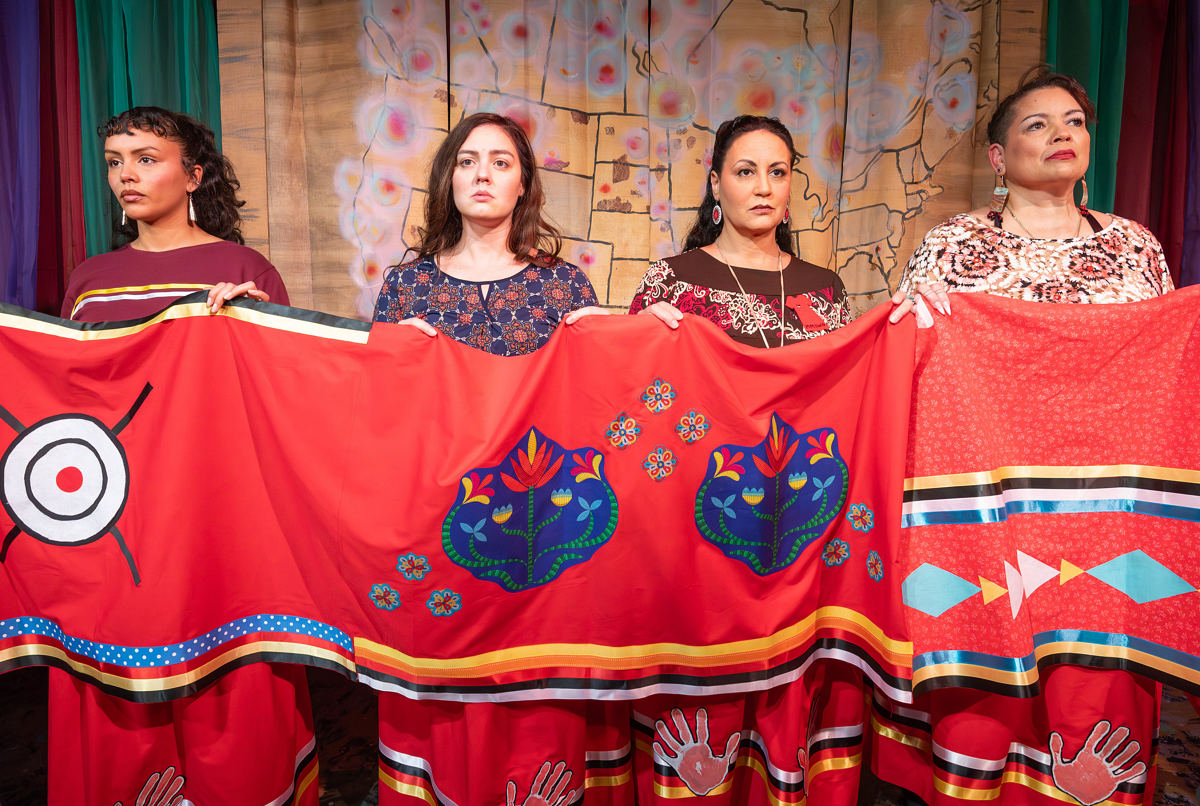

World premiere puts human emotion to the tragedy of First American women who go missing every year by the thousands.
FOUR WOMEN IN RED: Theater Review
Whenever I ponder the “Manifest Destiny” genocide U.S. rulers wrought against this continent’s original inhabitants, the sheer injustice of it all makes me feel like tearing my hair out, gnashing my teeth, slashing my flesh, rending my garments and howling at the moon. And I don’t even have the honor of being Native – so imagine how Indigenous people feel about what is arguably the greatest land theft in human history and this vile villainy of cosmic proportions, which continues to this very day?
To find out, L.A. theatergoers don’t have to make a pilgrimage to, say, Wounded Knee, but can go to the Victory Theatre in Burbank to experience the world premiere of a tremendously important and entertaining drama, Four Women in Red. The winner of the Los Angeles New Play Project Playwriting Award, this poignant, powerful production dramatizes the troubling issue of MMIW – Missing and Murdered Indigenous Women. “Murder is the 3rd leading cause of death for Indigenous Women,” and the homicide rate for Native females is 10 times “higher than all other ethnicities,” as are other incidents of sexual abuse and forms of violence.
The entire cast is Indigenous, but beyond that, so are the play’s key creatives and crew members, hence Red has a cultural authenticity that Hollywood’s “all Black” musicals that were written and helmed by “palefaces” such as Vincente Minnelli’s 1943 Cabin in the Sky and Otto Preminger’s 1954 Carmen Jones didn’t – and couldn’t possess.
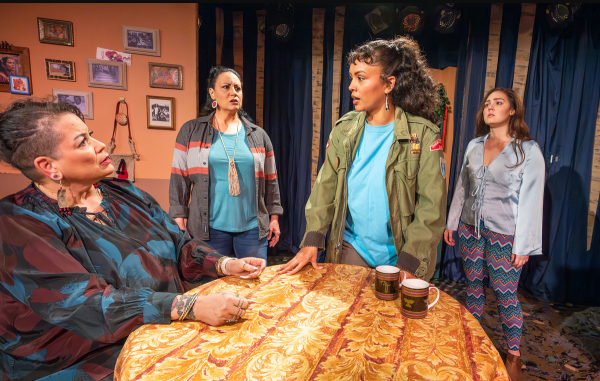 Carolyn Dunn, Jehnean Washington, Harriette Feliz and Zoey Reyes Photo by Tim Sullens
Like many iconic characters since Homer’s Odyssey, Red’s dramatis personae are embarked upon an epic quest. The eponymous quartet first encounter one another in a sheriff’s office where the mother and daughter Lynda (Carolyn Dunn, of Muskogee Creek, Tunica-Choctaw/Biloxi and Atakapas-Ishak ancestry) and Jo (Harriette Feliz, Chumash), plus Marie (Jehnean Washington, descendent of the Yuchi, Seminole and Shoshone Nations) and Sadie (Zoey Reyes, who is Dineh and Chicana) are gathered to receive any news about the ongoing search to find their female loved ones who have seemingly vanished into thin air, without a trace.
Having something so profound in common, the foursome bond and support one another. While Red dramatizes the plight of MMIW, just as importantly it depicts their fight to find a missing daughter or ex-girlfriend (as in Sadie’s case, giving an LGBTQ slant to this story). Instead of being mere passive victims, the titular four women unite to struggle together, becoming protagonists, as they seek the return of their kidnapped or murdered female relatives, etc., or to at least learn what happened to them and where they went (or were absconded to).
The women do so in different ways. Marie is a podcaster. Jo imagines she is some sort of mythic Indigenous superhero. Sadie organizes a search party near a “man camp” – all-male, non-Native encampments often set up by extractive industries near tribal lands, where the only females for miles around are Indigenous. (What could go wrong?)
Aside from allusions to “man camps” and sex trafficking, Red doesn’t delve deeply into any explanations of the MMIW phenomenon, which in 2022 impacted at least 5,487 Indigenous girls and women. The psychosexual attitudes of men of the dominant majority culture as, among other things, a perpetuation of conquest and control, may also be factors. Consider the fact that in Disney’s 1995 animated feature Pocahontas, the 12-ish-year-old title character, was sexualized, rendered as a voluptuous woman clad in a revealing (presumably) buckskin costume. Be that as it may, Red isn’t primarily concerned with possible causes, but rather with dramatizing the fact of MMIW and the resistance against these insidious crimes afflicting Native females.
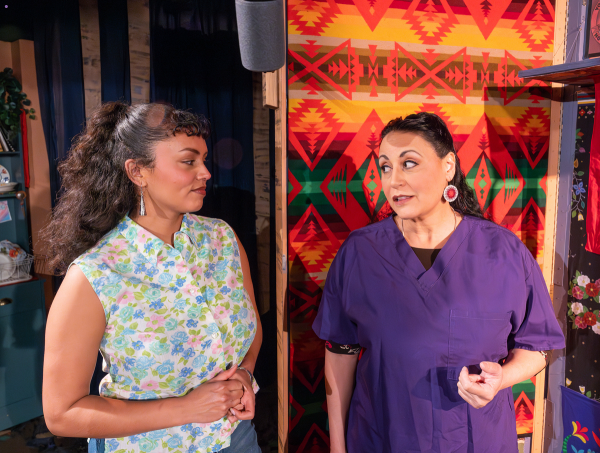 Zoey Reyes and Jehnean Washington Photo by Tim Sullens
And it does so very strongly, especially due to the drama’s Indigenous pedigree. Four Women in Red culminates with an act of solidarity and resistance that some ticket buyers my feel is too on the nose. But while the MMIW situation is widespread and well known among tribal peoples, non-Natives are far less aware of this persistent problem that plagues Indigenous girls and women, so this reviewer felt the play’s dramatic denouement was indeed appropriate. However, the evocation of the eponymous color “red” was not per se explained, especially as this could refer to communists or nowadays, to Republicans (as in “red states”). Is it a reference to the fact that for centuries Apaches, Sioux, Mohawks, et al, were considered to have “red” skins, just as people of Asian, African, Latino and Caucasian ancestry were referred to as being “yellow,” “Black,” “brown” and “white”? This wasn’t explicitly explained; maybe it was mentioned in passing and it went over the head of your humble scribe, but since “Red” is in the play’s title, I think it should have been clearer, particularly what the red hand symbolizes.
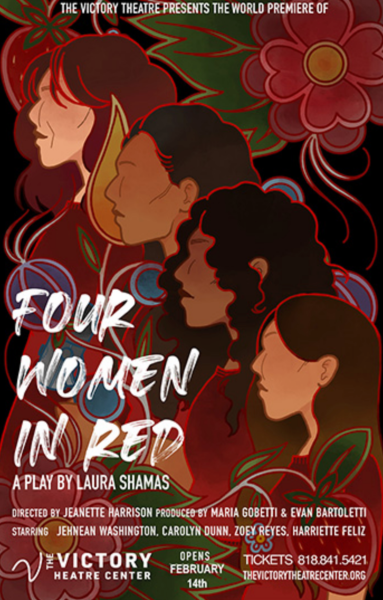
However, this is just a quibble about a production that deserves to be seen far and wide by large audiences. The Oklahoma-born bard of this one act play is Laura Annawyn Shamas, who is Chicksaw, and director Jeanette Harrison is a descendent of the Onondaga Nation. Set decorator Oogie Push, who designed nimble, movable panels that allow the onstage action to fluidly flow, is of the Meskwaki Nation, Bear Clan. Costume designer Lorna Bowen, who is Seminole, Cherokee and of the Muskogee Nation, enhances the play’s realism with Indigenous apparel and jewelry, such as ribbon dresses and turquoise regalia. Lighting designer Grayson Basina is Ojibwe, and this Indigenous team heightens the cultural authenticity and sensitivity of the depiction of people who have been so bedeviled by Hollywood’s one-sided misrepresentations that in 1973 Sacheen Littlefeather declined Marlon Brando’s Godfather Academy Award to protest and draw attention to decades of celluloid stereotypes (and stage – yes, I’m talking to you, “Tiger Lily”!).
Red’s casting of all Indigenous women obviously deepens the drama’s sense of being genuine. The preternaturally pretty Zoey Reyes has a face straight out of central casting perfect for stage and screen and is outstanding as Sadie who is (with apologies to Madonna) desperately seeking her ex-girlfriend. Ms. Reyes co-starred as Krista in Netflix’s RezBall, a 2024 sports movie set at a New Mexico reservation that also deals with hard hitting themes, such as suicide, and she is a thespian whom casting directors, agents, directors, etc., should keep their eyes on.
Just as those who enjoy theater that entertains as well as enlightens auds about major topical issues should flock to see Four Women in Red, a Bertolt Brecht-like “Lehrstücke” or learning play, intended to educate and spur action. As such, it fulfills the anti-racist mission of The Victory Theatre Centre’s mission to “to educate, challenge and entertain its audiences… to end racial inequities in our industry and therefore our culture.” There is probably no better way on stage now in L.A. to celebrate the long-awaited freedom of our brother Leonard Peltier than by seeing this moving, uplifting play about Indigenous women fighting for justice – and some peace of mind.
Four Women in Red is being performed on Fridays and Saturdays at 8:00 p.m., and Sundays at 4:00 p.m. through March 23 at The Victory Theatre Centre, 3326 W. Victory Blvd., Burbank, CA 91505. I(818)841-5421. A talkback will take place after the Sunday, March 9 matinee with actress and Native Voices at the Autry artistic director DeLanna Studi (Cherokee Nation), moderated by managing director Elisa Blandford.
For info about Missing and Murdered Indigenous Women see:
Ed Rampell’s novel about the Native Hawaiian Sovereignty Movement for Indigenous rights, The Disinherited: Blood Blalahs, will be published this Spring.
