


One Night in Manhattan with Jimmy, Maya and Miles Plus an Autocratic Auto-da-fé Versus Autobiography
LAST NIGHT AT MIKELL’S: Theater Review
Just about the highest praise I could heap on Larry Muhammad’s Last Night at Mikell’s is that it was worth enduring the pre-curtain bother and wait to experience it. As a thee-a-tuh reviewer, I’ve covered hundreds of plays, and can’t remember ever having undergone such pre-play confusion. A table near the door to The Robey Theatre at LATC had plenty of playbills, but declined my request for one of the programs to peruse while waiting. Then it was announced that the doors were open and ticket buyers rose to enter – only to be told that they had to wait, standing around 15, 20 minutes and to get in line – including an elderly woman with a walker and grumbling others for whom this was a hardship. (I had just attended Downtown LA’s Bernie/AOC rally where I’d literally been standing for hours) Finally, we were given playbills and admitted to the miniscule theater, where time-consuming seating was on a first-come-first-served basis. Then director Ben Guillory introduced the play – followed by another taped intro (judging by the mellifluous, stentorian tones of the disembodied voice, it was probably also by The Robey Theatre Company’s Producing Artistic Director).
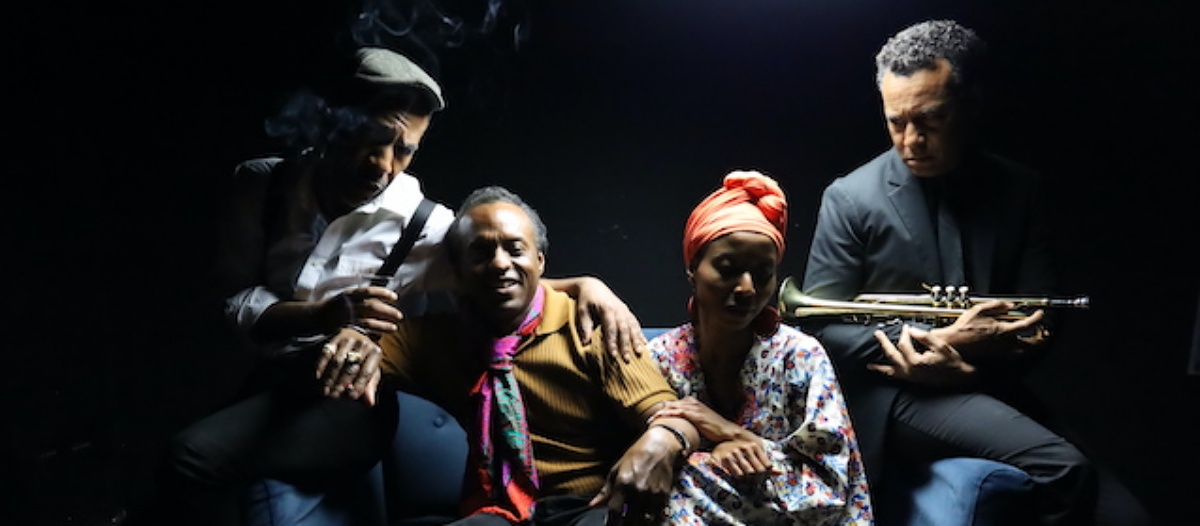
Finally, after all this strange rigmarole, about 35 minutes late, Last Night at Mikell’s commenced, but this stellar production proved, as said, to be well worth the inconveniences. With a bar, tables, chairs and stage, the set was designed by Grant Gerrard to look like the eponymous legendary nightclub on Manhattan’s Upper West Side, where most of the action takes place. A montage or mosaic of images (designed by Vanessa Fernandez) projected on the walls mostly featured outstanding African American artistes, including John Coltraine, Lena Horne, Sly Stone, Amiri Baraka, Toni Morrison, et al., imparting the sense that this jazz club is a cultural gem.
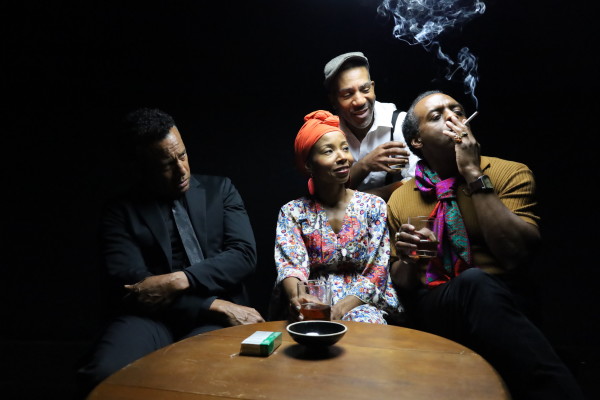 Nick Gillie as Miles Davis, Raquel Rosser as Maya Angelou, James II as David Baldwin, Julio Hanson as James Baldwin
The real life-Mikell’s, perched at the corner of 97th Street and Columbus Avenue, was indeed a beloved hangout for the Black literati and musicians. The play begins, presumably in the 1980s, with James Baldwin (Julio Hanson) bumping into fellow scribe Maya Angelou (Raquel Rosser) on an Upper West Side street. Delighted to see each other, they head over to Mikell’s to catch up, as Baldwin – who was born and raised in Harlem – has just returned home from one of his many jaunts overseas for some R&R (although being a so-called “Native” New Yorker myself, it seems that NYC is a most unlikely place for what that immortal philosopher, Elmer Fudd, called: “At wast, west and wewaxation.”)
Meanwhile, hoping to meet up with “Jimmy,” trumpeter Miles Davis (Nick Gillie) has already gone to their favorite haunt, only to find the doors to Mikell’s inexplicably locked. When James’ younger brother, Mikell’s bartender David Baldwin (James T. Lawson II, son of the Civil Rights icon), finally reluctantly opens the doors only to find out it’s the jazz legend who has been banging on them, he lets the regular enter, only to inform Miles that this is the titular last night at Mikell’s.
Gentrification is chasing the nightclub out of business, and combined with the appearance of Maya and the newly returned Jimmy, the trio plans to make a night of it, celebrating Baldwin’s reappearance at NYC and mourning the closing of the popular club. Over the course of the night, it turns out that Baldwin is fatally ill, and the play imagines this final meeting of the minds at their beloved gathering place.
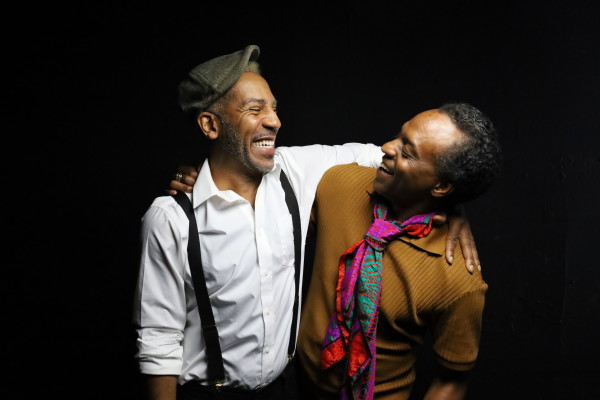 James T. Lawson II and Julio Hanson
Guillory expertly helms the quartet of thesps, who all deliver outstanding performances that bring their respective historical characters vividly back to life. Based on the little I knew of the authors and musician, I found all four portrayals to be realistic and convincing. Of course, I never met any of these now deceased real-life figures, but actor Danny Glover, who attended opening night, told me that he’d met the Baldwin brothers (Jimmy and David – not Alec, Stephen and Daniel) when he was on Broadway in the cast of Athol Fugard’s “Master Harold”… and the boys. Glover told me that the Baldwins came backstage in 1982, and Danny had nothing but praise to heap upon Last Night at Mikell’s and the actors’ depictions of the luminaries they were dramatizing.
Raquel Rosser excels as Maya and renders a beautiful version of Angelou’s poem “And Still I Rise” as a monologue. Ms. Rosser is preternaturally pretty and her exposed muscular throat, which is bare (costumes designed by Naila Aladdin Sanders), enhances her finely honed acting. I don’t have a fixation on necks and rarely if ever mention them in reviews, but she’s such an exceptional actress that even Ms. Rosser’s neck gets into the act, exuding her intensity. Modigliani would have had a field day painting her neck, and casting directors and agents should pay attention this gifted artist.
 Raquel Rosser as Maya Angelou
As Baldwin, Hanson imparts a realistic sensibility about the writing life, and there is a wonderful monologue about what most freelancer writers have to contend with from editors and publishers who, like god, often work in mysterious ways. Having said that, for some reason this play looks down on Baldwin’s writing a piece for the New York Times – I assure you, most freelance journalists would not sneer at this opportunity, but would likely be pleased to write for the newspaper of record, which confers prominence and presumably decent literary rates.
Baldwin’s obsessive scribing is ascribed with being what’s driving him to an early grave, and to be sure, his heavy smoking and drinking took its toll on the literary titan who was, alas, when all was said and done, just a mere mortal after all who should have taken better care of himself. Unfortunately, Maya’s character repeats her admonition against Jimmy working too hard ad nauseum and it becomes tiresome to hear this frequent refrain, which makes Angelou sound like a nag. (I consider the playwright to be responsible for this repetitiousness, not Ms. Rosser, who is merely reciting the lines and playing the part that has been written for her.)
Last Night at Mikell’s premise put me in mind of One Night in Miami, which was inspired by what really happened after Cassius Clay won the heavyweight boxing championship on Feb. 25, 1964, and went back to his Florida motel with other Black notables: Singer Sam Cooke, actor/athlete Jim Brown and activist Malcolm X. While it’s known that this actually took place, nobody really knows for sure what these four iconic men said or did that one night in Miami. In his alternate history One Night in Miami, playwright Kemp Powers brilliantly conjured up what he imagines may have transpired in his gripping play, which I saw at its 2013 Rogue Machine premiere.
At the afterparty, Larry Muhammad told me that while Mikell’s was a real nightclub, the closing night dramatized onstage with Jimmy, Maya, Miles and David never happened – except in his imagination. Indeed, Baldwin died in 1987, and Mikell’s closed its doors four years later, so the story as presented could not have taken. (I figure that the title Last Night at Mikell’s has some sort of deep metaphorical meaning, perhaps about Black culture, or Jimmy’s demise in particular. But what does this honky reviewer really know, anyway?)
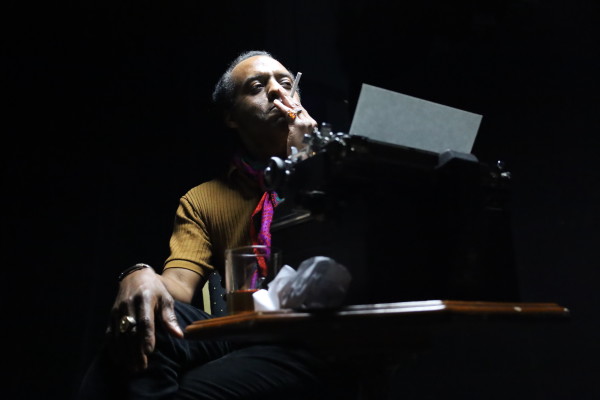 Julio Hanson
I also asked Mr. Muhammad what he thought about reports that as part of the Trump junta’s anti-DEI drive in the military, Secretary of Offense Pig Hogslop had Maya Angelou’s 1969 autobiographical I Know Why the Caged Bird Sings purged from the US Naval Academy library – although two copies of Hitler’s maniacal Mein Kampf were permitted to stay on the library’s shelves (as was The Donald’s memoir Mein Trumpf).
The bard laughed and went on to say, “I wouldn’t be surprised. Elon gave the Nazi salute. He’s an Afrikaaner, from a different time [when South Africa was still an apartheid state]. It’s time for artists to stand up for truth, justice and the American way,” Mr. Muhammad declared.
I also asked Ms. Rosser about Offense Secretary Pig Hogswill’s banning of I Know Why the Caged Bird Sing, by the character she plays, from military libraries, while der Fuhrer’s murderous Mein Kampf remained. “It’s atrocious,” the actress who channeled Angelou stated. “It’s a sad society. Nothing surprises me. Does MAGA know what it means? They replace something about love with hate. It’s very interesting,” Ms. Rosser lamented.
The Orwellian Trump regime may attempt to expurgate history from schools and libraries, etc., but as long as we have courageous theaters such as Robey and play’s like Mikell’s dedicated to using the First Amendment to tell the truth, the Trump-erialists won’t prevail. The one-act Last Night at Mikell’s is about 90-minutes long, performed without an intermission and not for the kiddies. This drama, inspired by real life, is for theatergoers interested in African-American themes, LGBTQ subject matter, insights into and examinations of what makes artistes tick, the prominent personalities depicted, and for audiences who just love great acting and writing.
Last Night at Mikell’s is being presented by The Robey Theatre Company through May 11 on Thursdays, Fridays and Saturdays at 8:00 p.m. and Sundays at 3:00 p.m. at the Los Angeles Theatre Center, 514 S. Spring Street, Los Angeles, CA 90013. For info and tickets: (213)489-0994.
Ed Rampell’s novel about the Native Hawaiian Sovereignty Movement for Indigenous rights, The Disinherited: Blood Blalahs, will be published this Spring.
