



TH IR DS is for the more adventurous theatergoer who enjoys leaving his/her comfort zone to take a walk on the wild theatrical side, which this show is in terms of both form and content.
TH IR DS: Theater Review
Playwright and co-star Ben Edlin’s TH IR DS is an intriguing, ambitious political play which takes Percy Bysshe Shelley’s edict that “poets are the unacknowledged legislators of the world” very seriously. Through the lens of what historian/playwriter Howard Zinn might have called “An Alternate History of the United States,” Edlin and Deborah Aquila (who share executive producer and story credits) have tackled America’s “last twenty years,” which director Jessica Aquila Cymerman calls in the playbill “the most socio-politically polarized in American history since the Civil War,” and in doing so this world premiere uses an innovative form of stagecraft to express the content.
During the past season, reflecting the temper of our times, Los Angeles theater has certainly seen a bumper crop of topical plays, which has been triggered by the above sense of domestic divisiveness, as well as by the fact that this is a presidential election year. (August alone saw the premieres of Human Error—and The Hispanic/Latino/ Latina/Latinx/Latine Vote—on L.A. stages.) In the broader culture, there’s the Reagan biopic and Alex Garland’s Civil War, which was a box office hit, just as Kevin Willmott’s mockumentary, C.S.A.: The Confederate States of America, about the South having won the War Between the States, attained notoriety upon its release in 2004.
According to the playbill, TH IR DS takes place “Tomorrow” and is set in what’s called “The Alliance of American States.” As is cleverly explained in faux exposition delivered in a video screened onstage by Prof. William Seward (Derek Webster), a bearded African American academic who has a vibe similar to pundits like Columbia University’s Jelani Cobb, the America in this alternate take on history is one wherein Pres. Lincoln avoided going to war with the Southern states, which ultimately resulted in the division of what is now the USA into thirds (hence the play’s title). These three nation-states are: The Union (composed of real America’s northeastern states); the Confederate States (consisting of real America’s southeastern states); and the Pacific States (real America’s western states), who do not exactly see eye to eye on things.
 "Migrant Mother" photo by Dorothea Lange
So, Edlin and Aquila (she’s referred to as “Story Co-Creator” in the playbill) have done the “Red State vs. Blue State” dilemma one better by adding a third entity to the already fraught equation. How can these American enclaves be brought together? As is illustrated by another video, which is being made by an undercover camera crew shooting a documentary in the Confederate States, many Southerners do not have access to clean water (a storyline apparently prompted by the H₂0 crisis in Flint, Michigan and Josh Fox’s 2010 documentary Gasland, which chronicled that methane released due to fracking caused tap water to be flammable in Colorado). TH IR DS returns to this film-within-a-play several times; it features a young couple, coughing coalminer Peter Todd (Irish actor Éanna O’Dowd) and his beleaguered wife Patricia Todd (Tess Harrison), who are desperately trying to save their newborn from the health effects of tainted water. In one extremely clever scene astute, perceptive aud members will recognize, Patricia poses in a way that clearly evokes the famous 1936 “Migrant Mother” photo of Dorothea Lange, who documented the Great Depression and Dust Bowl for the Farm Security Administration, a New Deal agency.
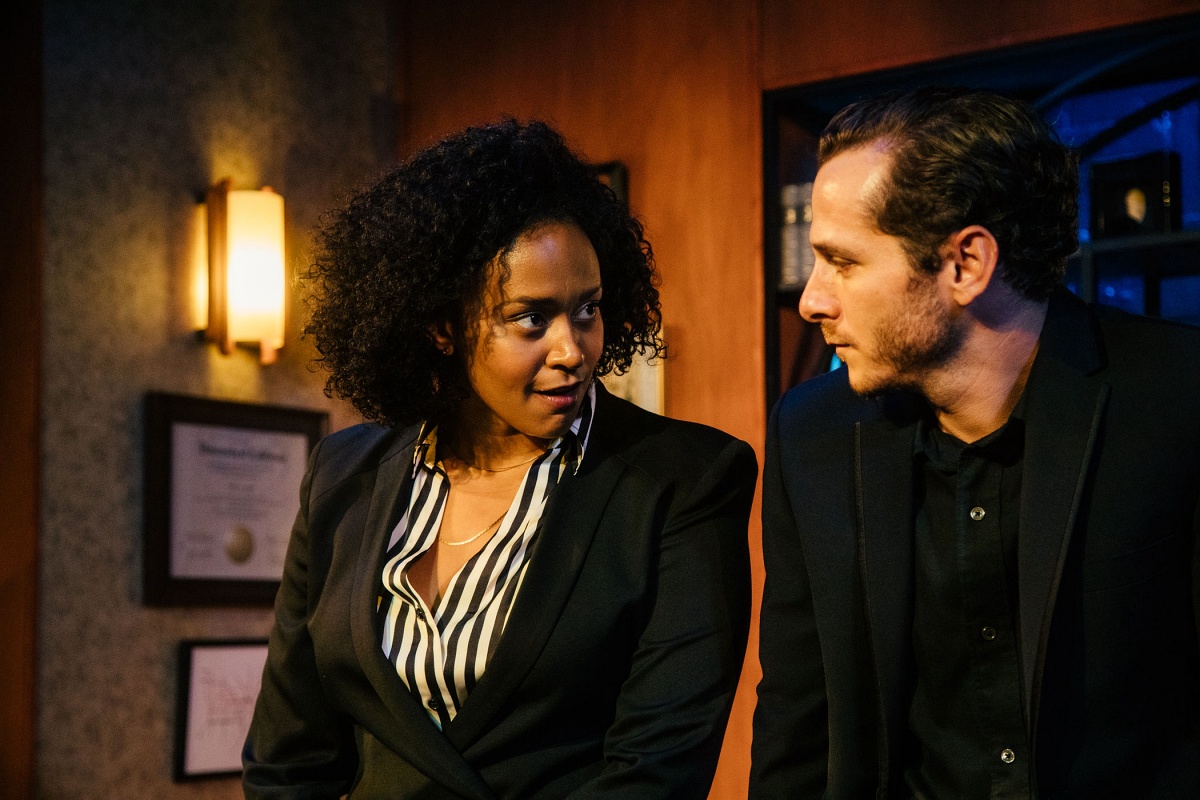
In the world premiere of TH IR DS, a purported plan to unify the three Americas is engineered by Catherine Shepard (Corbin Reid), the African American head of a water company headquartered in the Pacific States, and a firm staffer, the Jewish David Cohen (Edlin, the bard), who are negotiating a plan to bring clean water to the thirsty Southern states. In the works for years, Cohen has been negotiating this scheme long distance with Korean American Steven Choi (Brian Yeun), who represents interests in Dixie and strongly wants to resolve the poisoned water situation. In addition to being members of minority groups, Cohen and Choi have something else in common: Both are expecting their first child.

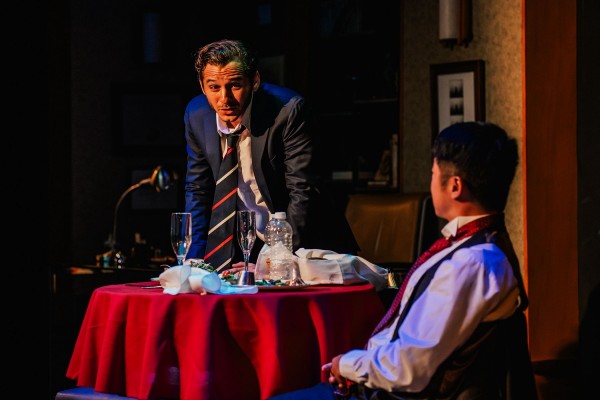
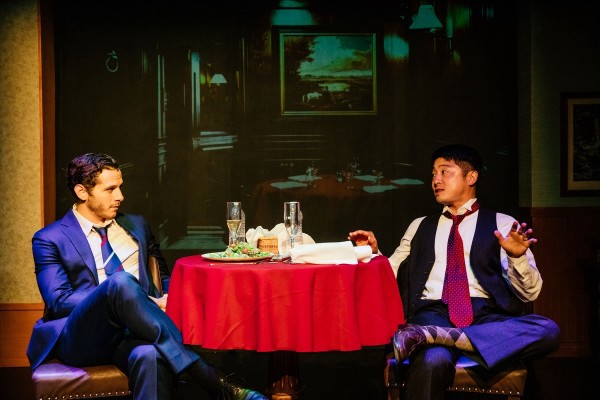
If Shepard oversees Cohen, James Cross (Carlo Mancasola), one of the Confederates States’ good ol’ boys, supervises Choi. After an intermission, when Shepard and Cohen fly way down yonder to the land of cotton to clinch the deal, once the agreement is inked, Cohen and Choi, who have met for the first time in person, bond over a celebratory supper.
However, without disclosing plot spoilers, there are flies in the ointment—or, in this case, the water. The pistol-packing, double-crossing Cross has a hidden agenda that threatens the hard-fought for project. And it turns out that so does Shepard, although what Catherine was hiding up her sleeve wasn’t clear to me. I think I’m at least as intelligent as the average viewer and I couldn’t understand what the motivation for her actions were. But unlike the typical ticket buyer, as a critic I had an opportunity to ask both the playwright and actress to explain to this dimwit what Catherine Shepard did and why, and Edlin and Reid set this nincompoop straight.

TH IR DS is a very complex production, and methinks that some dialogue needs to be added in order to clarify what Shepard is really up to—especially as this is a really important plot point. In any case, adding lines for the bodacious Corbin Reid’s character would be welcome as she is a riveting actress (co-star of the Starz series Run the World and a recurring character on Shonda Rhimes’ How to Get Away with Murder) who embodies the nationalistic and aesthetic intent of the sixties slogan “Black is beautiful.” The only woman to appear onstage (albeit touching as Todd, Tess Harrison is just seen onscreen), Reid has a commanding presence but treads the boards all-too-briefly in only two scenes. Given that TH IR DS is an imaginative reflection of our current politics, with the emergence of Kamala Harris as arguably the most prominent anti-fascist in America today, there may be more focus on Black women now in our politics than ever before (or, at least since the heyday of Angela Davis, who BTW also ran on a presidential ticket, years before Kamala did).
The muscular Mancasola imparts menace and is excellent as Cross, but it seems to me that in this ethnic savvy drama, the swarthy thesp is miscast because he is of Italian background. The role of Cross, should, in my simpleminded opinion, be played by a WASPy, Aryan type, to achieve maximum effect. Speaking of ethnicity, TH IR DS displays nuance with its depiction of a Jew contending with anti-Semitism and a Korean-American dealing with anti-Asian hate in a South that he nevertheless loves, even as he may mix kimchee with black eyed peas and collard greens.
According to director Jessica Aquila Cymerman, who nimbly helms the intertwined filmic and live stage elements, one third (appropriately!) of TH IR DS consists of the “documentary” about Patricia and Peter Todd and the faux historical background that talking head Prof. Seward pontificates upon, which were each specifically shot for this play. Although I often attend plays that use projections and film clips, this may be the highest percentage of film-to-theater equation in a live stage show that I’ve ever encountered. Some may find this hybrid, film-within-a-play technique to be discombobulating or off-putting, upending conventional notions of live theater featuring flesh and blood actors, up front and personal, although I felt it worked well and was unique. Some may also find the production to be slow and talky, others will consider it thought-provoking.
TH IR DS is for the more adventurous theatergoer who enjoys leaving his/her comfort zone to take a walk on the wild theatrical side, which this show is in terms of both form and content. Viewers who enjoy experiencing the dramatization of political issues and history, and feel that racial subject matter matters are likely to find this play to be a refreshing drink of water—even as they ponder: How close are we to another War Between the States?
