

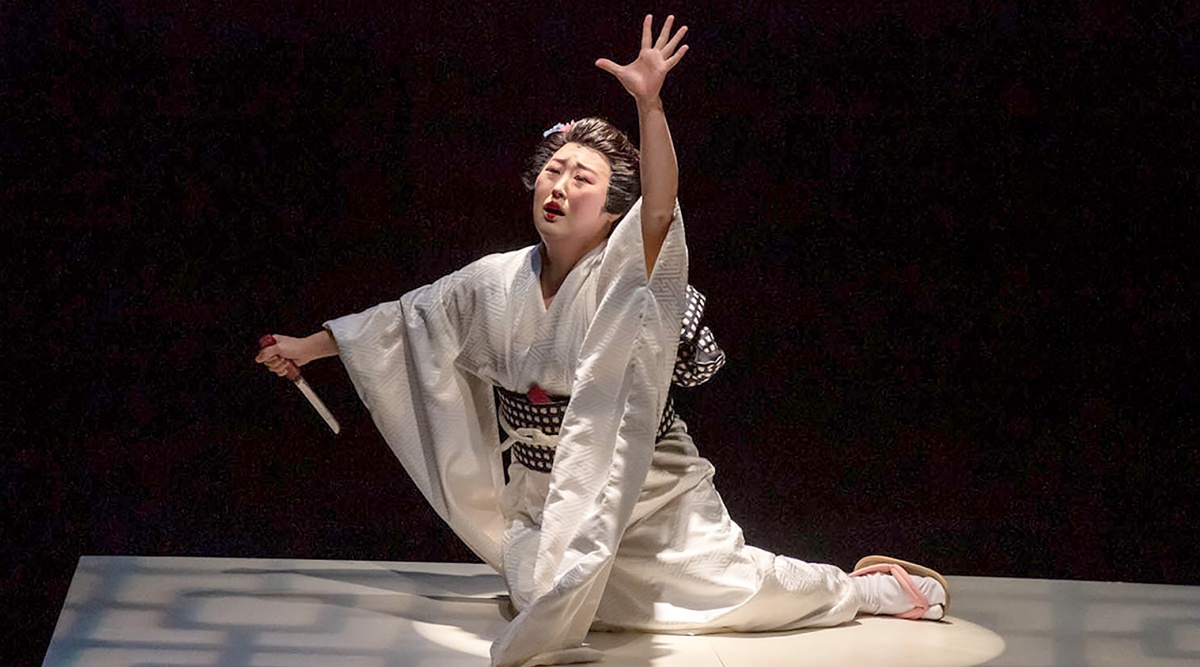


The trio of Asian women join forces and turn the tables on the racist roles that CioCio and Kim have been subjected to.
THIS IS NOT A TRUE STORY: Theater Review
One of the very best things a work of art can do is to give the voiceless a public voice in order to be heard. And award-winning playwright Preston Choi does that, loud and clear, in his great new This is Not a True Story. In this thought provoking, highly entertaining one-act play the characters of Cio-Cio-San (here called CioCio and played by Julia Cho) from Giacomo Puccini’s 1904 Japan-set opera Madame Butterfly, Kim (Zandi De Jesus) from the 1989 musical Miss Saigon, and the real-life Takako Konishi (Rosie Narasaki – more below on Konishi, who has a bizarre tie-in to the Coen Brothers’ 1996 movie Fargo) collide with one another, and especially in CioCio and Kim’s cases, with their Caucasian creators. Hilarity, poignancy and above all, insight into the damage that racial stereotyping causes ensues.
Kim, of course, is based on the Italian composer Puccini’s Cio-Cio-San in the adaptation of Madame Butterfly that’s updated and reset in Vietnam in 1975 in Miss Saigon, with music by Frenchman Claude-Michel Schönberg, book by Tunisian-born Alain Boublil and Schönberg, lyrics by Boublil and Wisconsin-born Richard Maltby Jr. Note that while early 20th century Nagasaki, Japan and Saigon (now Ho Chi Minh City), Vietnam 70 years later are very different places and times, the Western artists seamlessly make the transition. This is because for these white writers (and the audiences who have been spoon fed stereotypical pablum for ages), thematically, the story is essentially the same. In essence, both teenaged Asian females sexperience ill-fated love affairs with U.S. military personnel, which result in out-of-wedlock pregnancies.
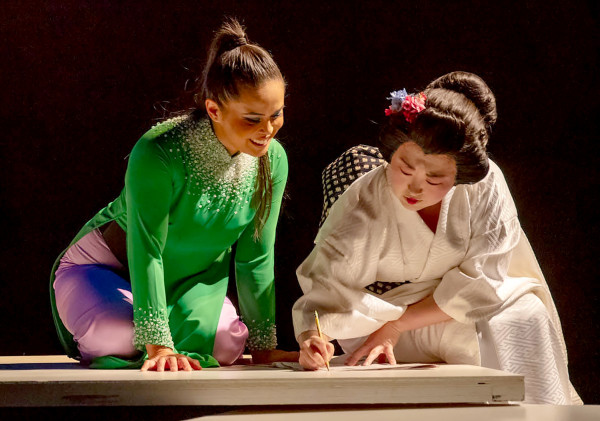 Zandi De Jesus and Julia Cho (Photo by Grettel Cortes Photography)
By the way, neither Butterfly’s Naval Lieutenant B.F. Pinkerton or Miss Saigon’s Marine Sgt. Chris Scott are particularly rich, powerful men. They are not high-ranking members of the U.S. military or ruling elite, and even though CioCio refers to Caucasoids as “barbarians,” the key attribute of their whiteness bestows upon them a sense of cultural superiority. As I recall from having seen the astoundingly racist Miss Saigon on Broadway years ago, Kim even actually chose Chris over Thuy, a powerful officer of the Vietnamese communists, even though the Americans were about to be defeated in Vietnam. The primary distinguishing characteristic and main source of the status for both Chris and Pinkerton is that they are white American males, which I believe is a source for the characters’ enduring popularity. Thuy may belong to the triumphant North Vietnamese army, but after all, he’s no Yankee Doodle Dandy! (I don’t think This is Not a True Story stresses what Spike Lee called Jungle Fever – the frisson of interracial romances, although Butterfly and Miss Saigon did explore this “younger than springtime” sexual obsession, as did David Hwang’s quite brilliant M. Butterfly, which was adapted for the big screen in 1993.)
In essence, kimono-clad CioCio and the áo dài (a long, split tunic Kim wears over silk purplish pants) adorned Kim are trapped in a sort of time loop, unable to escape their fates and committing suicide with, respectively, a knife and a gun, over and over and over again. They are prisoners of the stereotypical personas and trite cliches forced upon them by Western authors and audience expectations conditioned by the former.
Enter about halfway through this 90-ish minute play the character who is arguably the most perplexing, complicated one of the dramatis personae, Takako Konishi (aka “Kumiko”). I had never heard of her before, but essentially, she is based on an actual Japanese woman who was apparently deluded and allegedly lured to search for the buried treasure of Carl Showalter, the character played by Steve Buscemi in the Oscar-winning Fargo, after she watched a VHS version of the movie (not the related TV series that first aired on FX in 2014).
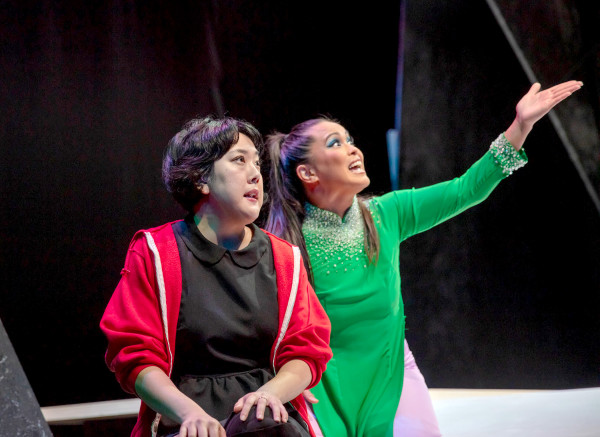 Rosie Narasaki and Zandi De Jesus (Photo by Grettel Cortes Photography)
As I was completely unfamiliar with Konishi’s tale of woe, I did a deep dive to research her background, including a trip to the University of Tokyo and the U.S. Library of Congress. Okay, okay – so that’s a total lie, but what would you expect from a review of a play entitled This is Not a True Story? My investigation consisted of googling he name and going to Wikipedia, which stated: “Konishi’s story was detailed in the 2003 short documentary film This Is a True Story, directed by Paul Berczeller, in which she is portrayed by Mimi Ohmori. The urban legend surrounding her death is the basis for the 2014 film Kumiko, the Treasure Hunter.[6] Konishi and the circumstances surrounding her death are the basis for Reel Bay: A Cinematic Essay by Jana Larson, published by Coffee House Press in 2021.[7]”
Troubled as Konishi is, she has the advantage of being a literate, more contemporary Asian woman, and for what it’s worth, she’s also the only one of the three who actually visits America (which, alas, proves to be her undoing). I don’t want to reveal plot spoilers, but suffice it to say that the trio of Asian women join forces and turn the tables on the racist roles that CioCio and Kim have been subjected to. They start to stand up and question the typecasting and tropes forced upon them by white artists and dominant majority audiences and cultures in the West. Kim laments: “You take our voices, now you take our names!”
How will the trio challenge the Western stereotypes? Will CioCio and Kim turn their dagger and gun on “whitey”? Word slinger that playwright Preston Choi is, he comes up with the perfect solution. And it is one that cleverly explains the title of his play, a potent plaintive plea against racism at a time of increasing anti-Asian hate crimes.
This is Not a True Story is being presented by Artists at Play in association with the Latino Theater Company now world premiering at the Los Angeles Theatre Center in the third largest of LATC’s five theatrical spaces, the 250-seat Lupe Ontiveros Cinema Center. Scenic designer Yuki Izumihara’s spare set has an expressionist vibe, enlivened with some theatrical FX. (Beware the flying babies!) This includes sound designer M. Glenn Schuster’s soundtrack, projection designer Vanessa D. Fernandez’s imagery projected onto the stage. This includes a title projected early on that encourages audiences to laugh at cliched accents.
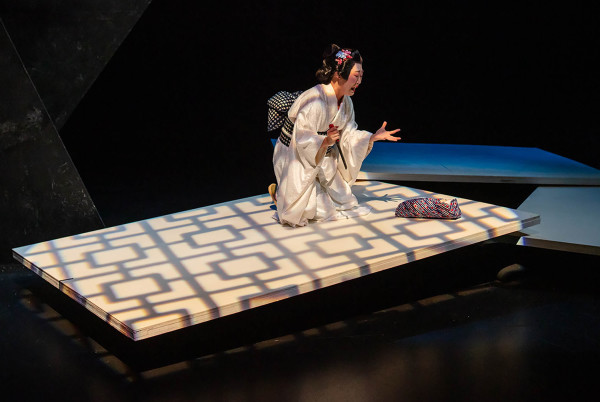 Julia Cho (Photo by Grettel Cortes Photography)
If I have one problem with the show, it’s that it can be repetitive – but this is a mere quibble, given how outstanding This is Not a True Story otherwise is. Reena Dutt skillfully directs her ensemble to deliver nuanced performances that are sometimes, tragic, sometimes comic and always on point. The casting is subversively shrewd. Offstage, Miss Saigon’s L.A.-born Zandi De Jesus, who excels in her part, is not Vietnamese – she’s of Filipina ancestry. This is particularly apropos because the role of Kim was originated on London’s West End and Broadway by Lea Salonga, who was also born in the Philippines – not Vietnam. Likewise, Julia Cho is Korean-American, not Japanese, like CioCio. (According to the playbill, Preston Choi is of Korean/Irish heritage.)
Hollywood has a long “tradition” of miscasting Asians. The star of 2005’s Japan-set Memoirs of a Geisha was Chinese actress Ziyi Zhang, and her co-star was Malaysia-born Michelle Yeoh. Even worse is a wretched “Yellowface” history of casting Caucasians to play Asian characters (or to change the parts to be Westerners). John Wayne even played Genghis Khan once – or was it Attila the Hun? No matter, because for ages, on the Western stage and screen, for white creatives and audiences, if you’ve seen one Asian, you’ve seen them all. DON’T GET ME STARTED!!!
Fortunately, thanks to recent productions such as J. Elijah Cho’s terrific Mr. Yunioshi and Choi’s stellar This is Not a True Story, this sordid, sorry story about cultural misappropriation and misrepresentation is changing, as representation becomes more truthful, culturally sensitive, authentic and accurate. Especially as artists of various ethnicities create works about themselves and their own backgrounds, as they decode and deconstruct Westernized iconography. This is true for people from other ethnicities too, as Will Power’s drama directed by Debbie Allen and revived this summer at the Kirk Douglas Theatre this summer, Fetch Clay, Make Man, deals with Black stereotypes.
The venerable Jose Luis Valenzuela, Artistic Director of the Latino Theater Company at the LATC, introduced This is Not a True Story at its the world premiere. At the post-show reception in LATC’s gracious lobby, I caught up with Valenzuela and asked this living cultural treasure why the Latino Theater Company is co-presenting a play about Asians, not Hispanics, and he replied: “Because I love the theater company, Artists At Play. It’s an important community. This is Los Angeles – inclusivity.” Oppressed communities sticking together, especially when one comes under attack. This is Not a True Story is an excellent and entertaining dramatization of onstage solidarity and “writing” wrongs, a Puccini putsch overthrowing misappropriation and misrepresentation – and that’s the truth, Ruth!
This is Not a True Story runs through October 15 on Thursdays, Fridays and Saturdays at 8:00 p.m. and Sundays at 4:00 p.m. at the Los Angeles Theatre Center, 514 S. Spring Street, Los Angeles, CA 90013. For info and tickets: (213)489-0994; tickets@thelatc.org. For more info go here. For more about other upcoming plays at LATC go here . For more info about Artists At Play, go here. .
