


Dramatizing the Mass Imprisonment of Japanese Americans During WWII
As the Trump regime rampages over our checks and balance, running rampant over workers’ and human rights, art is playing its role as another branch of power. The maniacal tyrant may try to crown himself king and usurp control of the Kennedy Center (will Kid Rock become a lifetime artistic achievement Honoree or Dennis Miller receive the Mark Twain Prize for American Humor?), but two new L.A. stage productions are standing up and speaking out against the racist Trumpian status quo. One, Four Women in Red, is about Indigenous people, while the other dramatizes the plight of immigrants and their children/grandchildren.
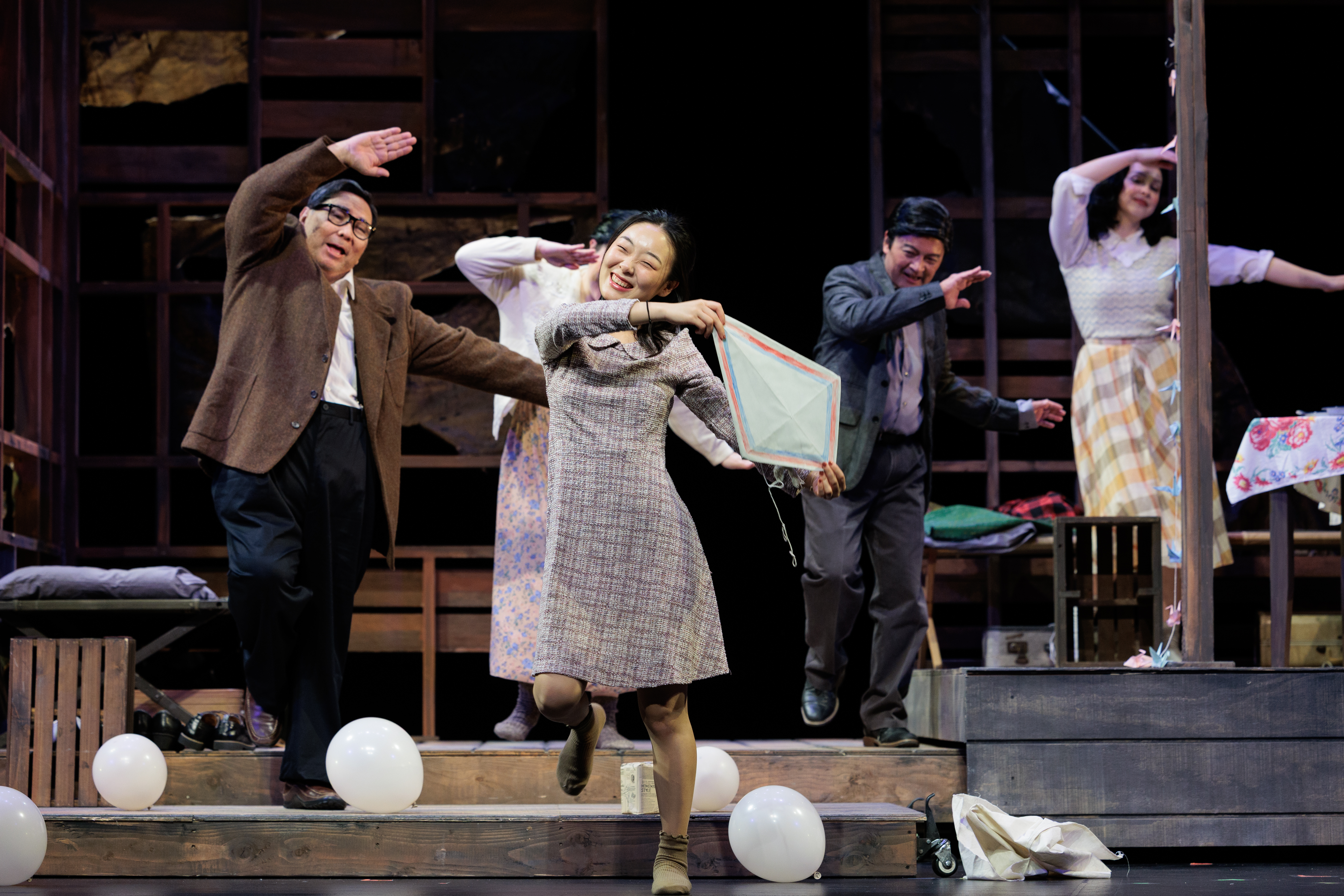
The world premiere of The Camp tackles the touchy topic of the concentration camps in the so-called “land of the free” that imprisoned 120,000 people during WWII. What was their offense – being undocumented or committing actual acts of sabotage? No, their “crime” was being of Japanese ancestry, and two thirds of them were U.S. citizens. After imperial Japan’s raid on Pearl Harbor, FDR signed executive order 9066 and The Camp follows the Shimono family, characters who are swept up in the racist roundup of tens of thousands of Japanese Americans and non-citizens who were herded together and shipped off to prisons and concentration camps. The curtain lifts with the Shimonos living at the fishing village of Terminal Island near Long Beach, which historically was the home of the first victims of the internment hysteria.
This harrowing fact-based saga is told via the medium of opera, with a libretto by Lionelle Hamanaka, whose parents were incarcerated at the Jerome War Relocation Center in Arkansas. Gee, doesn’t “relocation center” sound mo’ bettah than “concentration camp” or “internment camp”? As The Camp’s program points out, words often obfuscate rather than precisely express meaning, and the former Orwellian term “downplays” the stark, shabby conditions of the impoverished prison camps where thousands were coerced to move to (after losing all of their possessions and property).
The barracks (vividly materialized onstage by scenic designer Yuri Okahana-Benson) where the Shimonos are forcibly expelled to at an undisclosed location goes unnamed – although one link in this chain of forced removal and misery is indeed identified as Santa Anita, in L.A. County. By early 1942 this racetrack was converted into an assembly center for up to 18,000 human beings who were made to live in the horse stables at the track-turned-detention-center, an inhuman, temporary clearinghouse before these inmates of Asian origin were transferred to places such as the Jerome Camp.
In The Camp, one of those prisoners is the Shimono’s 11-ish year-old daughter Rebecca (lyric coloratura soprano Habin Kim), who catches a cold in the poorly insulated Santa Anita stables. You don’t have to be an aficionado of Verdi’s La Traviata or Puccini’s La Bohème to guess where this predictable plot point is going amidst the Shimonos’ trials and tribulations after the family’s transfer to a concentration camp.
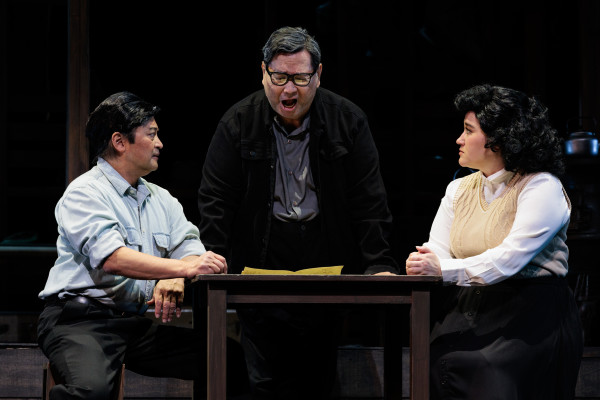 Roberto Perlas Gómez, Steve Moritsugu, and Alexandra Bass (Photo by Angel Origgi)
While the viewer can see Rebecca’s fate from a mile away, The Camp’s second act pleasantly contained rousing surprises that I didn’t see coming. This reviewer is usually reluctant to divulge plot spoilers, so allow me to alert readers here that to do this review justice I’ll have to reveal some elements of the opera’s storyline. Rebecca’s fisherman father Mas (baritone Roberto Perlas Gomez) discovers that the camp’s supervisor, a Caucasian named Edwards (bass Dennis Rupp), is pilfering supplies intended for the inmates, who have already been plundered and dispossessed. Edwards’ theft makes the prisoners’ hardscrabble existence even more wretched, and Mas heroically decides to take a stand, putting himself at risk of arrest and transfer to a penal institution far away from his family.
However, Mas’ fellow internee Tana (tenor Steve “Mor” Moritsugu) sticks up for and stands by his friend, rallying what is referred to as the camp’s shadowy “underground” (which is never clarified) and other internees to stick together with the embattled Mas against the concentration camps. This is a heartwarming, stirring act of solidarity and resistance, but then The Camp takes another plot twist and turn. Instead of unifying to simply fight against the camp’s administrators and soldiers, the dramatis personae rally onstage to oppose oppression and discrimination wherever they rear their ugly heads.
This is an obvious stance of defiance that The Camp is hurling against the Trump junta, a rallying cry against the mass round-ups, detentions and expulsions that the MAGA regime is currently in the process of carrying out. It reminded me of Kapo – before Gillo Pontecorvo directed 1966’s world famous, anti-colonial The Battle of Algiers, he helmed 1960’s Kapo, a gritty drama about opposition at a Nazi forced labor camp.
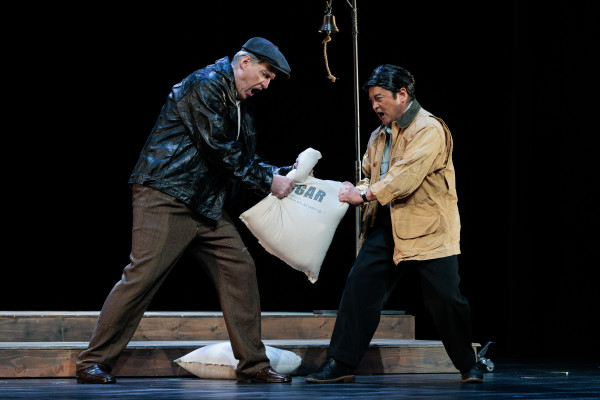 Dennis Rupp and Roberto Perlas Gómez (Photo by Angel Origgi)
The Camp’s ethos also reminded me of the mission of the Japanese American Citizens League, which, according to its website, was “Founded in 1929, the JACL is the oldest and largest Asian American civil rights organization in the United States.” JACL is actually mentioned in passing onstage (I believe by Tana), and it “monitors and responds to issues that enhance or threaten the civil and human rights of all Americans and implements strategies to effect positive social change” (see: https://jacl.org/). This reviewer is by no means an expert on JACL but it seems to me that over the years this steadfast Civil Rights group has been consistent in its vision and supported not only oppressed people of Japanese ancestry, but members of other persecuted ethnic groups as well, with that “an injury to one is an injury to all” ethic.
Kudos to Ms. Hamanaka’s libretto, as well as to composer Daniel Kessner, who initiated this opera and whose orchestral music, ably conducted by Steven F. Hofer, strikes the right notes, often ominous and full of foreboding, commingling with stringed instruments (Kozue Matsumoto on the koto, a Japanese plucked zither instrument) and flutes (Rachel Rudich plays the shakuhachi, a Japanese bamboo flute) that reference traditional Japanese music (which the opera’s program states Kessner has been interested in for “nearly 50 years”). The program also identifies the L.A.-born Kessner as being of Ukrainian and Jewish heritage, hence the composer emerges out of two groups who have historically experienced immense misery, suffering and oppression, which in part explains his empathy for The Camp’s downtrodden characters subjected to such cosmic injustice.
As laudable as this opera deftly directed by Diana Wyenn is, The Camp’s casting may raise some questions, as performers who are not of Japanese background play some of the ethnically Japanese roles. For example, Gomez, who depicts Mas, is identified in the program as being “Filipino-American,” while soprano Tiffany Ho, who plays Rebecca’s older sister Suzuko, is identified as a Vietnamese American. Patrick Tsoi-A-Sue, who portrays Suzuko’s romantic interest Nobu, hails from Trinidad. On the other hand, soprano Alexandra Bass, who plays the sisters’ mother Haruko Shimono, is listed in the program as Japanese American, while tenor Hisato Masuyama as the inmate Kenji, who stands in solidarity with Mas, is from Tokyo. Moritsugu’s mother and her siblings and parents were interned at Colorado’s Camp Amache, while his paternal grandfather was incarcerated during part of WWII and paternal great-uncle was one of 2,000 people of Japanese background interned in Hawaii.
As an opera reviewer, I’ve noticed that over the years the casting is often based more on an artist’s singing ability than on ethnicity and looks – overweight performers are sometimes cast in roles of supposedly conventionally beautiful characters, and so on. Having said that, this may raise the eyebrows of some purists who might feel that The Camp’scasting is a case of: “If you’ve seen one Asian, you’ve seen them all.” However, it should be noted that there are no “Yellowface” parts in this opera in the stereotypical tradition of Mickey Rooney as Mr. Yunioshi in 1961 Breakfast at Tiffany’s and Marlon Brando as Sakini in 1956’s The Teahouse of the August Moon. (BTW, theatergoers should be forewarned that a racial slur is in the opera’s lyrics, but “the J-word” is never used gratuitously.)
Be that as it may, The Camp is an entertaining, inspiring, topical opera resisting injustice yesterday – and today. Like Four Women in Red (the subject of my next review), it is an important production opposing the unfolding onslaught as history, alas, repeats itself in this unrelentingly racist country (as both works remind us). Unfortunately, the Aratani Theatre was only about half full, and since as many viewers as possible should see this significant work of art, perhaps the opera’s publicists and marketers should aim at the target markets of the impending ICE raids.
The Camp is being performed Saturday, March 1, 2025 at 7:30 p.m. and Sunday, March 2, 2025 at 2:30 p.m. at JACCC Aratani Theatre, 244 S. San Pedro St., Downtown Los Angeles. Tickets here.
NOT SO FUN FACT OF THE REVIEW that exposes the opportunism and expediency of racism: Although Hawaii had a large population of 160,000 Japanese Americans and non-citizens, unlike their continental counterparts, the overwhelming majority weren’t systematically imprisoned en masse. Why? Because their labor was needed by the U.S. colonizers in Hawaii for the war effort in the Pacific Theater. (See here.)
Ed Rampell’s novel about the Native Hawaiian Sovereignty Movement for Indigenous rights, The Disinherited: Blood Blalahs, will be published this Spring.
