

Scarred and Scared: All Creatures, Big and Small

In this two-act drama, the catastrophe that serves as the play’s “protagonist” (so to speak) aren’t the wildfires that recently beset L.A. County, but a tornado that struck Alabaster, Alabama.
ALABASTER: Theater Review
The Fountain Theatre prides itself on timely, topical productions that are reflective of and responsive to, as Marvin Gaye put it, “What’s Going On” in the world around us. Although set in Alabama, the Los Angeles premiere of Audrey Cefaly’s award-winning Alabaster is exquisitely au courant in that it dramatizes and explores how survivors of natural disasters cope and carry on—or don’t. In this two-act drama, the catastrophe that serves as the play’s “protagonist” (so to speak) aren’t the wildfires that recently beset L.A. County, but a tornado that struck Alabaster, Alabama (an actual place where, serendipitously, co-star Virginia Newcomb actually hails from).
As the terrifying storm’s sole survivor, June (Ms. Newcomb) is scarred—physically as well as psychically. With her kin killed by the cyclonic blast, June is faced with the necessity of having to carry on in its aftermath. But can she?
Ironically, June’s scars are precisely what leads her to who just might be the vehicle of the Southerner’s deliverance from her lonely, self-imposed exile in the ramshackle farm where she has lived all her life. Alice (Erin Pineda) is a photographer/ documentarian whom the clever June has sought out to chronicle the storm-ravaged woman’s story for the Northern city slicker’s forthcoming book about women with scars. (Holy Diane Arbus!)
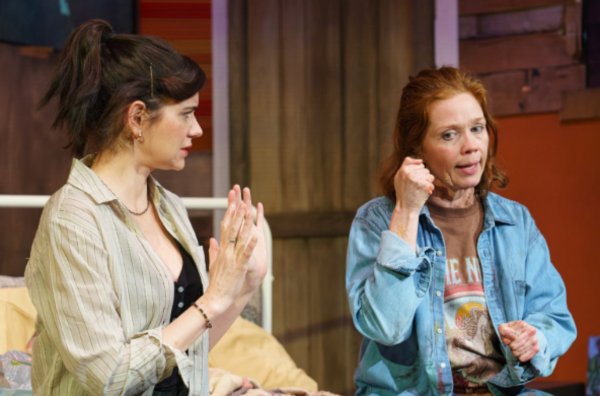 Erin Pineda and Virginia Newcomb (Photo by Julie Fowells)
Their fateful rendezvous is a case of the unstoppable force meets the immovable object, a collision course craftily orchestrated by June. Beneath her stereotypical “redneck,” “cracker” veneer, June’s smarts belie her from the “holler” born persona. Indeed, as Alice goes down the rabbit hole, she discovers that June is more than a mere damaged subject for her lens, but a painter who creates the type of “Primitive Art” Grandma Moses was famed for.
As the sly June has sensed, beyond Alice’s façade of hot shot shutterbug who hobnobs with the likes of Annie Leibovitz, the cosmopolitan artiste has endured her own calamities – including manmade ones. June discerns a sorrow that Alice’s camera encounters in all of her subjects and figures out that her photo book about scarred women is to a large extent a self-portrait—although the photographer’s lacerations are internal. June’s wounds may be physical (The makeup design is by Krys Fehervari.), but like her counterpart, she too bears psychological scars.
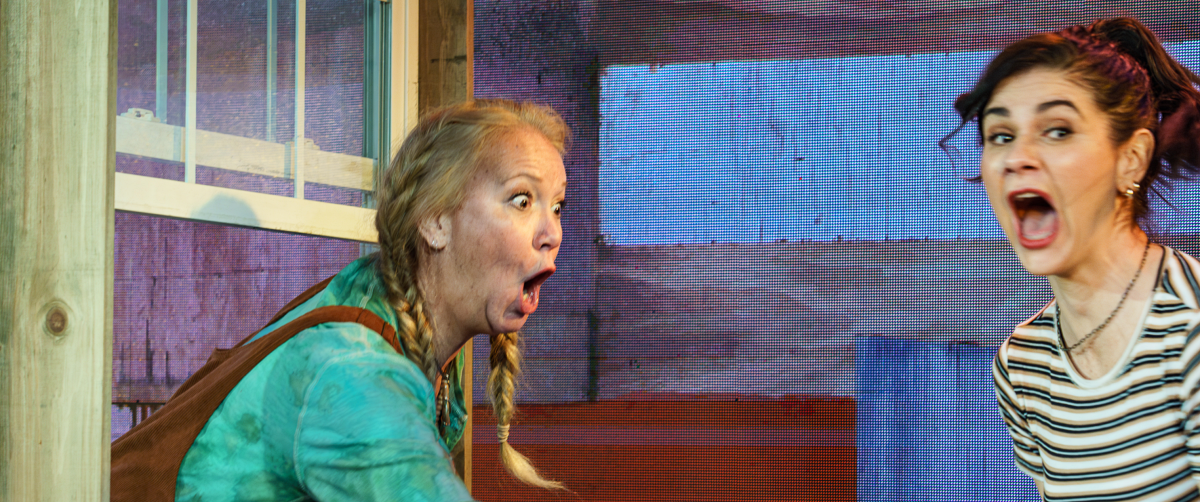
As if these two characters aren’t complicated enough, the farm (with a clever layout by scenic designer Frederica Nascimento, enhanced by Ly Eisenstein’s vivid video design) is also inhabited by a mother and daughter, who Weezy (Carolyn Messina) lets us know right away are actually goats. Weezy and Bib (Laura Gardner) are the best beasts this reviewer has seen behind the “hoof-lights” (I’m endlessly amusing myself) since the Will Geer’s Theatricum Botanicum and A Noise Within adaptations of George Orwell’s Animal Farm and Edward Albee’s The Goat Or, Who Is Sylvia? mounted a decade ago at the Davidson/Valentini Theatre at the Los Angeles LGBT Center. As someone who always marvels at actors’ ability to transmute themselves, I couldn’t help but wonder how Ms. Messina and Ms. Gardner researched and prepared for their roles? And if they are Method Actors, how they stay in character while onstage? That sure got my goat - inquiring minds want to know.
Cefaly’s inclusion of the goats is extremely empathetic in that it cosmically dramatizes that our furry and feathered friends also have feelings and can experience grief, loss and death, which is at the heart of Alabaster. There is a sexual tension between Alice and June almost from the get-go. Will the frisson lead to passion? If eros is the life force, will the two women be fortunate enough to sexperience this affirmation of intimacy and pleasure 2-gether? Will love help deliver them from the cataclysmic tragedies that have rocked their worlds in this alternately scathing and poignant play well-directed by Casey Stangl?
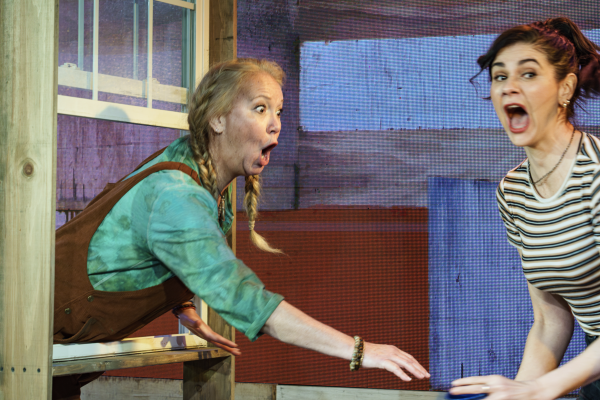 Erin Pineda and Virginia Newcomb (Photo by Julie Fowells)
 Sound designer and composer Andrea Allmond’s mood-inducing soundtrack subtly enhances this production that is, however, not likely to be every theatergoer’s cup of tea (or hemlock). The endless psychological sparring and verbal fisticuffs between the cantankerous, curmudgeonly (before her years) June and Alice put me in mind of Ali and Frazier’s “Rumble in the Jungle.” Their Faulknerian sound and fury is frequent and Cefaly’s characters are so tormented that to some viewers they may make Tennessee Williams and Eugene O’Neill’s tragedies seem like musical comedies in comparison. Disputatious people (and goats) who conjure up conflict out of thin air where there is none are among the most exasperating beings on this or any other planet. Some may find Alabaster to be loud, tiresome, and off-putting.
Given the downbeat subject matter of the Grim Reaper, loneliness, alienation, plus the incessant argumentation, this is a case of ticket buyer beware. (You have been forewarned, Dear Reader!) However, audiences who enjoy and are interested in excellent, incisive acting; drama-as-catharsis; LGBTQ content; thoughtful, thought-provoking themes about grief, loss and death and how to deal with and move on from them, are likely to find attending Alabaster to be a rewarding theatrical experience.
Alabaster is being presented Fridays, Saturdays and Mondays (except Feb. 17) at 8:00 p.m. and Sundays at 2:00 p.m. through March 30 at the Fountain Theatre, 5060 Fountain Ave., Los Angeles CA 90029. For tickets/info: (323)663-1525 or www.FountainTheatre.com.
Ed Rampell’s novel The Disinherited: Blood Blalahs about the Native Hawaiian Sovereignty movement for Indigenous rights will be published this Spring.
