

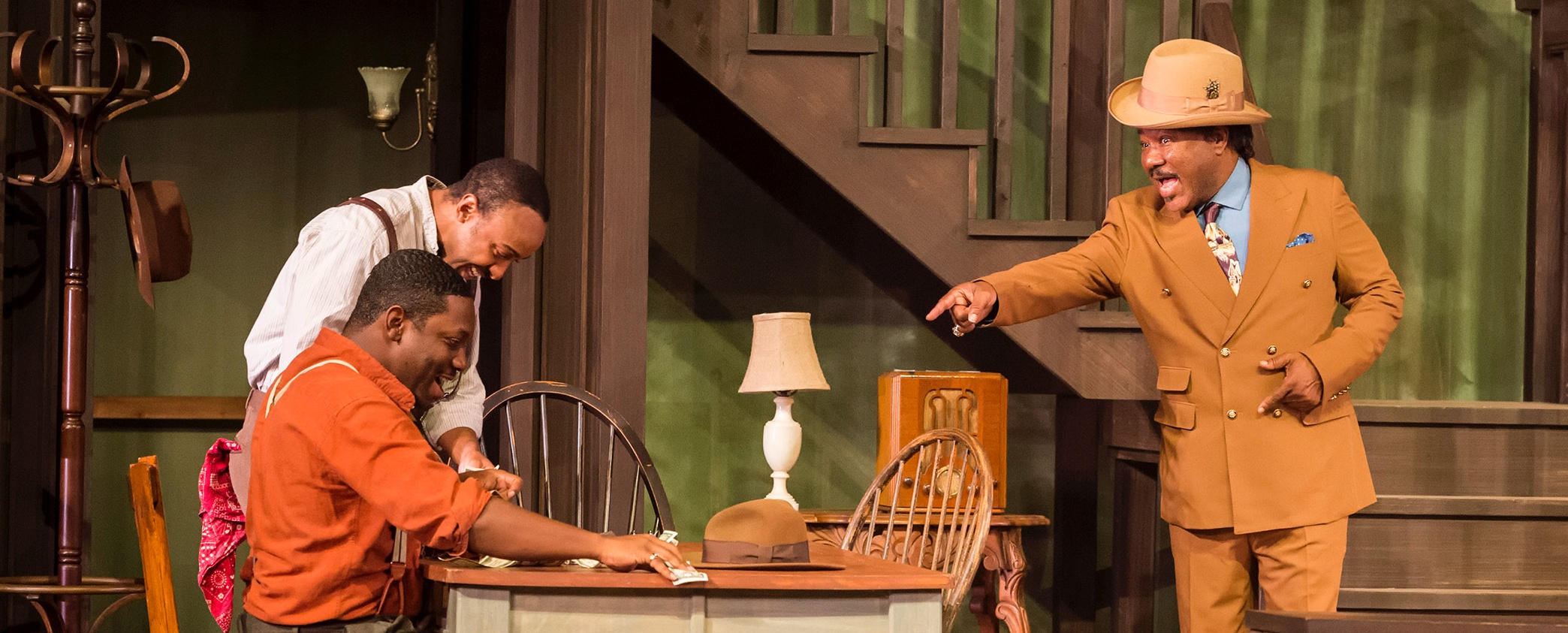


Set around 1936, the cleverly titled The Piano Lesson dramatizes the push and pull between generations and rural and urban Blacks.
The Piano Lesson is the second play in August Wilson’s “American Century Cycle” that A Noise Within has presented this year. (Last April ANW mounted King Hedley, which took place during the 1980s and was also directed by Gregg T. Daniel and co-starred Gerald C. Rivers.) Wilson’s epic decalogy, also known as the “Pittsburgh Cycle,” consists of ten plays, with the action happening per production in a different decade throughout the 20th century, exploring African American life in the Hill District of Pittsburgh, where the award-winning playwright grew up. (Wilson’s Ma Rainey’s Black Bottom is an exception to this time/place template.) The Piano Lesson opened on Broadway in 1990 and won the Pulitzer Prize for Drama, Drama Desk Award for Outstanding Play, New York Drama Critics’ Circle award for Best Play, and received five Tony nominations.
Set around 1936, the cleverly titled The Piano Lesson dramatizes the push and pull between generations and rural and urban Blacks. 30-something Berniece (Nija Okoro) is the niece of Doaker Charles (Alex Morris), a (presumably) retired railroad employee who owns the Pittsburgh house they live in with Berniece’s 12-year-old daughter Maretha (Madison Keffer, who actually looks older than her character is supposed to be). The trio are presumably part of the Great Migration, that wave of Blacks seeking greater freedom and opportunity, who moved up North to get away from Southern apartheid in search of what author Isabel Wilkerson called “The Warmth of Other Sons.” But you can’t escape the past.
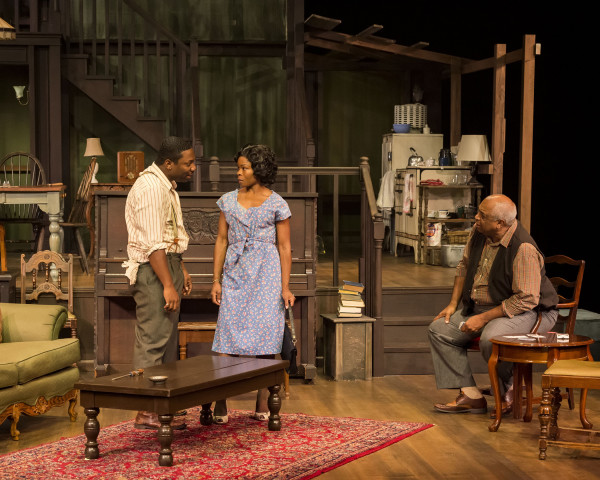 Evan Lewis Smith, Nija Okoro, Alex MorrisPhoto by Craig Schwartz
The Charles household is roused at about 5:00 a.m. by the unannounced arrival of Berniece’s brother, Boy Willie (Kai A. Ealy) and his friend Lymon (Evan Lewis Smith). Berniece is none too happy to see them and irritated that they ruined her sleep, especially when Boy Willie insists on waking up and seeing Maretha, who he hasn’t laid eyes on for three years. He and Lymon have driven a rickety old truck loaded with watermelons all the way up to Pittsburgh from way down yonder in the land of cotton. Their plan is to sell the truckload of sweet juicy gems to the Yankees. With the money they raise, the girl-crazy Lymon – who has had a whiff of that greater northern liberty in a land with more liberty and chances in life – plans to relocate to Pittsburgh and find a gal to settle down with.
Boy Willie, too, wants more out of life than just being a sharecropper and toiling away for whitey. With his proceeds from the watermelon haul, the ambitious Boy Willie wants to purchase a piece of land and start his own farm back in (I assume) Mississippi. But the 30-year-old, who apparently just served a stint behind bars, needs more money in order to seal the land deal. To raise the needed capital (because the redlining banks weren’t exactly handing out loans to Blacks – indeed this is a Piano subplot, as aspiring preacher Avery, played by Jernard Burks, is applying for a loan in order to build a church), Boy Willie plans to sell the eponymous piano ensconced in Doaker’s living room in order to raise the rest of the money he owes for the land deal.
There’s one fly in the ointment – like her brother, Berniece was bequeathed the piano by their parents, and she adamantly opposes parting with the musical instrument, which is carved with images of their ancestors. Wilson endows his characters with complexity and contradictions. Berniece hasn’t tickled the ivories for years but can’t bear the thought of losing this iconic family heirloom that has a provenance stretching back to slavery days. She suspects Boy Willie killed her husband Crawley – who “fell” down a well – three years earlier and is eager for him to leave their household and return to Dixie. Boy Willie protests his innocence and while he is a hustler, he is also a striver seeking to better his lot in life by owning a piece of land of his own and becoming a farmer, in the place where he was born and raised.
Grace (LeShay Tomlinson Boyce) is a young woman who both Boy Willie and Lymon romantically pursue. The aforementioned Gerald C. Rivers – a regular at Will Geer’s Theatricum Botanicum and famed for his pitch-perfect reenactments of Dr. Martin Luther King’s oration – enters the scene as Wining Boy, a hard-drinking, fast-talking, onetime piano player who has seen better days. He is reminiscent of Wilson’s character of Elmore in King Hedley, who in turn reminded me of Sammy Davis’ drug-dealing smooth operator Sportin’ Life in Otto Preminger’s 1959 screen adaptation of the Gershwins’ opera Porgy and Bess.
Although the word “Piano” is in its title, and a few numbers are played by Rivers and at least one lovely spiritual is sung, Wilson’s play is not a musical per se. (Jeff Gardner is the sound designer, Maritri Garrett is the music director.) However, just in time for Halloween, Piano does have a supernatural twist. Its final “character” is a ghost, who haunts Doaker’s house, where the play’s entire action takes place (scenic designer Tesshi Nakagawa created the impressive, two-story set). As in Toni Morrison’s Beloved, the haunting symbolizes the enduring presence the past has in the lives of contemporary African Americans. Lighting designer Brandon Baruch enhances the spooky ambiance. Along with this spectral figure, the piano with its carved portraits, etched into the wood, represent the legacy of these characters who are interconnected by blood or by being townsfolk – and sharing a common history. Will these bonds endure or be frayed as Boy Willie tries to sell the titular instrument, over staunch, stubborn Berniece’s dead body?
Much of the dialogue is in period vernacular, although always understandable (Andrea Odinov is the dialect coach). Gregg T. Daniel admirably directs his ensemble in this moving two-act play, which is about three hours long. Like the piano’s carvings, all of the thesps deeply, indelibly etch their all-too-human characters, who are full of longing for belonging, embodying the African American experience and beyond. The smoldering Nija Okoro’s sexually repressed Berniece, who likely hasn’t been touched by a lover since her husband’s untimely death, yearns for yet spurns would-be beaus. Jernard Burks’ Avery’s love for her is unrequited but he finds respite in the illusion of being a man of god. Kai A. Ealy’s aspiration to be somebody, to make something of himself in a white man’s world is palpable. Madison Keffer shows promise as Maretha, who is still coming into her own.
Veteran thespian Alex Morris, who has racked up 75 credits on IMDB.com, excels as someone who’s seen it all and now, with advancing age, in his retirement, just wants to enjoy a hassle-free life and some peace of mind. Evan Lewis Smith’s good-natured Lymon wants the “better” things in life, like a flashy threadbare suit he buys from the scheming Wining Boy. Rivers turns in one of his best performances as the pianist who has fallen on hard times, plus it’s a hoot to see Gerald’s trademark dreadlocks ensconced beneath Wining Boy’s wig (designed by Shelia Dorn).
In 1995, there was a TV-movie adaptation of The Piano Lesson co-starring Charles S. Dutton, Alfre Woodard and Courtney B. Vance. The best known of August Wilson’s august decalogy is likely Fences, which was adapted for the big screen in 2016, directed by and starring Denzel Washington and Viola Davis. This year, Denzel’s son, Malcolm Washington, directed and co-wrote a Netflix version of The Piano Lesson, co-starring his brother John David Washington as Boy Willie and Samuel L. Jackson as Doaker. A notable cast, to be sure – but there’s nothing like a live performance on the stage, especially when delivered by A Noise Within, which has once again showed itself to be among of L.A.’s top theaters with this poignant production written by the bard of Pittsburgh, the Shakespeare of the African American experience.
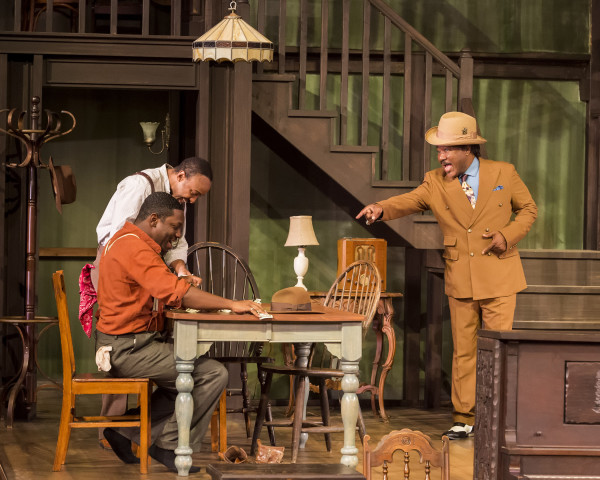 Evan Lewis Smith, Kai A. Ealy,and Gerald C. RiversPhoto by Craig Schwartz
A Noise Within presents The Piano Lesson on Thursdays, Fridays and Saturdays at 7:30 p.m. (dark Oct. 31), with 2:00 p.m. matinees on Saturdays and Sundays through Nov. 10 at 3352 E. Foothill Blvd., Pasadena, CA 91107. The performance on Thursday, Oct. 24 is “Black Out Night,” an opportunity for an audience self-identifying as Black to experience the performance together; tickets include a post-show reception (non-Black-identifying patrons are welcome to attend, or to select a different performance). Post–performance conversations with the artists take place every Friday and on Sunday, Oct. 27. For info and tickets: www.anoisewithin.org; (626)356-3100. Free parking is in an adjacent garage.
