

Along the way, there are many satirical references to the classic cliches of the Bond pictures, including their very visual, sexualized opening credit sequences.
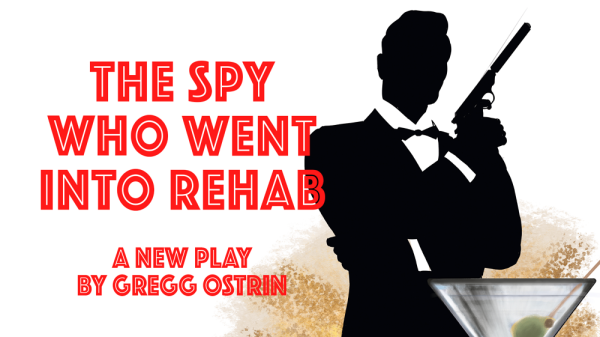
THE SPY WHO WENT INTO REHAB Theatre Review
As I entered Pacific Resident Theatre’s smaller “co-op space,” Herb Alpert’s jaunty, trumpet-y instrumental piece “Casino Royale” was playing on the P.A. system. In fact, this clever choice was a perfect mood-setter that (literally) set the stage for Gregg Ostrin’s The Spy Who Went into Rehab, as Alpert’s upbeat brassy tune was the theme music for the 1967 comedy of the same name, a star-studded spy spoof that parodied the 007 thrillers. In Casino Royale, a variety of actors played James Bond, including none other than Woody Allen!
The first movie based on Ian Fleming’s (supposedly) suave secret agent, Dr. No, had premiered in 1962 and proved so popular that by 1965, the genre was already being lampooned on the small screen in Get Smart, co-created by Mel Brooks and Buck Henry. The Broccoli/Saltzman Bond blockbusters went on to become literally the most profitable, longest-running film franchise in Hollywood history. As originally epitomized by actor Sean Connery, the British espionage agent was a debonair, stylishly-dressed, hard-drinking, chain smoking, gambling, and womanizer who was “licensed to kill” on behalf of English imperialism as a member of Her Majesty’s Secret service.
Former Naval Intelligence officer Fleming’s postwar character actually emerged in the cultural zeitgeist just as the English Empire was being eclipsed on the world stage. London may no longer have been the world’s preeminent superpower, but through covert actions, James Bond would continue the colonial, capitalist crusade for white supremacy over the Third World and communist countries (including, tellingly, bedding many nonwhite female “conquests” starting in Dr. No, plus lovers from the East Bloc, starting with the second Bond picture, 1963’s From Russia with Love). According to the Hollywood ballyhoo, 007 was “the man who men wanted to be, and the man who woman wanted to be with.” A fantasy figure who, as the sun set on the British Empire, was still making the world safe for imperialism (through clandestine operations).
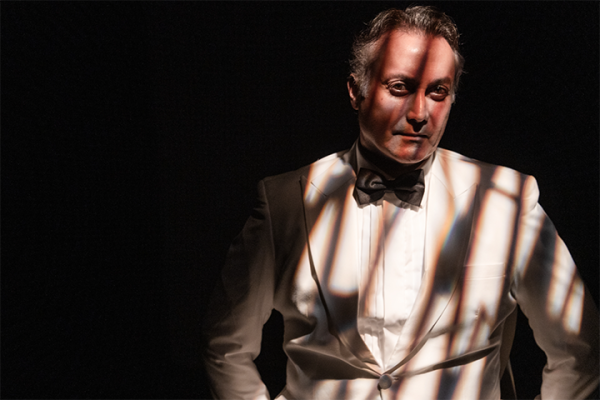
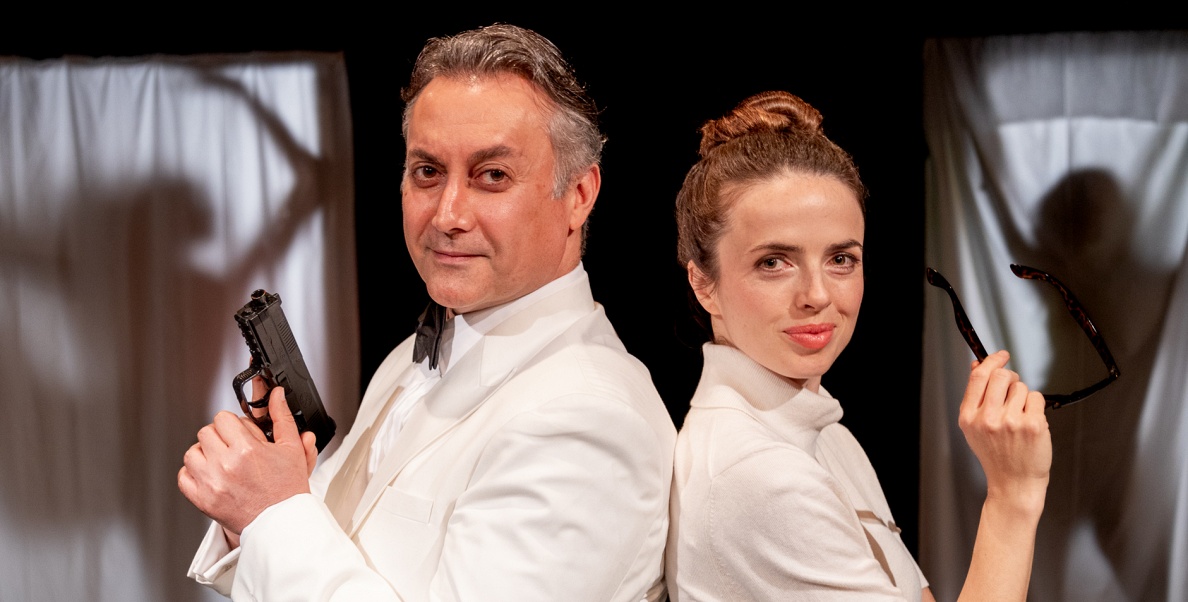
Gregg Ostrin has taken this potent potion and cannily shaken and stirred it with the notion and concoction of putting this vodka martini swilling smoker, gambler, compulsive seducer, multiple killer in a rehabilitation center (or is it?). The preternaturally handsome Sean Connery was only 32 when he shot Dr. No and oozed cool like an Uzi. But what would happen to a man with his bad habits as he aged? (Assuming that, considering all of his derring-do, he lived that long. (Author Ian Fleming, who shared some of his literary creation’s bad habits, died when he was only 56.) At the treatment facility superspy Simon Cross (Satiar Pourvasei), who calls himself “Cross, Simon Cross” and originally appears onstage in (but of course) a white dinner jacket and black tie, provides lots of laughs as he is confronted with his wicked, wicked ways and subjected to therapy and a 12-step program presided over by Stella (Mariah Shirley on the night I attended, but Jill Renner has played the part throughout the run), wherein his “cool” virtues are unmasked as debilitating vices.


Simon’s group therapy cohorts include the nonbinary Pixie (Alondra Andrade), exotic dancer Yvonne (Rachel Townsend) and the gay Gary (Stuart W. Howard). Together, overseen by therapist Stella, they deconstruct not-so-simple-Simon’s male mystique, his toxic masculinity, with lots of jibes and drollery. Along the way, there are many satirical references to the classic cliches of the Bond pictures, including their very visual, sexualized opening credit sequences. In a double role, Howard also plays cat-stroking supervillain Lazarus Rex, who is reminiscent of Bond’s nemesis Blofeld, that SPECTRE mastermind. Rehab also has a title song by Ava King, written by Ostrin, and the play’s sound design is by Jason Culp (and I am assuming he’s the son of Robert Culp, co-star of the 1960s TV series I Spy, which, if correct, only deliciously adds to the play’s overall delirious zaniness).
Cyndy Fujikawa adroitly helms this genre spoof and also plays Z, the female head of Cross's intel agency (although on the night I saw Rehab, Dendrie Taylor portrayed the espionage chief who looks askance at her errant spy’s ultra-masculine mask). Rehab is about 80-minutes long and performed without an intermission. When Ostrin’s comedy opened in June, it was only supposed to run for a month, but it has been repeatedly extended. As had Wolf Mankowitz’s The Bespoke Overcoat, a theatrical adaptation of The Overcoat, a short story written in 1842 by Ukrainian-born Nikolai Gogol, which, when it opened March 9 at the Pacific Resident Theatre’s mainstage, originally had been slated to run until April 21, but after repeat extensions, is now closing months later. So, stay tuned, as, like the 007 films often ballyhooed, Rehab, like James Bond, will “return.”
Just a couple of more points: Rehab is the second play I’ve reviewed in less than a year, set at a treatment facility. Last October, writer/director Tim Venable’s Baby Foot was, in contrast to the comedic Rehab, quite a heavy drama that took place in a rehabilitation center, presented by Rogue Machine upstairs at the Matrix Theatre’s The Henry Murray Stage. Also, considering the fact that James Bond was originally an exemplar of white supremacy, it’s arguably eyebrow-raising that while he excels in the role, Rehab’s Simon Cross is depicted by an Iran-born actor. I wonder what the playwright might be getting at with this bit of contrary counter-casting? But then again, Fleming’s decidedly English agent was originally portrayed not by an Englishman but by a Scotsman, Connery, and then by George Lazenby, an Australian (and don’t get me started on casting Woody Allen as 007!!!).
Ian Fleming’s long-lasting character has also spawned serious analyses, including James Chapman’s 2022 Dr. No., The First James Bond Film and 2024’s James Bond Will Return: Critical Perspectives on the 007 Film Franchise, both published by an academic publisher, Wallflower Press, an imprint of Columbia University Press. And now the latest member of this not-so-secret service is Gregg Ostrin’s good-fun, perceptive, insightful tongue-in-cheek The Spy Who Went into Rehab.
To see/hear Hollywood Progressive’s video review of Rehab by Sharon Kyle, Dick Price, and Linnea Friberg-Price, go here.
As of this writing, The Spy Who Went into Rehab is A Second Stage Production, part of PRT’s New Play Summer Series of Comedic Works, playing Fridays and Saturdays at 8:00 p.m. and Sundays at 3:00 p.m. at the Pacific Resident Theatre’s Second Stage through August 25 at 7051/2 Venice Blvd., Venice, CA 90201. There is free parking behind the theatre. For more information, call (310) 822-8392 or go here.