

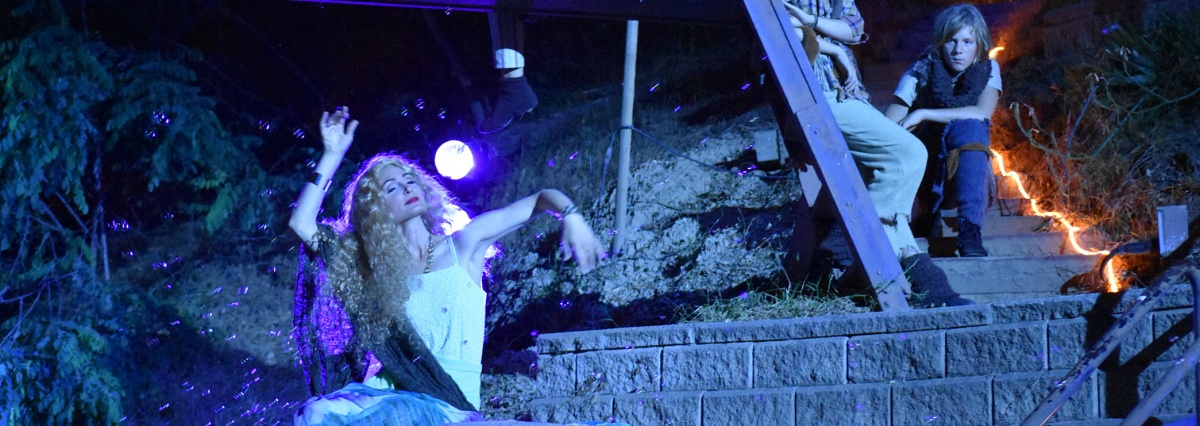


Forever Young for Ladies and Gentlemen and Children of All Ages: J.M. Barrie’s Freudian Classic for the Ages
WENDY’S PETER PAN: Theater Review
J.M. Barrie’s eternally charming Peter Pan, arguably one of the most beloved and produced plays of all time, is getting the Will Geer Theatricum Botanicum treatment at that arcadian outdoor outpost north of Malibu, a very fitting setting for dramatizing enchanted Never Land. Scottish playwright J.M. Barrie’s masterpiece is presented in “a retelling” by Ellen Geer, who also directed the two-act, two-ish hour play, with one intermission.
All hands are on deck in this worthy revival of Barrie’s immortal fable about the boy who refuses to grow up, with Gabbi Beauvais portraying the eponymous Pan. After Peter and that magical sprite Tinker Bell sprinkle the Darling children—John (the agile Jaz Bennasar), Michael (Julius Geer-Polin) and Wendy (Quinnlyn Scheppner) – with “pixie dust” and teach them how to fly, with promises of adventure, the impish Pan lures them from their staid nursery/bedroom in London to Never Land (aka “Never Never Land,” “Neverland”). (Willow Geer depicts the adult Wendy as well as Pan’s supernatural sidekick Tinker Bell, audibly expressing her ethereal character—seen onstage only as a light—by jingling bells and making utterances in a voice that could be described as “faerie-ish,” although Willow does have a human accent.)
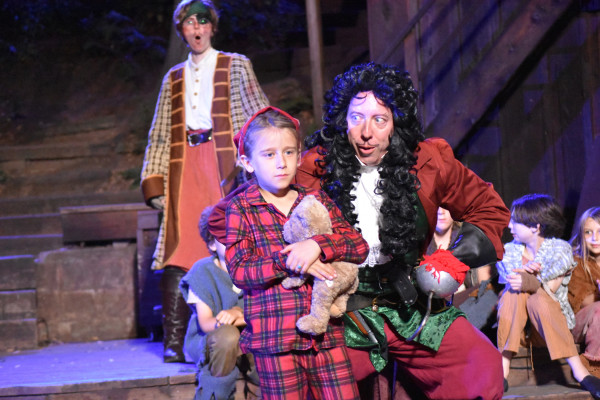 Sky Wahl, Julius Geer-Polin,Lynn Robert Berg and the Lost Boysphoto by Ian Flanders
Evading their dogged caretaker Nana (John E. Phillips, who also plays the nonconformist pirate Smee, dons a cute canine costume to play the Newfoundland dog) they set off for Never Land, located “second to the right, and straight on till morning” near the “stars of the milky way,” reached “always at the time of sunrise.” There, the adventure-bound children encounter Wendy’s Peter Pan’s familiar characters, including: The Lost Boys, the Pirates and Tiger Lily.
In Ellen Geer’s retelling, that Indigenous tribal woman is portrayed by Ianthe Marini (an award-winning performer who has played Anita in West Side Story and is an accomplished Doctor of Musical Arts), and her relationship to nature is stressed, whereas Barrie’s original, unfortunate depiction of Tiger Lily referred to her as “the belle of the Piccaninny tribe” and is quite caricaturish. Barrie referred to Tiger Lily’s tribe as “redskins” who called Peter their “Great White Father.” Marini’s Tiger Lily is dignified and, along with Peter, is one of the play’s most courageous characters. (If memory serves correctly, Marini also recognized the original inhabitants of Topanga before the proverbial curtain lifted on Pan.)
Never Land’s Pirates are, but of course, led by none other than Captain Hook, who is portrayed with great comic panache by Lynn Robert Berg. The swaggering, preening pirate, resplendent in his buccaneer’s outfit deliciously designed by Tracy Wahl, steals the show. Audiences will relish Berg’s devilish dandy and man-you-love-to-hate persona, and it called to mind the oft-televised Peter Pan musical (first aired in 1960) with the unforgettable Cyril Ritchard as Hook, one of those portrayals that made an indelible impression on all who saw it.
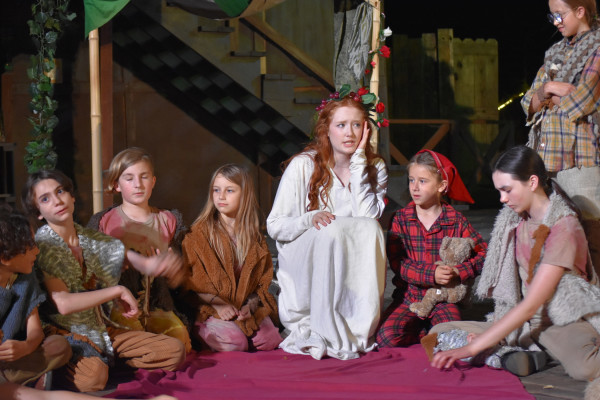 Quinnlyn Scheppner and the Lost Boysphoto by Ian Flanders
Interestingly, like Ritchard before him, Berg does double duty, also playing Mr. Darling, the bossy father of the three children who, perhaps in part, flew the proverbial coop to escape his strongarm style of parenting. The fact that the same actor who depicts the father figure is also the villain of the piece is one of the remarkable things that makes Barrie’s play a Freudian field day for amateur psychoanalysts. (I hold an AAD degree—“Also A Doctor.”)
The fact that Pan has often been portrayed on stage and screen by females—Betty Bronson in a 1924 silent movie I once saw her present at the Museum of Modern Art; Funny Face’s Sandy Duncan; Olympic gymnast Cathy Rigby; and most memorably of all, by the one and only Mary Martin in the aforementioned musical made in 1960—is indicative of Barrie’s dramatization of Peter’s conflict over his emerging sexuality and gender identity. Peter—incarnated in Wendy’s Peter Pan by the female Gabbi Beauvais—is clearly brave, does lots of “boyish” things like dueling his archenemy, Captain Hook, and is often cocksure of himself. But in this production, we see Peter experience anguish; he is puzzled that both Wendy (played by the exceedingly lovely, budding Scheppner) and the seemingly older, womanly Tiger Lilly, want something more from him than being mere “friends” or relatives. When Wendy wants to kiss Pan, he doesn’t have a clue what the darling Ms. Darling is referring to, as she tries to express her prepubescent sensuality.
Peter Pan’s refusal to become a man manifests itself as a refusal to go to school or work, in order to remain carefree, an incarnation of “joy” and “youth” forever. In the musical version, Peter sings: “If growing up means it would be beneath my dignity to climb a tree, I’ll never grow up, never grow up, never grow up, not me!” He may be avoiding responsibility, but Pan is also denying his sexuality. The very name Barrie bestowed upon his character may be a code to be cracked, as “peter” can refer to male genitalia and “pan” could be a reference to pansexual. The play also expresses confusion over fathering and especially mothering.
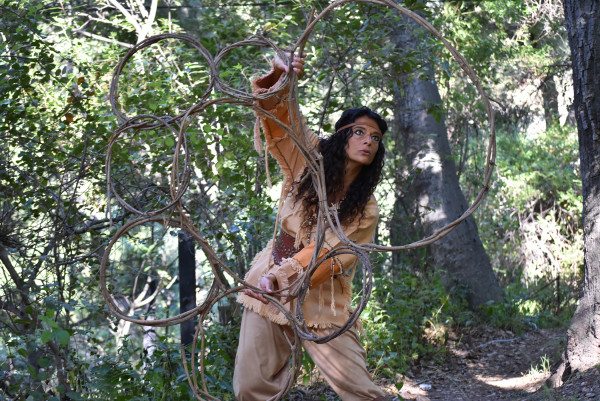 Ianthe Marini as Tiger LilyPhoto by Ian Flanders
Watching Wendy’s Peter Pan, for the first time I deciphered one of Barrie’s most essential symbols: The crocodile (amusingly rendered by costume designer Tracy Wahl and assistant Sky Wahl) who stalks Captain Hook, reveals himself to the pirate by the ticking of a clock the croc has also swallowed, along with Hook’s tasty hand (castration anxiety, anyone? Paging Dr. Freud!). It dawned upon me while watching this play that the ticking of the clock actually represents the passage of time, and hence mortality—as Peter Pan rues, maturity, old age and death comes to us all. One may try to live one’s life as a myth—but, alas we are mere mortals, flesh and blood, and time catches up to us all.
Defying age, Ellen Geer directs an energetic iteration of Barrie’s legendary work. As one has come to expect (but never tires of) from this outdoor stage ensconced in Topanga’s sylvan glade, the mise-en-scène makes enchanting use of the amphitheater’s natural surroundings, turning Topanga Canyon into a reasonable facsimile of Never Land, even if the stage itself is mostly bare. Fight choreographer Cavin (CR) Mohrhardt enhances the derring-do and combat between the Lost Boys and Pirates. I assume that prop master Ian Geatz helped create the illusion of the rising tide, albeit in a very simple if imaginative manner.
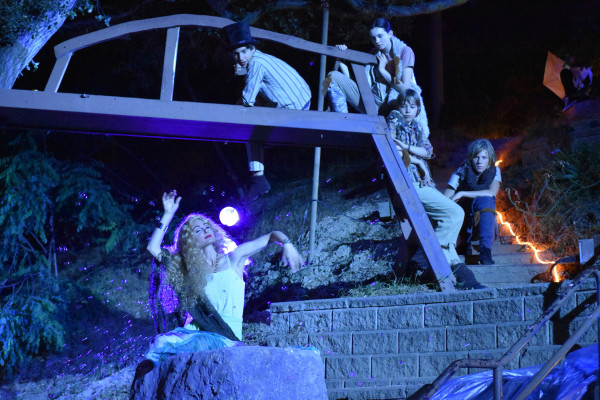 Robyn Cohen, Jaz Bennassar, Aster Laine Smith,Cole Dechant and Asher Edwardsphoto by Ian Flanders
As for the “flying,” the play’s pixie dust is provided by aerial and movement choreographer Lexi Pearl. Our protagonist Pan, Ms. Beauvais herself, teaches what in the program is called “aerial arts,” and she displays some breathtaking athleticism that suggested to me that Broadway version of Spiderman from a few years back (if less death-defying). As to how the Theatricum’s characters emulate flight, your reviewer won’t reveal any plot spoilers here—you’ll just have to see it yourself (and will be glad you did).
One question I have is that according to the program, Wendy’s Peter Pan takes place in 1916 and 1940, in part in London, when England was entangled in World War I and then WWII, although neither war is specifically referenced. On the other hand, Barrie’s play (which he later novelized) premiered in 1904. I don’t understand the time change, but this is just a minor quibble.
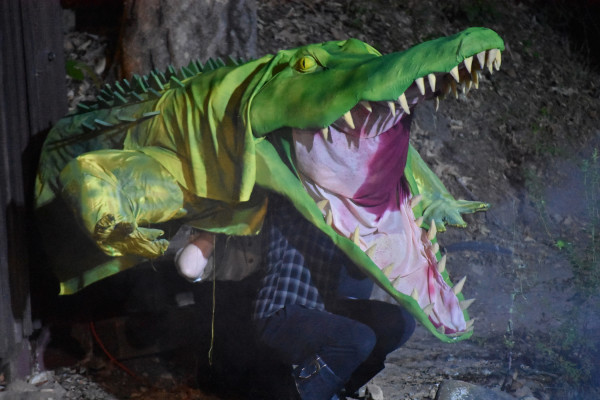 The CrocodilePhoto by Ian Flanders
Despite all of Barrie’s submerged, subliminal sexual symbolism, on the pure entertainment side, Wendy’s Peter Pan works on a totally different level for the kiddies, and this critic doesn’t ever recall seeing so many children at a WGTB live performance. For the most part, they were well-behaved—as were we adults who, for about two golden hours were allowed to fly back to our childhoods by reliving the glorious adventures of that forever young lad who refuses to grow up.
Will Geer Theatricum Botanicum is presenting Wendy’s Peter Pan through October 4 in repertory with: The Winter’s Tale, A Midsummer Night’s Dream; Moliere’s Tartuffe: Born Again; The Hispanic/Latino/Latina/Latinx/Latine Vote at 1419 North Topanga Canyon Blvd., Topanga, California 90290. For info and tickets: 310-455-3723; https://theatricum.com/wendys-peter-pan/.
FUN FACT OF THE REVIEW: In the 1924 silent screen version of Peter Pan, Tiger Lily was portrayed by Anna May Wong!
ALOHA OE (FAREWELL TO THEE): Donald Sutherland, who, among his many screen roles, co-starred in the 1970 antiwar satire M*A*S*H (for which Ring Lardner Jr., one of the blacklisted Hollywood Ten, won a screenwriting Oscar) and in 1972 performed with Jane Fonda, Paul Mooney, Holly Near, Peter Boyle, etc., in the anti-Vietnam War film FTA (Free the Army or Fuck the Army), which the Nixon administration literally banned.
