

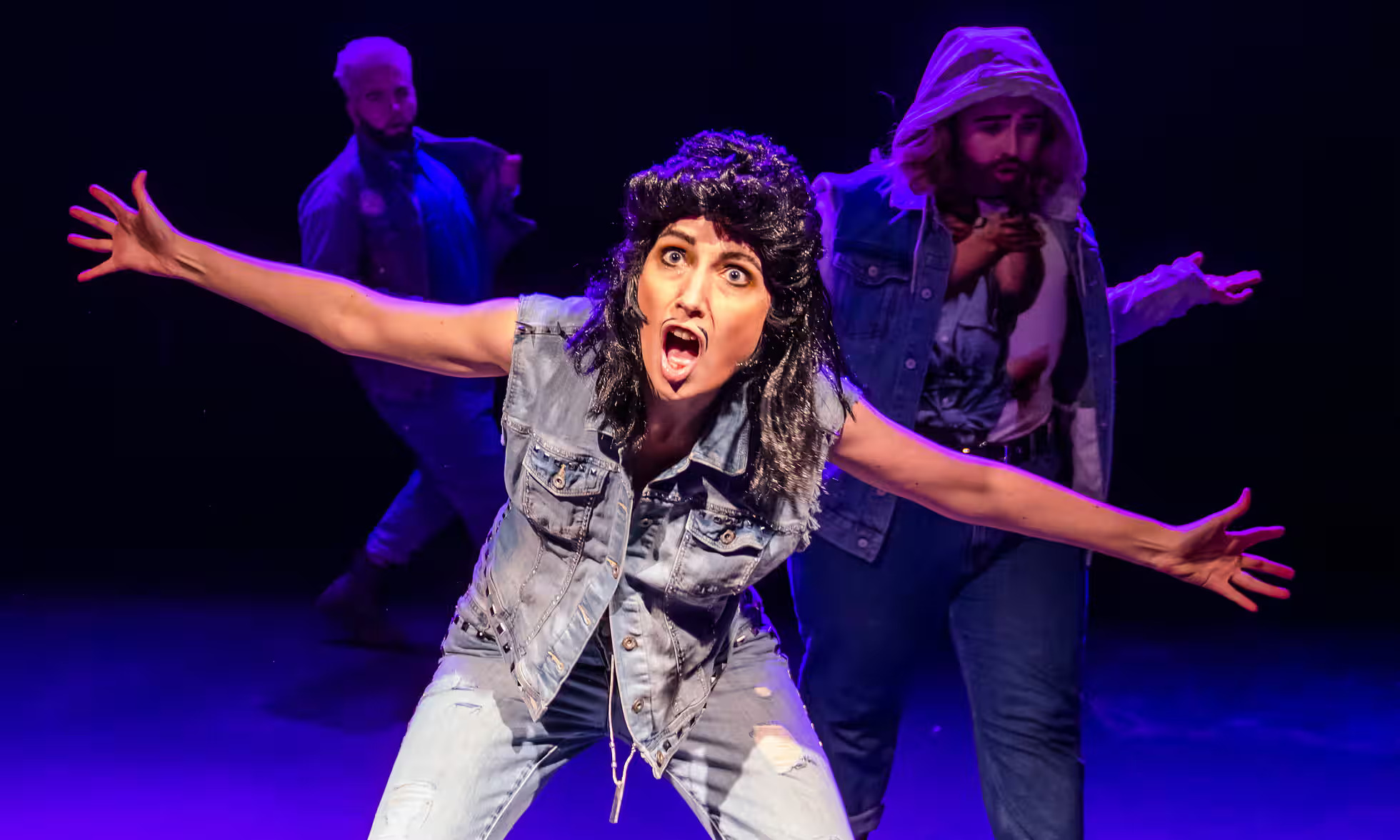


Near the end of Bulmer-Willis’s set, the Bard asks his audience to keep telling me who I am. Telling Shakespeare who he is tells us—if we are listening—who we are.
In April of 2024, near the end of a Shakespeare Association of America (SAA) convention in Portland, Oregon, William Shakespeare prowled the tables packed into a hotel meeting room. The gender-ambiguous Bard was rocking a black-and-white, 17th-century(ish) ensemble: white-lace ruff, gay white plume, unruly black wig, graffiti moustache and goatee, and an extravagantly tumescent codpiece as potent—and extended—as a metaphor. This cocksurely brandished embellishment, an indispensable accessory for the fashion-forward Renaissance courtier, was cockily erected to give a poke the eye to any cock-o’-the-walk who might be tempted to take its measure.
 Drag King Loose Willis
The Bard was animated by Drag King Loose Willis who, in a cascade of drag, was being played by the British comic Katy Bulmer. Bulmer-Willis’s conjured Bard was, as he was in life, farcical, fierce, playful, serious, sardonic, subversive, brilliant (Bulmer is a Cambridge graduate), bawdy, and brave. Brave because while committing comedy in front of any audience takes courage, it beards fate to evoke the Bard of Avon, the cultural touchstone of the Western canon, before a clench of committed canoneers and Shakespeare specialists—professors, literary critics, independent scholars, and ardent amateurs—who perchance could view a send-up of the Bard, Bardolators, and Bardolatry as callow and cheeky. But, as Lucio says in Measure for Measure, Our doubts are traitors and make us lose the good we oft might win by fearing to attempt. Instead of closing ranks, the convention-weary crusaders were receptive to, and delighted by, a pitch-perfect, sustained (90-plus minutes) delivery of complex material filtered through a complicated persona. The Bulmer-to-Willis-to-Shakespeare cataract of drag, in its mingling and muddling of gender and identity, was quintessentially Shakespearean.
So surely did Bulmer-Willis channel the Bard’s blithe spirit that the session occasionally, and eerily, tacked toward séance. The summoned ghost, shifting between commanding the class and penetrating the tablescape (preceded by that preposterous codpiece) kept the congregation titillated—by seeding the set with the puns and entendres with which Shakespeare inseminated his work; off-balance—by quizzing certified experts on obscure passages from the plays that they frequently couldn’t identify; involved—by presenting yellow Post-it awards to those who did identify those passages (among them my Renaissance-fair spouse whose award—in the Bard’s own hand and presented by the Bard himself!—is now prominently displayed among her academic honors); and alert—by levying $10 fines for arbitrary violations of capricious codes of behavior (which the finees good-naturedly paid).
Having taught for several years, I watched with admiration as the materialized Bard turned the tables on teachers, though not via lecturing. Not only is lecturing integral to academia, but also these Bardians of the Galaxy were coming off days of being lectured on arcane (to laypeople) topics: “Vigilance and Epistemological Uncertainty in Early Modern Drama”; “Reading for the Plantationocene in Early Modern Literary Cultures.” Rather, the tenured time-travelers were tongue-tied, rendered inarticulate by a pop quiz administered by the Bard! (Not being psychotic, they knew it wasn’t really the Bard, but still … it kinda was.) Re-studented and fearful of looking foolish in front of peers of the Renaissance realm, they’d been codpiece-whipped.
A word, good sir?
A joy of journalism is that it provides a rationale for accosting remarkable people who might otherwise call the police: An interview? Sure. After watching Bulmer’s poised control of craft—timing, modulation, subject knowledge, material selection, audience rapport—I approached them (the gender-fluid Bulmer’s pronouns are they-them-their) and solicited an interview. They consented graciously.
[Note: I have pronoun dysphoria. Like most of my Woodstock-era peers, my education was steeped in the Western canon, a too-big-to-fail culture bank with vast assets that amalgamate Judeo-Christianity and White supremacy. Literally old-school, we were raised within rigid, and rigidly enforced, gender boundaries; though we were no longer gender-segregated, the small-town elementary- and high school I attended—both in the same building—had entrances that were still marked Boys and Girls. From our earliest daze, we were canon-fodder, grammar-groomed by anglophiles, then handed off up the pipeline from grade school to high school to college. (Why are anglophiles attracted to schools? Because that’s where the students are.) The world has changed since then. Gender is no longer the prison it was—it’s now a halfway house—but English grammar has lagged the transition; no elegant, androgynous-first-person-singular pronoun has emerged from the language closet. In the absence of a generally accepted, non-binary pronoun, English speakers and writers have, when pronouning individuals who identify as gender-fluid, lazily settled on the awkward—because plural—“they-them-their.” Though I respect, support, even celebrate, those seeking release from gendered straight-jackets, decades of brainwashing prevail: I cannot scan past a pregnant pronoun—a singular they—without it jolting my concentration like a pothole in the road to enlightenment. To retrain my inner ear to hear a dysphoric pronoun cringelessly would take decades of J.D. Vance-style language-conversion therapy—and even if such therapy existed, even if it worked, even if I could afford it (would Medicare cover it, do you think?), and even if sufficient years were left me—until a therapeutic breakthrough, I would live in fear of the grammar police revoking my poetic license. (Worse, I’d feel I deserved it.) But beyond mental inflexibility, there is a writerly reason to respect the traditional mating rituals of subjects and verbs: It is hard enough to communicate with other sentientities without putting non-binary syntactic speedbumps—which is what they is (See?)—into the flow of thought between communicator and communicatee. Existing conventions indulge some rule-bending: e.g., dialog for a pirate movie: I orders you to hang ‘em from the yardarm! Make ‘em walks the plank! I wants me grog! Thar they blows! (See?) We—alright, I—needs (See?) a new convention, a textual sign similar to the sic we sic (sic) pedants sic on hapless quotees’ grammar and spelling errors. My condition requires a lexical flag that acknowledges pronoun over-crowding. So, until someone comes up with something better, I will, when shot-gunning marriages between bitextual pronouns and partners, henceforth italicize the first letter of the over-populated pronoun (e.g., “they want.”) It will comfort me. Think of it as a pronoun companion animal.]
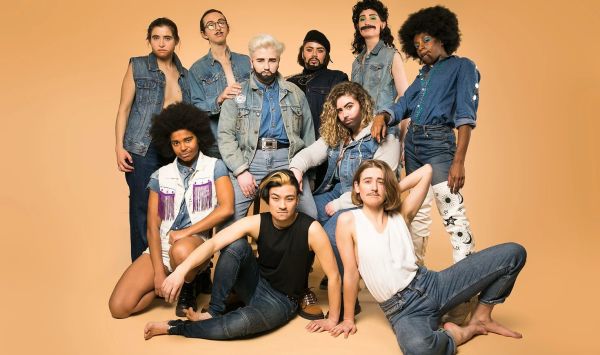 Pecs Drag Kings
Looking forward to the interview, I scanned the Marriott’s noisy (both people and décor) lobby the next morning for the sprite who’d puckishly trolled a platoon of passionate pilgrims. Across the way, a tall, rosy-cheeked girl waved in my direction. So different was she—even her body differed—from the previous evening’s codpiece-brandishing apparition that I looked past her, assuming she was waving at an SAA peer; no way this short-haired blonde could have transubstantiated her too, too solid flesh into the dark-haired, gravity-defying chimera who had effortlessly gamboled across a self-erected narrative scaffold. But she they had: All trace of Loose Willis erased from their visage, the eldritch Bard dematerialized, this was Katy Bulmer. After an exchange of hellos, we decamped to find a quieter spot.
We exited—not pursued by a bear—into a blue and clear day, dormant Mt. Hood dominating the far horizon. We crossed the street to a park spread along the west bank of the placid Willamette (wil-LAM-it) River. The Kimpton Hotel abuts the park. We entered, made a reservation for a later lunch, then found a brass-accented nook and settled in comfortable chairs arranged around a low table. Then, for several hours, we discussed Katy Bulmer’s ménage à drag, their melding of Shakespeare and comedy, and, most fascinating—for me—comedy itself.
Most fascinating because for me comedy, not cleanliness, is next to godliness. Listening to great comics preach, being part of their congregations, is as close as I come to religious experience. Conventional clerics’ livelihoods depend on their preaching harmoniously to their choirs, who attend services seeking shelter from topical storms. Shepherds who stray from The Truth, who go rogue and instead tell reality-resistant flocks the truth—the whole truth—quickly find themselves decongregated, dechoired, and deflocked. Great comic are rogues; they preach disharmony. Like riverboat pilots guiding wayfarers down streams of consciousness, great comics navigate placid surfaces that conceal snags and reefs, treacherous subtextual currents of social interaction. They are consummate conjurers, but where magicians work with illusion, great comics work with disillusion.
Where ordinary clerics—and good comics—aim to affirm congregants’ preconceptions, to soothe unease in a disharmonious world, great comics aim to disrupt preconceptions, to generate unease, preaching not just the comforting, sanctioned Truth that we in the anti-choir sometimes want to hear, but also the whole truth that we need, that we crave, to hear. By revealing the world warts and all, great comics change it, or the way we see it, which are the same. Like frontier scouts, great comics escort us through the final frontier—human nature—conducting us closer to the whole truth, close enough to be singed. For us, nearing that whole truth rouses the profound, elemental awe that our ancestors felt when looking at the infinite depth and vastness of the night sky, an awe dulled by modernity’s compulsion to explain everything.
I felt that awe the first time I saw Eddie Izzard. Late one night more than 20 years ago, my wife and I and another couple were remoting across a desolate TV-scape. We alit on Izzard’s Dress to Kill and stopped to gawk at the cross-dressed Izzard’s body-hugging, black-and-spangled pants-suit, his tastefully applied makeup, his carefully cropped, styled-and gelled-blonde hair. We listened, tittering nervously at first, but by the time Izzard got to that radical set’s “Cake or Death” segment, we were laughing so hard that two of us fell off the couch. Izzard’s performance changed the way I saw, and see, the world, the way I see others, the way I respond to how they choose, want, need—pick one—to be seen. (During Dress to Kill, Izzard calls himself an “executive transvestite”; after several years publicly transitioning, they now call themselves Suzy Eddie Izzard.)
A (far from exhaustive) list of other great comedians who through their writings or appearances have changed my/the world: Samuel Clemens/Mark Twain (who, besides having been an actual riverboat pilot, is a progenitor of modern standup via his reputedly funny lecture tours), Lenny Bruce, Redd Foxx, George Carlin, Richard Pryor, Chris Rock, Bill Maher, Samantha Bee, Sarah Silverman, Wanda Sykes, Margaret Cho, Kathy Griffin, Chelsea Handler. My list lately skews non-male. This is because, for most of recorded history, men dic(k)tated that women couldn’t be funny. But then suddenly they were, and on this side of that mysterious event horizon, there are a lot of very funny women non-male comics. Katy Bulmer is one of them.
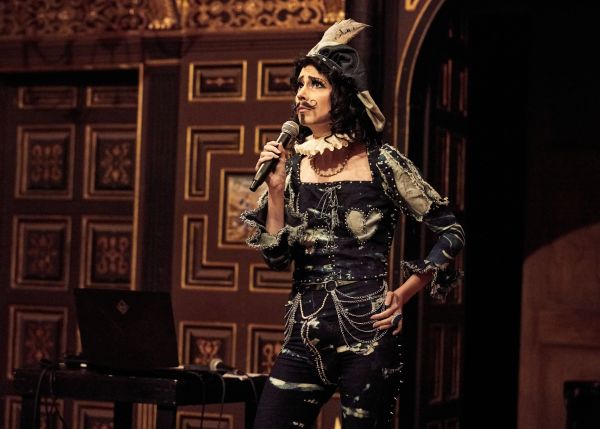 Loose Willis in character
The pull of drag
British performers are diligently analytical and articulate about their craft, which brought a special delight to our intercourse. Bulmer grew up in Norwich, a cathedral city 100 miles north and east of London. They began doing standup at Cambridge after joining the student comedy troupe Footlights, of which they say,
(Footlights) was a great opportunity to learn as we had shows every fortnight. I did get on well with most of my peers there, but it always felt like boy's club and that there was this sort of invisible barrier I couldn't integrate myself entirely into, so I worked on solo stuff more than sketches as a group. I then moved to London (and did standup) for a while but found it disheartening so I just sort of stopped after a few too many soul-crushing experiences and watching my male peers get agents and regular work and succeed when I didn't really feel like I was doing anything different. It felt like there was only ever room for maybe one girl to succeed and that wasn't me, but I also know I probably lacked confidence in myself and my abilities at the time.
I asked them about transition from standup to drag. They were discouraged by the misogyny of straight standup when they were propositioned by Pecs Drag Kings, an all-female, non-binary theater and cabaret company:
Pecs … was founded by a group of people who were also at Cambridge round the same time as me. They had just begun experimenting with kinging and putting on their first shows, and they asked me if I'd ever like to do standup in their next show as a male character, as they had seen me do standup at university. I agreed as I thought it would be a fun opportunity to pastiche some of the awful male comedians I'd seen on the circuit and then it just went on from there. I'd be in every show and I could experiment with my work and make fun of all the dissatisfaction I had with the scene with this character.
Drag’s scope has broadened, now encompassing any garbing that projects identity. People will now say, I’ll be leaving as soon as I finish putting on my work drag. I asked Bulmer about drag as armor:
Yes, I think with drag or any character comedy there is a level of armor. It's the character saying these things rather than myself so you can get away with more and people don't automatically assume it's about you personally—whereas interestingly I feel like the material I do in drag is incredibly personal. I also feel with drag there's an element of it immediately giving you higher status than the audience due to the costuming, heels, embellishments—it can make you look so otherworldly the audience perceive you as more in charge.
Traditionally, drag has been associated with queening, male cross-dressing and assuming female identities and traits. Though sniggered at, queening was tolerated and even, in limited circumstances, celebrated. Kinging—female cross-dressing and assuming male identities and traits—was considered deviant and legally suppressed. Kinging’s recent public forays have addled reactionaries unmanned by biological females coloring outside proscribed gender lines.
Like most comics, Bulmer works up their material by writing out ideas, then trying them out on friends, colleagues, and their partners, in Bulmer’s case the editor and film critic Sean McGeady. Has the transition from traditional standup to kinging affected the material’s content?
In regards to gendered material yes, I remember material that touched a lot on my womanhood, sexism I experienced as a woman. There was a stereotype that all women comedians talk about is periods and boyfriends so I feel like a lot of my material was a response to that and a lot of it got harsh, sexist feedback. I remember some reviews of standup shows I was in at university: One said I was acting like I didn't have a father; one said everyone who had a penis in the show was a good standup and everyone who didn't was bad; a lot of them would describe my physical appearance, which I didn't notice as much for the men. It was the first time I realized I was always going to be viewed through the lens of this is a woman doing comedy rather than this is a comedian. People were always going to be fixated on my gender rather than what I could do, so I suppose drag shields me more from that.
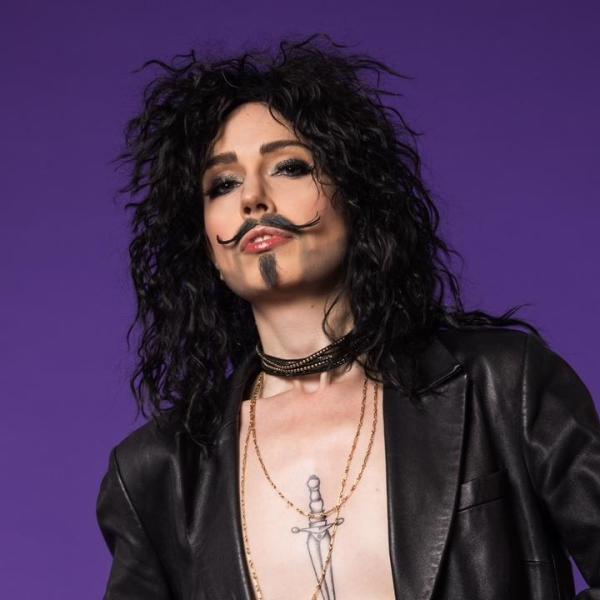 Loose Willis as Will Shakespeare Photo credit: Henri T (@henritartist)
But why does anyone not White and male need a shield?
Shakespeare’s transcendent genius alchemized the coarse, polyglot tongue he inherited into a source of the sublime. The venal administrators of British colonialism, seeing profit in his invention, cynically recast his gleeful muddling and satirizing of their society’s gender and identity follies as exemplars of White Manly Manliness. Turning his words into weapons—his plowshares into swords—they exploited the Bard’s elevated language, tongue-lashing the world to feed their insatiable hunger for more. First England, then its recalcitrant child-state America, then the Nazis, misappropriated his supernatural creativity, perversely marketing it as a priori evidence of their droit du couleur, their White right to rule and rape. (That it worked—and works—so well, and that so many rulees and rapees bought—and buy—into this malignancy is repugnant.)
Shakespeare in drag
Talking about Shakespeare and drag is dissonant because Shakespeare is drag. Regardless of characters’ gender, all parts in Renaissance dramas were played by males, some female characters played by pre-pubescent boys. Period authors deliberately muddled gender, drawing dramatic tension, and laughter, by exploiting the gap (audiences didn’t mind the gap) between gender expectations and staged gender and identity turmoil. In the process of subverting and satirizing social attitudes, period authors presented kaleidoscopic gender permutations, male actors playing not only straightforward male and female characters, but also male and female characters pretending to be other male and female characters pretending to be other male and female characters.
While gender-blending inspires the plots of many Renaissance comedies, the broader category of identity confusion frequently drives period dramas and tragedies as characters’ identity crises lead to existential chaos. In Macbeth, the ambitious (therefore masculinized) Lady Macbeth sways the weak-willed (therefore feminized) Thane of Cawdor; his too-easily abandoning his too-weakly held identity leads to chaos. In King Lear, the king’s mental confusion causes him to lose himself; that leads to the dissolution of his family and his kingdom. In Hamlet, Polonius, the king’s adviser, eradicates his identity by hiding behind an arras (it’s curtains). Here the pen is the sword, a (writing) instrument of Polonius’s death. The Bard’s word-play—a literal death sentence executed by Hamlet‘(s)word play—is the direct result of Polonius’s choosing to deny his identity.
Period dramas’ and tragedies’ identity conflicts spring from pride, superstition, stubbornness, and in Hamlet’s case, Shakespeare implies, too much education. Hamlet in particular is driven by the hyper-verbal Prince’s agony over the gap he feels (which he minds) between who he is and who he thinks he ought—or ought not—to be. Shakespeare was well aware of living in a world of dragging, of hiding behind curtains. Among his most-quoted lines: In As You Like It, Jaques says,
All the world’s a stage, and all the men and women merely players. They have their entrances and their exits; and one man in his time plays many parts.
The Roaring Girl
In the late 16th and early 17th centuries, London and the broader British public were scandalized by Mary Frith, AKA Moll Cutpurse, AKA the Roaring Girl. Shakespeare’s junior by 20 years, Frith was a proto-feminist and provocateur who flouted civil and gender norms: Considered a threat to public order, she is said to have been the first English female to smoke in public, and her habitual cross-dressing marks her among the earliest recorded drag kings. One tale has her accepting a bet that she would not, while wearing men’s clothing, ride a horse “from Charing Cross to Shoreditch” (3.5 miles). A reverse Lady Godiva, she won the bet and 20 pounds, a substantial sum at the time.
Frith’s fearlessness earned her multiple arrests, jailings, and punishments for thievery and pandering (for supplying sex partners for both men and women). One of her sobriquets, the Roaring Girl, is derived from roaring boys, a description of roaming gangs of belligerent young men. Shakespeare cites these gangs in Romeo and Juliet, a reference that animates West Side Story; and some have suggested that Frith’s behavior influenced the strident Katherina in The Taming of the Shrew (which later became Kiss Me, Kate). Frith’s infamy inspired at least three contemporary plays, one of which is lost. Of the extant two, one is Amends for Ladies, in which Firth, in yet another provocation, publically played Moll Cutpurse (herself). The other, The Roaring Girl, is a dramatization of Frith’s life. All three plays were staged in a competitive and raucous London theater scene in which Shakespeare and other “commoner” playwrights were sniffed at as a cacophonous cohort of upstart crows that critics condescendingly called the Roaring Boys.
Bulmer talks about drag allowing them space to roar:
Drag allows me to take to complexities and contrasts I feel in myself as a person: masculine and feminine, high culture and low brow, glamour and depravity, power and fear, and pull them to the surface in the vision I present when I'm on stage. Arriving in drag is an immediate signal to the audience that I am here to subvert, to poke fun, to play and resist the normative. Stand up is a skill I work on constantly but doing drag for me is performance art: a chance for true creative expression and subversion. And I love rhinestones.
What’s in a name?
In Shakespeare, the subtext is mightier than the text. An ever-present, off-stage chorus constantly commenting and judging (albeit silently), subtext is what makes Shakespeare the, not a, Bard. It—subtext—is what drives Romeo and Juliet to dramatic heights. The subhead above is the better-known part of Juliet’s lovelorn lament, her question answered by the phrase that follows: that which we call a rose by any other name would smell as sweet. Juliet’s question is oft-quoted to suggest misplaced priorities, implying that, though we may change what we call a thing, its essence remains the same. But what evokes the tragic in Romeo and Juliet is subtext: For the ill-fated lovers, the answer to what’s in a name? is everything.
What does Judeo-Christianity think about naming? The following responses were generated by Google’s Artificial Intelligence (AI) engine:
In biblical times, naming something was a sign of authority and ownership.
In the Bible, naming is a significant act with spiritual and social meaning.
In the Bible, God instructs Adam to name everything.
[That these responses are generated by AI is relevant because current deployments of AI are based on large language models (LLMs). LLMs voraciously vacuum all extant text(s). They have greedily gobbled both the light and dark webs—in their entireties—plus myriad non-public databases, plus anything new. AI companies’ servers are constantly processing all this data—the energy requirements are enormous—then their algorithms distill and provide answers. The above AI responses thus supply a subtextual concentrate of historical and current human thought about, and attitudes toward, naming.]

From the King James Bible, Gen.2 Verses 18-20:
And the LORD God said, It is not good that the man should be alone; I will make him an help meet for him. And out of the ground the LORD God formed every beast of the field, and every fowl of the air; and brought them unto Adam to see what he would call them: and whatsoever Adam called every living creature, that was the name thereof. And Adam gave names to all cattle, and to the fowl of the air, and to every beast of the field; but for Adam there was not found an help meet for him.
Let’s unpack: The LORD anoints Adam, his creation, viceroy of Earth, betokening his planetary dominion by tasking him with naming everything, including his future helpmeet. She is not-yet-created because the LORD, and so his viceroy also, considers her creation, and her naming, a lower priority than the cattle, the fowl of the air, and the beasts of the field. Does not the subtext surging beneath these 101 words—among the most famous and influential of all words—illuminate human history?
What’s in a name? For oppressors, everything that matters: ownership, hegemony, dominance, control. Power. Among the first tasks for conquerors and colonizers is naming, and for decolonized nations, renaming, which takes back their agency.
Why are so many female names—Charlotte, Christine, Danielle, Philippa—diminutive? Why does Donald Trump call people names? Wanna-be-masters of the universe wield two weapons: firearms and language. Within the latter, naming is particularly potent because it seems so innocuous. It isn’t: Naming is coercion. Naming is duress in drag. Kinging, by breaking age-old molds, subverts that by inverting language on multiple levels, including body language. We see this in the (outwardly) playful noms de drag chosen by the Pecs Drag Kings cast: Scott Free, Thrustin LImbersnake (my favorite), Loose Willis, Izzy Aman, Victor Victorious, Mr Goldenballs, John Travulva, Johnny Gash. Insurgent comedy guerillas, the Pecs cast use their native tongue to lick the enemy, turning tables on those who have so effectively, and for so long, used language as a cudgel. Naming is claiming. It is also reclaiming.
Bulmer, who has always considered herself gender-fluid, tells a story about a conversation with school-girl chums:
We were talking about who we’d like to go out with. I said, Boy or girl? Conversation stopped. I said I was joking and determined not to have that conversation anymore.
Near the end of Bulmer-Willis’s set, the Bard asks his audience to keep telling me who I am. Telling Shakespeare who he is tells us—if we are listening—who we are. For some of us, Shakespeare is the champion of White, male supremacy; for others of us, he fervently undermines that. At the end of Taming of the Shrew, order is restored: Katherina, donning officially sanctioned female drag—obedience and modesty—submits to her lord and master Petruchio. Yet for most of the play, she is far smarter, faster, meaner, and funnier than he. For most of Taming of the Shrew, Katherina is, gloriously and unapologetically, roaring.
Shakespeare died April 23 1616. It has taken 400 years, but finally other girls—people who want not to be strait-jacketed by the gender proscriptions of threatened males—are also roaring gloriously and unapologetically. Katy Bulmer is one of them.
