

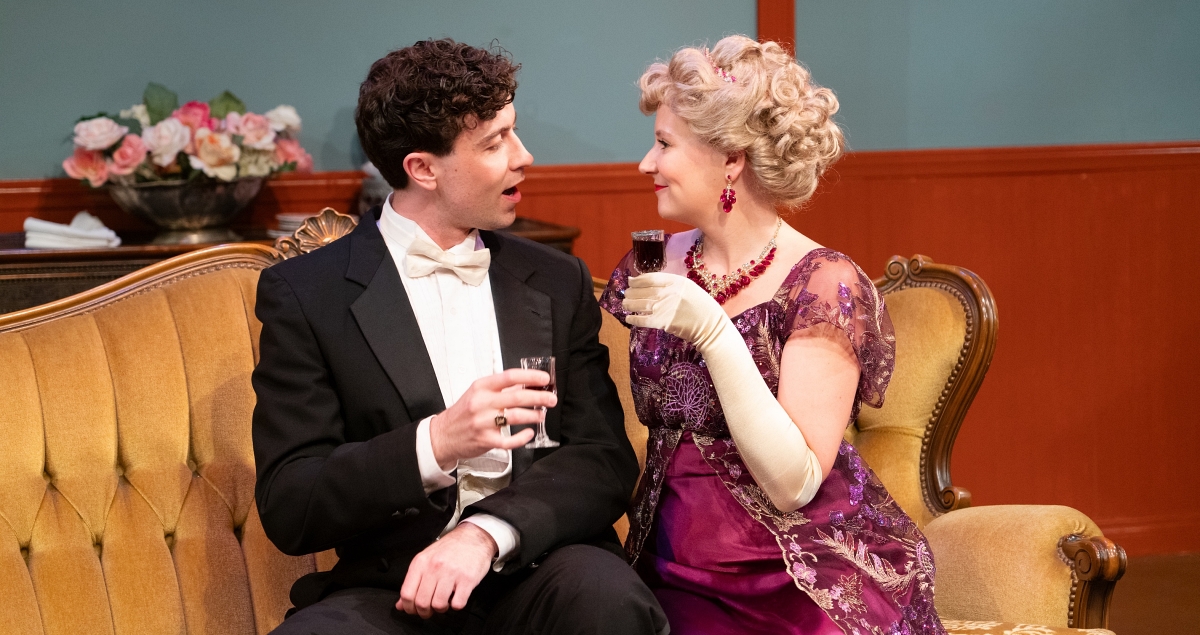


It’s no mystery that this well-acted, well-directed production of Priestley’s political play about the well-heeled remains well worth seeing
AN INSPECTOR CALLS: Theater Review
British socialist J.B. Priestley’s An Inspector Calls is a clever dramatization of the British class system. In this two-act drawing room play, which was first produced in the Soviet Union in 1945, Inspector Goole (Mouchette van Helsdingen) unexpectedly shows up at the posh home of an upper class U.K. family, the Birlings, in the fictitious industrial city of Brumley, located in England’s North Midlands. Identifying herself as a police inspector, the portentously named Goole announces the suicide of a young working class woman, Eva Smith (Arezu Tavakoli), and proceeds to dissect how each member of the privileged family and Gerald Croft (Isaac W. Jay) – who is there celebrating his engagement to Sheila Birling (Katyana Rocker-Cook) – played a role in the 22-year-old’s death.
Goole’s takedown of the port-swilling ruling class characters, clad in gowns, white ties and tails (costume designer Michael Mullen has a keen eye for this period piece), starts with elitist snob Arthur Birling (played with an English accent by David Hunt Stafford, Theatre 40’s Artistic and Managing Director), the fatuous factory owner of what he calls “the works,” where Eva had gone on strike, demanding higher wages. Instead of acceding to the workers’ modest demands, Arthur sacked the pesky proletarian, thus launching Eva’s downwards spiral. Pompous status conscious Arthur is more preoccupied with attaining the knighthood he yearns for than with Eva’s sorrowful fate.
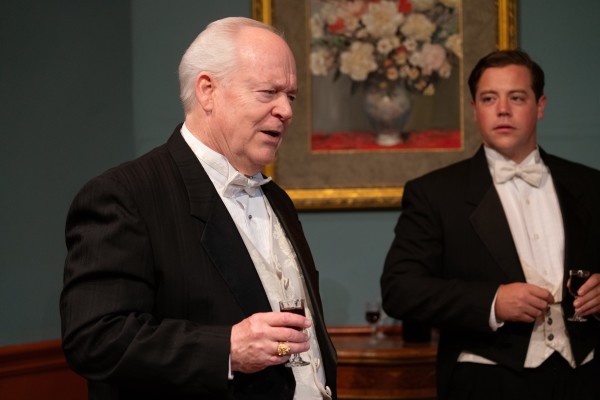 David Hunt Stafford, Monty Renfrow
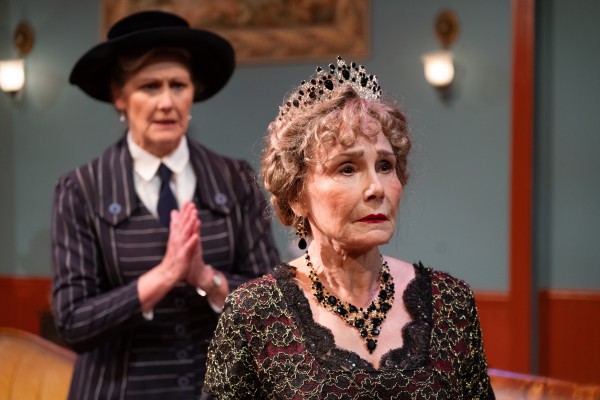 Mouchette van Helsdingen & Diana Angelina
One-by-one, the self-proclaimed inspector goes on to delineate the specific role every patrician character played in Eva’s undoing and ever-deepening crisis. In this sense, Priestley’s An Inspector Calls is an exemplar of the Whodunit genre, wherein all of the prime suspects are grilled by a detective or amateur investigator possessing uncanny deductive powers, then subjected to the grand finale, often in a drawing room. There, said sleuth confronts each character, reveals motives, then pronounces with absolute certainty who the culprit is.
Agatha Christie, creator of Belgian detective Hercule Poirot, perfected this format (indeed, Ms. Rocker-Cook co-starred in Theatre 40’s 2023 production of Christie’s Towards Zero, wherein Stafford played Superintendent Battle). Today this tried-but-true tradition continues in the CBS series Elsbeth, with Carrie Preston as a quirky Miss Marple-like crime solver; in the Knives Out film franchise, with former 007 star Daniel Craig as Detective Benoit Blanc; and in the Inspector Poirot pictures starring and directed by mustachioed Kenneth Branagh.
Sometimes the setting of a production is a determining factor, and mounting this play for a limited engagement at the Greystone Mansion high atop Beverly Hills is a stroke of sheer theatrical genius. The Tudor Revival manor, formerly the Doheny Estate, organically complements this class conflict fable. The set, so to speak, was the former Living Room and Minstrel Gallery of this posh residence that was derived from the wealth of prominent Angeleno oil baron Edward L. Doheny. It is precisely the type of upscale place Arthur Birling would live in – or at least aspire to inhabit and own.
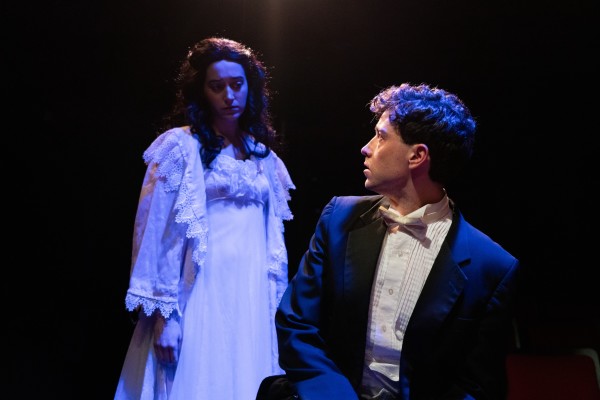 Isabella Dibernardino & Isaac W, Jay
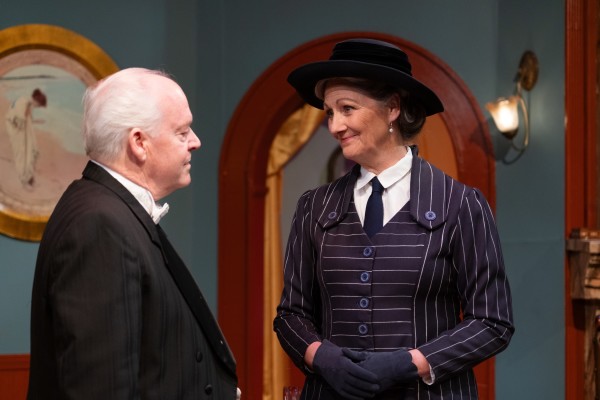 David Hunt Stafford, Mouchette van Helsdingen
Greystone Mansion is also an especially apt choice for this Whodunit because this site was where a notorious murder-suicide occurred in 1928. Indeed, in 2017 Kathrine Bates’ The Manor dramatized those tragic events in a play that literally moved from room to room where those incidents are believed to have taken place. (Talk about “immersive theater”!) So, evocatively staging An Inspector Calls inside this mansion is quite resonant and a brilliant idea, as the estate becomes a veritable character in the drama. With tongue in cheek, I’d cheekily say that by doing so, it gave set designer Jeff G. Rack the easiest job on Earth.
Another inspired touch is changing the gender of Priestley’s title character, who in the original versions of An Inspector Calls that was performed at Moscow’s Kamerny Theatre and Leningrad’s Comedy Theatre in 1945, and in most mountings afterwards, Goole was male. Thus, in addition to contending with class issues, this iteration of Priestley’s classic has van Helsdingen’s character confront sexism, making the current offering of the 80-year-old Whodunit all the more relevant with a feminist vibe.
(BTW, there have been a number of screen adaptations of Priestley’s political play, including 1965 and 2010 Bengali renditions, plus 1973 and 1979 Soviet films – both directed by Aleksander Proshkin – wherein all of the inspectors were played by male actors. In the 1954 film version directed by Guy Hamilton – who went on to helm James Bond thrillers – Alastair Sim portrayed the inspector.)
Cate Caplin adeptly directs her dramatis personae, with Iranian-Argentinian-American actress Arezu Tavakoli cannily cast as Eva, whose “exotic” beauty bewitches those staid Anglo-Saxon males, including scion Eric Birling, played by Monty Renfrow with a strong sense of self-loathing that made him the standout in this well-oiled ensemble. (Isabella DiBernardino portrayed Eva from Nov. 3-Dec. 3.)
Priestley’s period piece is shrewdly set in 1912, shortly before World War I shattered the not-so-genteel world of the British gentry. Yorkshire-born Priestley was clearly down on the Downton Abbey-type upper crust crowd. In 1942 the Cambridge graduate co-founded the socialist Common Wealth Party, and was reportedly influential in helping the Labour Party win Britain’s 1945 elections, and the establishment of the U.K.’s welfare state. A novelist as well as playwright and essayist, he wrote the novel James Whale (of Frankenstein fame) adapted for the screen in 1932 as The Old Dark House, starring Boris Karloff, and which also contained social commentary on the British class system.
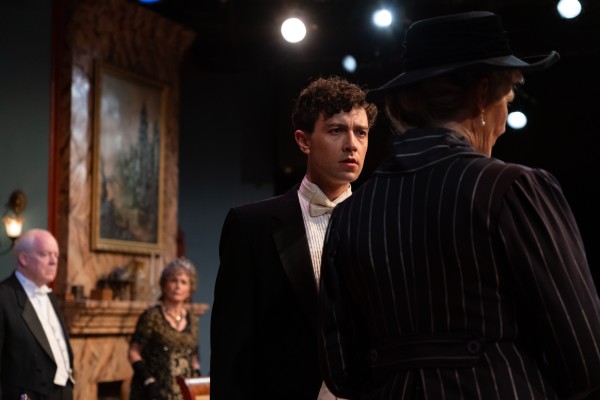 David Hunt Stafford, Diana Angelina, Isaac W. Jay and Mouchette van Helsdingen
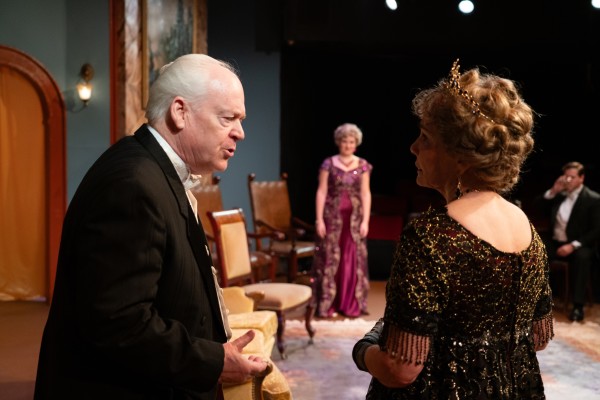 David Hunt-Stafford,Katyana Rocker-cook, Diana Angelina, Monty Renfrow
However, An Inspector Calls arguably strays from the strict party line, with a spectral theme. The 1912 setting for this costume drama is also important because nowadays, more sophisticated members of la crème de la crème would be far more likely to demand to see identification and to have their lawyers present. Nevertheless, with the divide of the haves and have nots sharper than ever, the drama’s generation clash and sexism, Priestley’s morality play is still timely. It is also a stellar example of how eat-the-rich agitprop can be rendered in a highly enjoyable, entertaining, good fun way, while perhaps slyly poking fun not only at the capitalist class (who are always good for a laugh), but also at genre conventions. It’s no mystery that this well-acted, well-directed production of Priestley’s political play about the well-heeled remains well worth seeing – especially at Beverly Hills’ very own old dark house, the Greystone Mansion.
This is the last week to see Theatre 40’s An Inspector Calls presented at Greystone Mansion, 905 Loma Vista Drive, Beverly Hills, CA 90210. It is being performed there at 7:30 p.m. on Wednesday, January 14; Thursday, January 15; Friday, January 16; Saturday, January 17; and Sunday at 2:00 p.m., January 18. Info and tickets: (310)364-3606;http://theatre40.org. Free parking.
