

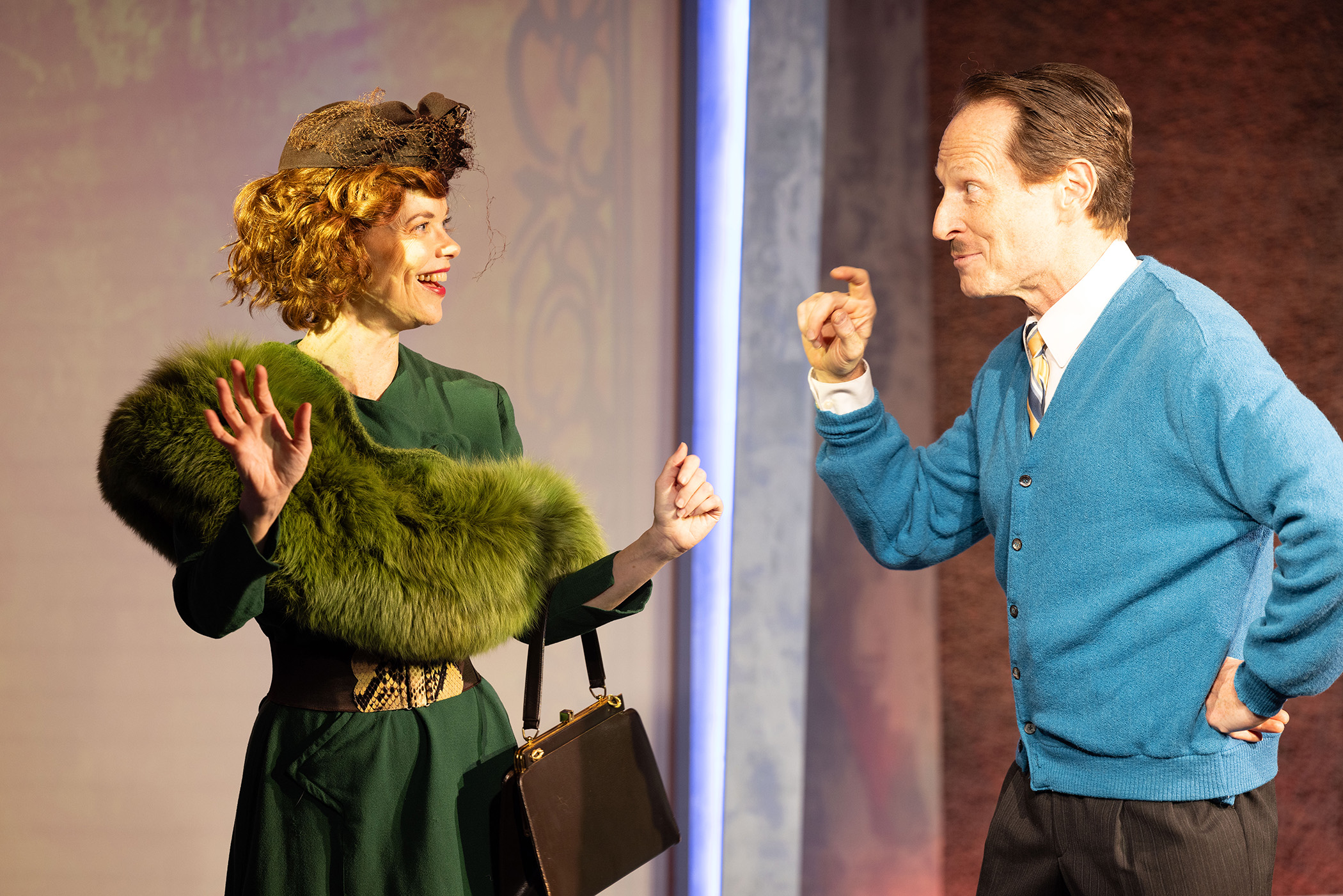


With its ruminations on fascism, Crevasse is, alas, all too topical, as it dramatizes the campaign by “Hitler’s favorite filmmaker” to “go Hollywood.”
CREVASSE: Theater Review
In my decades of theatergoing, bard Tom Jacobson’s Crevasse is likely the most brilliant, highest caliber two-hander this critic has ever had the privilege to see mounted on the boards. This quality is true in terms of playwriting, theme and acting, and if you are a cinephile, Crevasse is simply a must-see. With its ruminations on fascism, Crevasse is, alas, all too topical, as it dramatizes the campaign by “Hitler’s favorite filmmaker” to “go Hollywood.”
But when she came to Tinseltown in 1938, Leni Riefenstahl (the dazzling Ann Noble) was stymied in her effort to distribute Olympia, her 1936 documentary about the Berlin Olympics (talk about an impeccable sense of timeliness!) in America by the fact that most studio moguls were Jews. By and large, they refused to meet with the German helmer—except for two non-Jewish big machers in the motion picture industry.
Producer Hal Roach, of the Our Gang and silent screen comedies—who'd proposed an ill-fated joint venture movie deal with Vittorio Mussolini (Il Duce’s son)—invited Riefenstahl to dinner. This is only mentioned in passing in Crevasse, which zooms in on when Leni met Walt Disney (the malleable Leo Marks). The cartoonist had been deeply impressed by Riefenstahl’s 1935 Triumph of the Will, about the Nazis’ party congress at Nuremberg. Uncle Walt invited the German director for a tour of his animation studio while he was working on Fantasia.
This much we know is factual; playwright Tom Jacobson told me he unearthed notes per Disney’s account of their actual meeting. But like Kemp Powers, who wrote the play One Night in Miami... about the actual get-together of Malcolm X, Sam Cooke, Jim Brown and Cassius Clay right after he became world champ, Jacobson imagined most of what transpired behind closed doors between the German documentarian and the American animator. And what a rich, resonant imagination Jacobson has! (Let’s hope that, like Miami, Crevasse becomes a film, too.)
This heady concoction is superbly reenacted by only two actors, who each flawlessly portray three parts. In addition to depicting Disney, Obie Award-winner Leo Marks also portrays the swastika armband-wearing Joseph Goebbels, the Third Reich’s Minister for Public Enlightenment and Propaganda, as well as Ernst Jaeger, Leni's press agent who had the vexing “misfortune” of being married to a Jew.
 Ann Noble and Leo Marks (Photo by Matt Kamimura)
In addition to playing that wife and an FBI agent, Ann Noble incarnates the complex Leni Riefenstahl in one of the best performances this critic has ever seen onstage. Noble’s ignoble Leni is alternately fetching and kvetching, alluring and imperious, aesthetic and sinister. The two actors’ seamlessly sliding from one character to another in this one-act play is reminiscent of the hilarious Broadway adaptation of Alfred Hitchcock’s The 39 Steps.
Tom Jacobson is simply an extraordinary, prolific playwright who often dramatizes historical material, such as in his The Chinese Massacre (Annotated). This award-winning bard is currently setting his sights on an extremely of-the-moment subject - fascism. In addition to Crevasse, L.A.’s Open Fist Theatre Company is now presenting Jacobson’s two-part The Bauhaus Project, about the role of art and artists during the rise of Nazism and anti-Semitism in Germany.
Now, a few observations. In terms of the zeitgeist, it’s fascinating that Crevasse world premiered in the same month that another play opened about a director charged, like Riefenstahl, with making viciously racist propaganda pictures. D.W. Griffith, who directed the 1915 Civil War era epic The Birth of a Nation, was dramatized in Korean American Philip W. Chung’s new world premiere play, Unbroken Blossoms at East West Players. It was directed by Jeff Liu—who also helmed Jacobson’s The Chinese Massacre (Annotated).
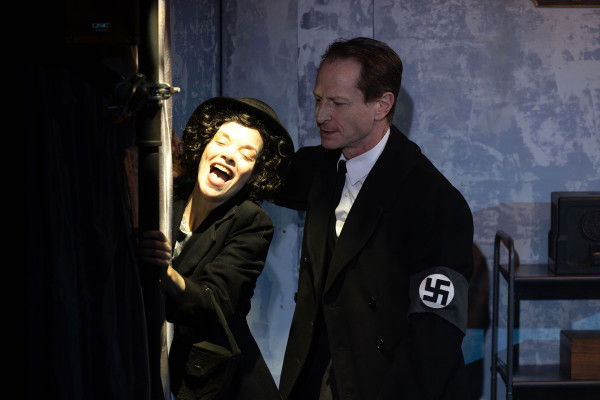 Ann Noble and Leo Marks (Photo by Matt Kamimura)
In terms of form, the power of Riefenstahl’s so-called documentaries is largely derived from the fact that she lensed Triumph, Olympia, etc., with the aesthetic of feature filmmaking. Filmically, Riefenstahl emerged out of the world of narrative movies—not actuality—wherein the athletic actress starred in a cycle of mystical mountaineering movies, such as 1929’s Alpine extravaganza The White Hell of Pitz Palu, co-directed by Arnold Fanck, the master of the “mountain” genre, and the great Weimar metteur en scène G.W. Pabst.
Leni was not only in front of the cameras in some of the mountain movies; she also co-directed 1926’s The Holy Mountain with Fanck and 1932’s The Blue Light with Béla Balázs. Thus, Riefenstahl’s cinematic sensibility was forged in fiction films, and she imbued her “nonfiction” subject matter with a fictitious frame of mind—which is appropriate, as fascist ideology is based on lies and illusions. One could call her Triumph of the Will Riefenstahl’s “Fascist Fantasia.”
Jacobson’s title for his drama, Crevasse, is apropos, as this word is defined as a deep, open crack, especially in a glacier. As noted above, originally a dancer, Leni made her mark as an actress and co-director in Germany’s prewar mountain movies. A crevasse can also be considered a Freudian vaginal symbol—in particular, an icy one. The mountain movies were suffused with a strange sexuality, and there has been much speculation over the years about Riefenstahl’s sex life. (Crevasse has a tense frisson between Leni and Disney that suggests she wasn’t above sexchanging sexual favors for getting her way, careerwise—although the play dramatizes her rebuffing of Goebbels’ unwanted advances.)
One of Jacobson’s characters survives the Nazis’ death camps, and if memory serves correctly, Riefenstahl was accused of arranging for Roma slave laborers to be allowed out from concentration camps in order to work as extras in her dreadful movie Tiefland (aka Lowlands, which was shot during WWII but not released until 1954). It would have been a perfect touch if Crevasse’s aforementioned survivor escaped perishing in a forced labor camp because Leni had cast her as an extra.
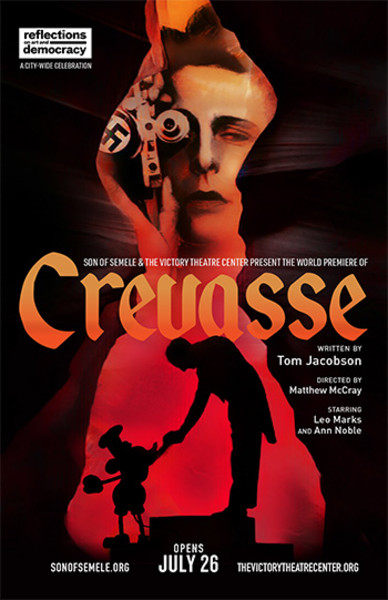
Matthew McCray tautly directs his cast of two—or is it six?—as they effortlessly, smoothly transition from one character to another. Scenic designer Evan Bartoletti’s set is deceptively complex, as the play takes us behind what appears to be a series of curtains, revealing Goebbels’ Berlin ministry, Disney’s Hollywood studio, and more. Lighting designer Azra King-Abadi casts some of the best shadows I’ve seen this side of (speaking of agitprop) Sergei Eisenstein’s Ivan the Terrible.
Some may mistakenly think that since Walt Disney is a lead character in Crevasse that it is a play for children, but this intellectual feat of antifascist theatrical derring-do is definitely not for the tykes. There are also Nazi images some may find triggering and disturbing, so it is also not for the faint of heart—Tom Jacobson does not Mickey Mouse around with his antifascist subject matter. The bravura Crevasse is, however, for the serious theatergoer, who enjoys adult themes, great writing and stellar acting, as well as mandatory viewing for film history fans. This is an animating look at the nature of fascism and propaganda, emerging out of the collective psyche just as MAGA maggots menace us once again—with the triumph of the swill.
Crevasse is being performed on Fridays and Saturdays at 8:00 p.m., and Sundays at 4:00 p.m. through August 18 at The Victory Theatre Centre, 3326 W. Victory Blvd., Burbank, CA 91505. Info here; (818)841-5421.
