

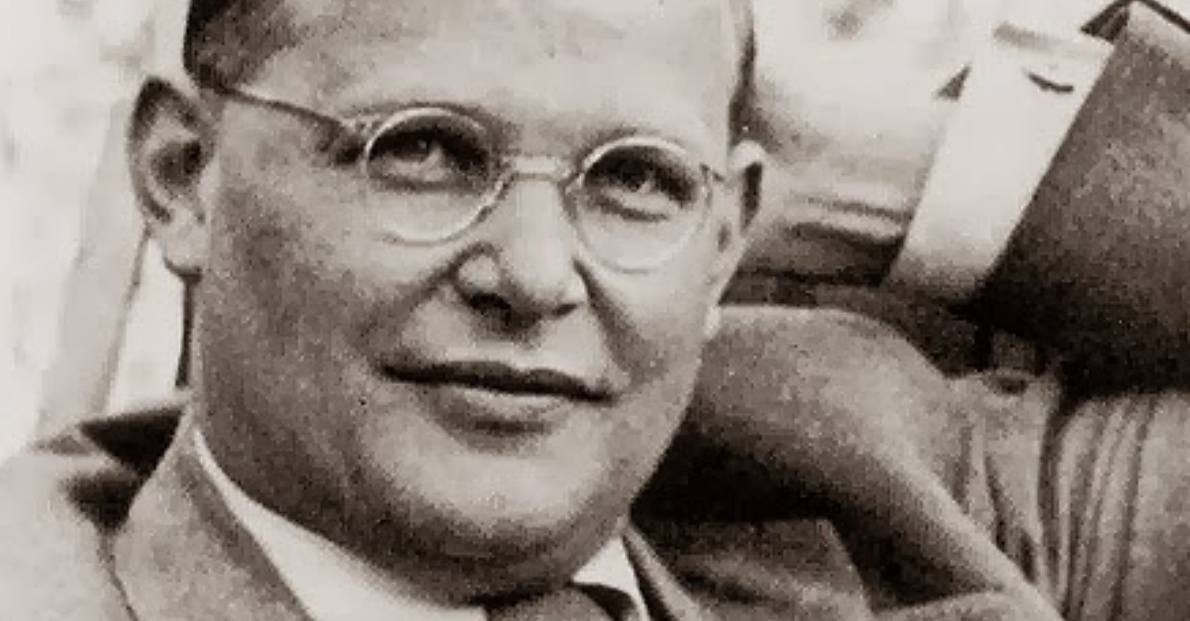
A Hero for Our Time

Walter Moss: A Review of “Bonhoeffer: Agent of Grace.” How much more heroic he was than the so-called present-day super-heroes of comics or films.
Scanning to see what was available on Amazon Prime, I discovered a film (of almost an hour and a half) called “Bonhoeffer: Agent of Grace” (shown earlier on PBS in 2000 and also now on YouTube). Remembering my 1960s’ fondness for Bonhoeffer’s character and ideas, I decided to watch it. (Spoiler alert: Stop here if you don’t want to know how he died.) After doing so, my main takeaway was, “Now here’s a real hero for our time”—even though he was executed by the Nazis in April 1945, just a month before Germany’s surrender. How much more heroic he was than the so-called present-day super-heroes of comics or films, or than various celebrities, famous because of their films, music, or sports fame!
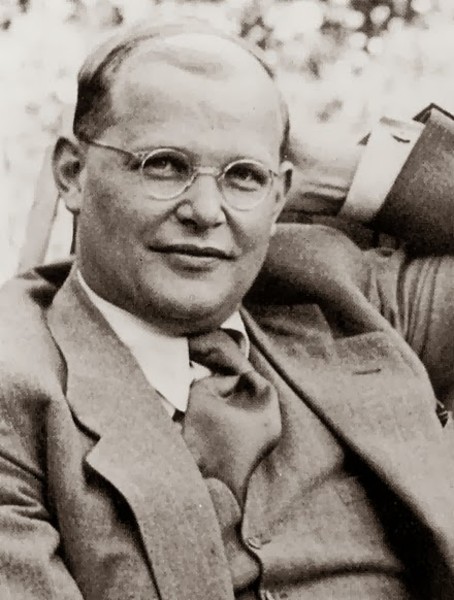
The film begins in 1939 with the German-born Bonhoeffer in a church in Harlem, New York, singing and clapping along with Black parishioners. According to a 2016 article in the Harlem World Magazine this event seems true to life. Dietrich was then 33 years old, but he had first come to New York in 1930 to accept a postgraduate fellowship and engage in further studies at Union Theological Seminary—he had already obtained a Doctorate of Theology from Berlin University. He came from a large and distinguished family in eastern Germany, where his father, Karl, was a psychiatrist and neurologist.
In 1930-31 New York (including Harlem) he experienced religion in new ways. One of his professors was Reinhold Niebuhr, who became one of the 20th century’s most famous theologians. Dietrich also became a good friend of Frank Fisher, a fellow seminarian who was Black and who took him to the Abyssinian Baptist Church in Harlem. There Bonhoeffer began teaching Sunday school and enjoyed African-American spirituals. The pastor there was Adam Clayton Powell, Sr. (father of a later congressman), who preached the Gospel of Social Justice, a powerful early 20th century progressive influence.
Returning to Germany in 1931, Bonhoeffer was ordained a Lutheran minister that same year. In 1933, he witnessed Adolf Hitler becoming chancellor of Germany, and from the very beginning opposed many of his policies. Partly as a result of Nazi interference in the running of the German Lutheran church, Dietrich went to London in 1934 to administer to two German-speaking Protestant churches and also engage in ecumenical efforts. In 1935, however, he returned to Germany in order to head an underground seminary for training Lutheran ministers.
In 1937 one of his best-known books, The Cost of Discipleship, was published. Meanwhile, mainly in northeastern Germany, he continued teaching in illegal Lutheran seminaries. In 1938, the Gestapo banned him from Berlin.That same year his brother-in-law Hans introduced him to the German Resistance that sought Hitler’s overthrow. Hans also told him that war was soon coming. As a pacifist and opponent of Hitler, Bonhoeffer knew he could not serve in the army if conscripted, which now appeared likely.
In 1939 another invitation from New York’s Union Theological Seminary seemed to offer at least a temporary postponement of any reckoning with being drafted. And, as we have seen, the film here being reviewed starts with his 1939 stay. The flashback it then offers to earlier in the 1930s is very brief, no more than five to six minutes. And it does not strictly adhere to Dietrich’s real-life chronology or actual occurrences. But it does remain true to the spirit of his German activities in the 1930s.
His criticism of Nazi policies, as well as the Gestapo’s persecution of him (e.g., forbidding him to teach or preach and requiring him to regularly report to it), his fondness for the ideas of Gandhi (see here for the impact Gandhi also had on Martin Luther King), and his introduction to the German Resistance through brother-in-law Hans are all depicted. And also the line he uttered to his friend Frank Fisher near the beginning of the film about leaving the U. S. (in 1939) after a short stay—“If I stayed [in America], I’d become a living lie to everything I believe in”—captures his willingness to risk Nazi imprisonment rather than abandon his church and the German people it served.
The film does not depict it, but at about the same time he wrote to Reinhold Niebuhr: “I have come to the conclusion that I made a mistake in coming to America. I must live through this difficult period in our national history with the people of Germany. I will have no right to participate in the reconstruction of Christian life in Germany after the war if I do not share the trials of this time with my people….Christians in Germany will have to face the terrible alternative of either willing the defeat of their nation in order that Christian civilization may survive or willing the victory of their nation and thereby destroying civilization.”
What most of “Bonhoeffer: Agent of Grace” does unveil is Dietrich’s activities during World War II from the German invasion of Poland in September 1939 until his own execution in April 1945. As the Nazis increased their oppressive policies during the war—e.g., in 1940 shutting down the main underground seminary where Bonhoeffer taught and increasing the oppression of Jews—he becomes more active in opposing Hitler’s policies.
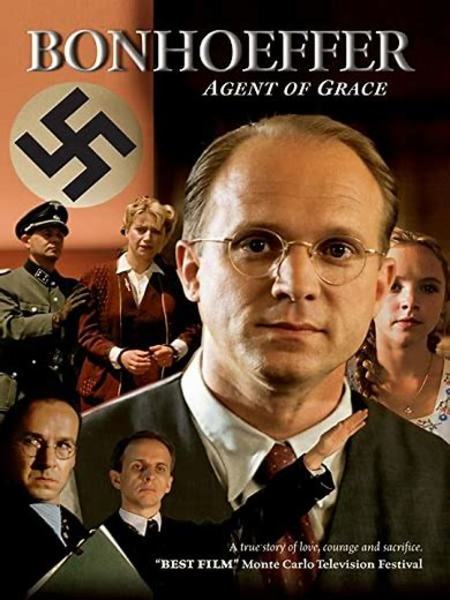
In 1938, his bother-in-law Hans von Dohnányi had first introduced him to people where he (Hans) worked at Abwehr, German military intelligence, who sought Hitler’s overthrow. But the film depicts Dietrich realizing a coup might mean assassinating Hitler, and he demonstrates some reluctance to go that far. Later, Hans shows him papers and pictures documenting Nazi horrors like that of extermination camps, and Dietrich decides to join the fight to get rid of Hitler. In 1940 another bother-in-law, Jewish-classified Gerhard Leibholz, husband of Dietrich’s twin sister Sabine, escapes with their two daughters via Switzerland to England. (Also during the first few years of the war, Dietrich and brother-in-law Hans helped other Jews escape to Switzerland.)
Although the film concentrates mainly on Dietrich’s opposition to Nazi rule during World War II, it also provides scenes between him and a young woman. She was Maria von Wedemeyer, the granddaughter of a wealthy northeastern German woman who supported Bonhoeffer’s religious work. Maria was still in her late teens, only about half his age. The film depicts their budding romance, mentions her grief when her brother and father are killed in the Battle of Stalingrad, and then (in early 1943), the couple’s engagement.
But they were engaged only a few months before Dietrich was arrested and incarcerated at Tegel Prison in Berlin, where he remained for about a year and a half. Although the film takes some artistic liberties, it correctly indicates that the arrest stemmed from both Dietrich and brother-in-law Hans being involved (behind the scenes) in plotting against Hitler, plots meant to kill him, but they failed.
During Bonhoeffer’s time in Tegel, the film concentrates mainly on his being grilled by Nazi prosecutor Dr. Manfred Roeder; Dietrich’s dealings with his main guard (a Corporeal Knobloch), who eventually aids him; visits from Maria; and his activities in his prison cell—mainly reading, writing, and occasionally speaking lines from some of his writings (he had access to books and writing materials). He recites lines, for example, from his poem “Who Am I?” In it he contrasts the noble image others have of him with the Bonhoeffer he knows—“Yearning for colors, for flowers, for the voices of birds, / Thirsting for words of kindness, for neighborliness….Weary and empty at praying, at thinking, at making, / Faint, and ready to say farewell to it all.”
In Maria’s visits to him prosecutor Roeder remains in the room—as Dietrich wrote to a friend in December 1943: “We’ve now been engaged for almost a year, and we still haven’t spent a single hour alone together! Isn’t it absurd? We deliberately have to repress all the normal concomitants of an engagement—the sensual and erotic element—and were obliged to exchange our first kiss under Roeder’s gaze. We have to talk and write about things that are not, fundamentally, of paramount importance to us; we spend an hour a month sitting decorously side by side, like schoolchildren in class, only to be torn apart once more; we know almost nothing about each other and have shared no experiences, because we’re spending even these months apart.”
Fortunately, however, many of the letters they wrote to each other during the Tegel-prison days have been translated and published as Love letters from Cell 92: The Correspondence between Dietrich Bonhoeffer and Maria von Wedemeyer, 1943-45. Reading them is heartbreaking, knowing that in April 1945 he’ll be hanged.
There have been some suggestions that Bonhoeffer was as attracted to another male as much, or even perhaps more, than he was to Maria. Whatever the case, however, plenty of mutual love comes through in their letters. (Enough so that the historical fiction book My Dearest Dietrich: A Novel of Dietrich Bonhoeffer’s Lost Love is based mainly on their letters.)
The film devotes a few scenes to her prison visits—as indicated above they are very restricted (averaging about one a month) and occur between late June 1943 and August 1944. We hear them both say they love each other. We even see them exchange (under Roeder’s watchful eye) a few modest kisses. But one has to read their letters to experience their real love for each other. But before a few examples from the letters, a little more background. When he is first incarcerated, she is a Red Cross student nurse in Hanover. (On 30 May, she writes to him that “working with the patients” gives her “a great deal of genuine pleasure.”) But to be closer to him at Berlin’s Tegel Prison, she requests and receives a transfer to a Berlin Hospital. She cannot start her continued training, however, until she recovers from some sort of foot problem—more than a year later, on 3 August 1944, Dietrich writes to a friend, “I expect Maria will rejoin the Red Cross when her foot is better.” She does, however, often stay with Dietrich’s parents, who live in Berlin.
After being there on 23 May, 1943 she wrote to him the next day: “You thought of me yesterday, didn't you? I sense how constantly you were at my side, how you went with me through all those unfamiliar rooms ….Oh, I fell in love with everything. Your house, the garden, and—most of all—your room….I never thought I could miss you and long for you more than I do, but I've done so twice as much since yesterday.”
In early June, not yet allowed to visit him, she writes, “My dear Dietrich, if only I could relieve you of even a little of your burden. There's nothing I wouldn't give for a chance to do so. I'm with you every moment, yet so terribly far away, and I long so inexpressibly much to be with you.” In a 2 September letter, she expresses herself more ardently: “There's really only one thing to say: I love you very much and belong to you completely in all I do, think, and feel.”
In general, her letters reflect a delightful young woman in love, full of youthful exuberance, but also smart and witty. He, the older clergyman, is more restrained, but still loving. On Christmas Eve, 1943 he writes her, “Maria mine—I see you in my cell wherever I look….It’s so hard to be apart when one is in love, but we’re never really apart, are we? Never, never. How shall I ever be able to compensate you for all the distress I’ve caused you— truly without meaning to—in recent months? Only, dearest Maria, by loving you for as long as I live and, over and above that, by asking for your love, which cannot but seem miraculous to me. Many thanks for your splendid Christmas letter….every word was like a Christmas present.”
One important made-up scene in the film is a discussion Maria and Dietrich have about him escaping from the Tegel prison. A definite time is not ascribed to the conversation, but she tells him his escape has been planned and he must leave or they will kill him. He responds that he loves her, he wants her, her wants life, but he can’t escape because there will be reprisals against members of his family and hers. She argues and asks, “What about me? I need you? I love you.”
Although there is no evidence that such an actual conversation took place, his guard Corporeal Knobloch had prepared an escape for him in the latter part of 1944, which Maria wanted him to act on, and he decided not to because of possible reprisals against some of his family members.
After Maria’s last visit to him at the Tegel Prison on 23 August, 1944, she will never see him again, but the film wraps up his story in about 20 minutes, allowing only a about a minute showing her trying to discover where he has been sent.
Although he was at several different locations after Tegel, the film condenses that reality to just showing him on the road, finally ending up at Flossenbürg concentration camp in southern Germany, where he will be executed.
Among the fellow prisoners who accompanied him was an Englishman who later described him as follows: “Bonhoeffer was all humility and sweetness; he always seemed to diffuse an atmosphere of happiness, of joy in every smallest event in life, and of deep gratitude for the mere fact that he was alive….He was one of the very few men I have ever met to whom his God was real and ever close to him.”
Before the prisoners reach Flossenbürg, the film depicts them in a bomb-damaged church, where upon request Bonhoeffer delivers sort of a mini sermon to his fellow prisoners. The words are taken from some of his prison writings and include the following: “We’ll need a new form of Christianity….Real Christianity means sharing each other’s pain….When that day arrives there will be a new language perhaps quite non-religious, but liberating and redeeming as was Jesus’ language. It’ll shock people. It’ll shock them by its power. It’ll be the language of a new truth.”
Since his death Bonhoeffer’s words about a new religious approach in our more secular world have often been cited and debated. But his thinking seemed similar to that of Dorothy Day, who discovered Christ-like behavior in non-Christians like Gandhi—three years after Bonhoeffer’s death she wrote, “There is no public figure who has more conformed his life to the life of Jesus Christ than Gandhi”—or even complete non-believers like the French writer Albert Camus.
But those interested in Bonhoeffer’s religious ideas and continuing impact will need to turn to the many additional sources available on him. This present review/essay will elaborate on only more point—his heroism.
Why, as I stated in my first paragraph, is he a “hero for our time”? 1) He had great values, with love topping the list. And 2) he stuck to them persistently, despite many temptations, to the very end—even though it meant being hanged at age 39. In our own day, possessing a proper hierarchy of values is hard enough, but pursuing them continually and persistently even if it means death before age 40 is truly heroic. How easy at various points—for example, when offered the chance to escape from prison—it would have been to rationalize (“I’m doing it for Maria,” he could tell himself), but he didn’t. One does not need to be a Christian or even a believer to display such wisdom and courage, but such behavior is indeed rare, whether in 1945 or today.
