

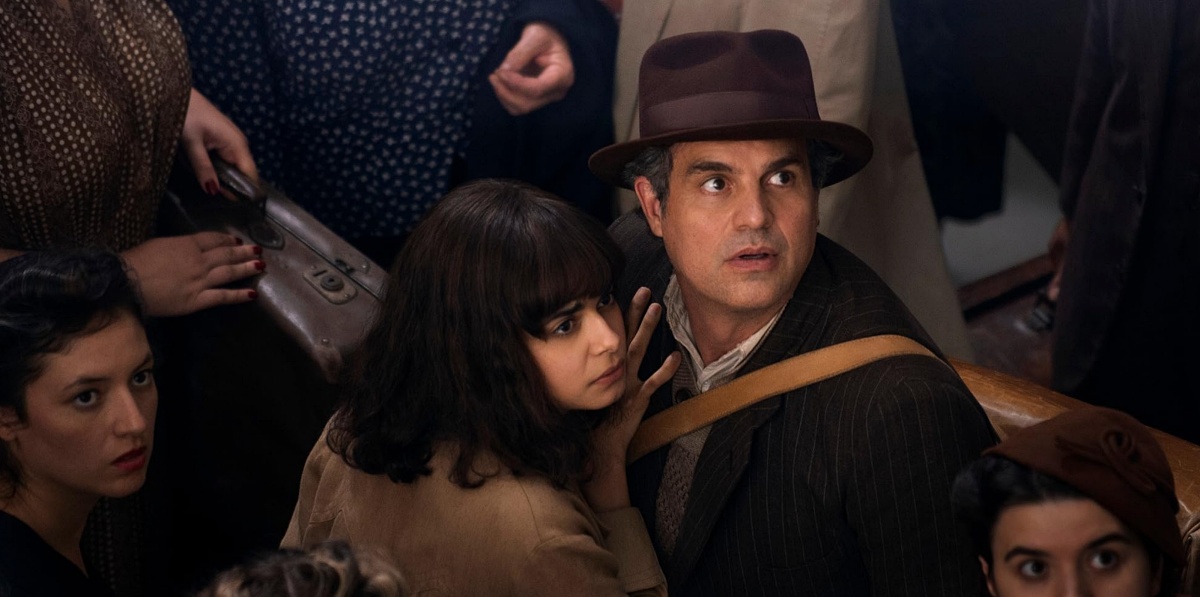

This Netflix series is based on the same-titled Anthony Doerr’s 2014 novel, for which he won a Pulitzer Prize.
In the new Netflix four-part series “All the Light We Cannot See” (hereafter “Light”), the father of Marie, one of the two main characters, says to Nazi officer Reinhold von Rumpel, “Death will come for you. But if you love someone...love is what outlasts it. Which is why my daughter lives in light, not darkness.” Rumpel then poses the question, “Is pain stronger than love?” But he later confesses to Marie, that at least in the case of her father, pain was not stronger because he tortured her dad “for three hours and still he told me nothing. He wouldn't give me an address. He wouldn't give you up.” Rumpel then tells Marie that he killed her dad. (But is he telling the truth?) Marie then mumbles to herself words that touch on the mystery of death, “Papa, you are not gone...until I am gone.”
All these words come in Episode 4. Before then, the series focuses more on light and darkness. But words of death, love, and light, all remind me of the ending of Tolstoy’s novella The Death of Ivan Ilych. As I wrote elsewhere, “On his deathbed Ivan finally gives himself over to love, to demonstrating it to his wife and son. Immediately after doing so his fear of death passed away. ‘Where is it? What death?’ There was no fear because there was no death. In place of death there was light.”
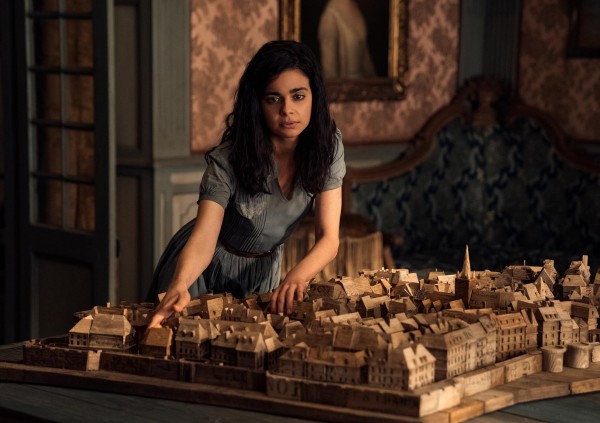 Aria Maria Loberti
In Episode 1 we see the French teenager Marie secretly broadcasting from the French, but Nazi-occupied, English-Channel town of Saint-Malo. She does this on shortwave frequency 13:10. Mainly she reads (using Braille because she in blind) Jules Verne’s Twenty Thousand Leagues under the Sea. But her broadcasts also include coded messages to the Allies, and she occasionally adds personal words, including to or about her father and uncle. The following quote from the first episode are some of those words.
Before I begin my broadcast today, I have something to say. Something from my own heart. Many years ago, a great professor used to offer words of wisdom to children on this very [radio] frequency. He spoke to children all across Europe. And when he spoke, he always played a particular piece of music. [Debussy’s “Clair de lune,” the third movement of Suite bergamasque]. . . . In this time of stupid darkness, in this time of ridiculous old men invading cities, stealing whole towns like bullying children stealing toys, I thought I would try to remember some of the things the professor said, and share them. Because he spoke always about light...He said the light that comes when you burn coal. . . . is actually sunlight. The point is . . . light lasts forever. For a billion years inside a piece of coal. But darkness, the professor said . . . Darkness lasts not even for one second when you turn on the light. [Quotes from the film can be accessed from the scripts for each episode. Episode 1 here.]
In that same occupied French town is Werner, a teenaged German corporeal (the second main character), a specialist in radio transmissions, who is supposed to ferret out anyone making illegal transmissions—like Marie is—which are punishable by death. But like Marie, he is a fan of the professor. At one point he relates, “I used to listen to a French radio station...There was this voice I listened to since I was a boy. He was a professor. I learned French. And I learned lots of true things about the world.” Later on, speaking of the same station, he says, “When I was a child, shortwave 13.10 was my only hope. Shortwave 13.10...was my escape. My refuge.”
This Netflix series is based on the same-titled Anthony Doerr’s 2014 novel, for which he won a Pulitzer Prize. There has been much written about the differences between the novel and Netflix series, but here only one thing will be mentioned about the variation. Director Shawn Levy related that he wanted to end the series with a “promise of hope,” so he eliminated some darker scenes found late in the novel.
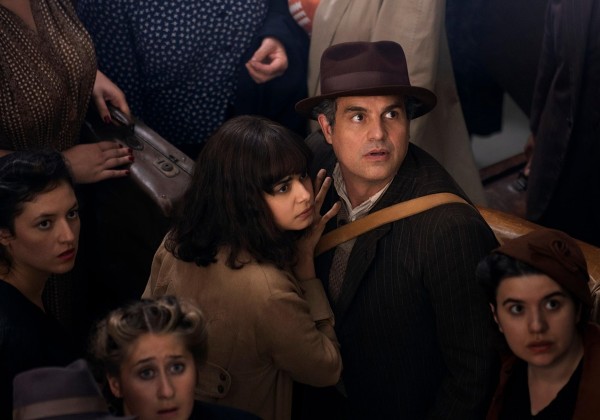 Aria Maria Loberti and Mark Ruffalo
This reviewer found the acting, series adaption, and plotting of the Netflix production more than satisfactory, with the two leads being especially good. Newcomer U. S. actress Aria Maria Loberti, who herself is legally blind, played Marie; and German actor Louis Hofmann played Werner. Although both actors are at least a decade older than the roles they played, they were believable as idealistic teenagers. Two more well-known actors also had leading roles and were credible: Mark Ruffalo as Marie’s father, and Hugh Laurie as his uncle. Adding to the creators of the series was the British Steven Knight, who mainly adapted the novel and wrote the script. Previously he had written the episodes of the highly-rated six-season “Peaky Blinders.”
Most of the “Light” episodes—each of them are about one hour—end in a dramatic, cliff-hanging fashion. And the chief “bad guy,” German officer Major Reinhold von Rumpel (German actor Lars Eidinger), on three occasions threatens to shoot or harm someone if he does not receive a satisfactory answer after he counts to ten, which he slowly does. But such melodramatic devices are about par for a TV series and are not major flaws.
I have always been a big believer in hope. In graduate school in the 1960s I appreciated the French existentialist Gabriel Marcel’s (and heard him give a lecture at Georgetown U). I remember a by Rev. Jesse Jackson when he ended by saying, “Keep hope alive. Keep hope alive! Keep hope alive! On tomorrow night and beyond, keep hope alive!” I liked Barack Obama’s when it appeared in 2006. And in 2022, after the death of my wife, Nancy, I ended an this way, “And, of course, while I’m hoping, I might as well also hope that when I die her smiling face will be there to greet me.”
I have always been a big believer in hope. In graduate school in the 1960s I appreciated the French existentialist Gabriel Marcel’s Homo Viator: Introduction to a Metaphysic of Hope (and heard him give a lecture at Georgetown U). I remember a 1988 speech by Rev. Jesse Jackson when he ended by saying, “Keep hope alive. Keep hope alive! Keep hope alive! On tomorrow night and beyond, keep hope alive!” I liked Barack Obama’s The Audacity of Hope when it appeared in 2006. And in 2022, after the death of my wife, Nancy, I ended an essay this way, “And, of course, while I’m hoping, I might as well also hope that when I die her smiling face will be there to greet me.”
And now as 2023 creeps toward its ending, we again need hope. Hope at a time when the Israeli-Palestinian and Ukrainian wars are killing many thousands; hope when according to a recent poll Trump (despite four criminal indictments against him) now leads Biden in 5 of 6 battleground states (for the 2024 election); and hope after a mass killing in Maine with a weapon no civilian should have. Hope we need if we are not to become too discouraged. Hope we need in order to persevere, in order to work, work, work so, as Martin Luther King Jr. (MLK) liked to say, “the arc of the moral universe” can bend “toward justice.”
Almost a decade ago, I wrote an essay in which I indicated that in his middle-age, the famous writer Leo Tolstoy contemplated suicide. I then asked, “If such thoughts can come to someone like Tolstoy with all his talents, wealth, health, fame, and devoted family, what hope is there for us less fortunate humans?”
My answer was that for religious believers, their religion presented some hope. For non-believers, however, “perhaps some sort of transcendence is the answer”; and for me personally there were primarily three sources, “nature, the arts [including music], and love,” and they all involved beauty.
Dostoevsky once had one of his characters say, “The world will be saved by beauty.”
It was a quote that the great carer-for-the-poor and lover of beauty Dorothy Day loved to repeat. She was also a great lover of classical music. And in “Light” it is one particular piece of such music—as indicated above, Debussy’s “Clair de lune”—that Marie says that “when he [the beloved “radio professor”] spoke, he always played.” And near the end of the last episode Werner, still in Saint-Malo, plays it on a radio broadcast and says to his sister (in Germany), “I don't know if you're listening. . . . but if you are, then know that I am alive.”
Besides the beauty of “Clair de lune,” the series also displays love. The mutual love of Marie and her father and grand uncle is touching. The father’s words that “if you love someone,” love outlasts death are meaningful, as is his undergoing of three hours torture rather than reveal Marie’s whereabouts. Also moving is the affection displayed for each other by the two main characters, the teenaged Marie and Werner, even though they do not meet face to face until the last episode, when they slow dance together and kiss.
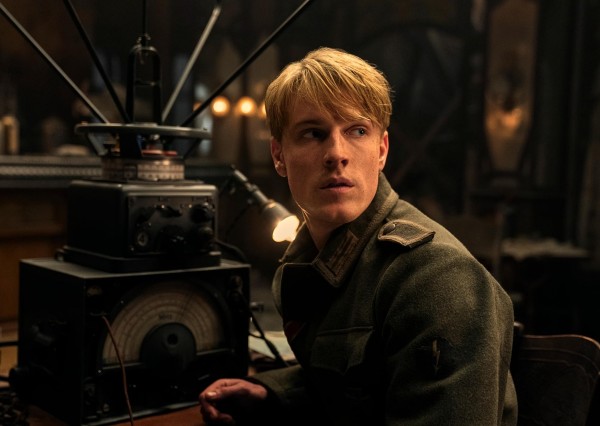 Louis Hofmann
Regarding nature, the beauty of Saint-Malo, with its coastal setting is evident, but it is wartime and the incessant Allied bombing mars that beauty. Mars it, but makes us think, as does the title of the book and series.
What are the words “All the Light We Cannot See” supposed to convey? Uncle Etienne repeats the phrase, as do the two main characters, Marie and Werner. One of the explanations author Doerr gives is that “there are countless invisible stories still buried within the Second World War—that stories of ordinary children, for example, are a kind of light we do not typically see.” These words remind me of those in another novel, Ian McEwan’s Black Dogs (1993), where his main character’s reaction to World War II in Europe is as follows:
He was struck by the recently concluded war not as a historical, geopolitical fact but as a multiplicity, a near-infinity of private sorrows, as a boundless grief minutely subdivided without diminishment among individuals who covered the continent like dust. . . . For the first time he sensed the scale of the catastrophe in terms of feeling; all those unique and solitary deaths, all that consequent sorrow, unique and solitary too, which had no place in conferences, headlines, history, and which had quietly retired to houses, kitchens, unshared beds, and anguished memories.
The title of the series, however, also leads me down another mental path—thinking of all the truths “we cannot see,” and the consequent need for humility. Several months ago on the LA Progressive site, I ended an essay with these words, “How refreshing it would be in this polarized Internet world of ours if we could all see [that]...we often don’t understand most of the complexities of this universe where we temporarily reside.”
The older I get, the more I realize how limited we all are about truths. As the Bible says, “We see through a glass darkly.” And as the Czech writer Milan Kundera once reminded us, we should learn to embrace that “strange pleasure that comes of the certainty that there is no certainty.”
Take war for example. When or if is it ever justified? Do I agree with pacifists like Gandhi, MLK, and Dorothy Day—she even opposed our entry into WWII—or do I think that some wars (like our battle against the Nazis and Japan) are justified? McEwan writes of WWII as a “multiplicity, a near-infinity of private sorrows,” but “Light” displays some of the many Nazi evils that the Allies fought against. It also, however, depicts the incessant Allied bombing of Saint-Malo, and we think of other cities where bombing killed innumerable enemy individuals, including women and children—e. g., Hiroshima, Dresden, and Tokyo during WWII, and various Ukrainian cities and Gaza City in 2022 and/or 2023. And yet, at the end of Episode 4 of “Light” when we see residents of Saint-Malo cheer wildly for entering U. S. troops, we feel “Yes, maybe we were right to enter the war.”
Yet, despite some uncertainty on if and when violence is justified—and if so how much—we feel simpatico to the sentiments expressed in Thomas Hardy’s poem “The Man He Killed.” There Hardy muses: “Yes; quaint and curious war is! / You shoot a fellow down / You'd treat if met [in civilian life] where any bar is.” Part of the beauty of “All the Light We Cannot See” is that amidst WWII a French teenager and a German teenager are able to ignore all the hate and propaganda of war. And near the end of the last episode Werner is able to say to Marie, “And when the war is over, if you want me to come, I will come.”
