

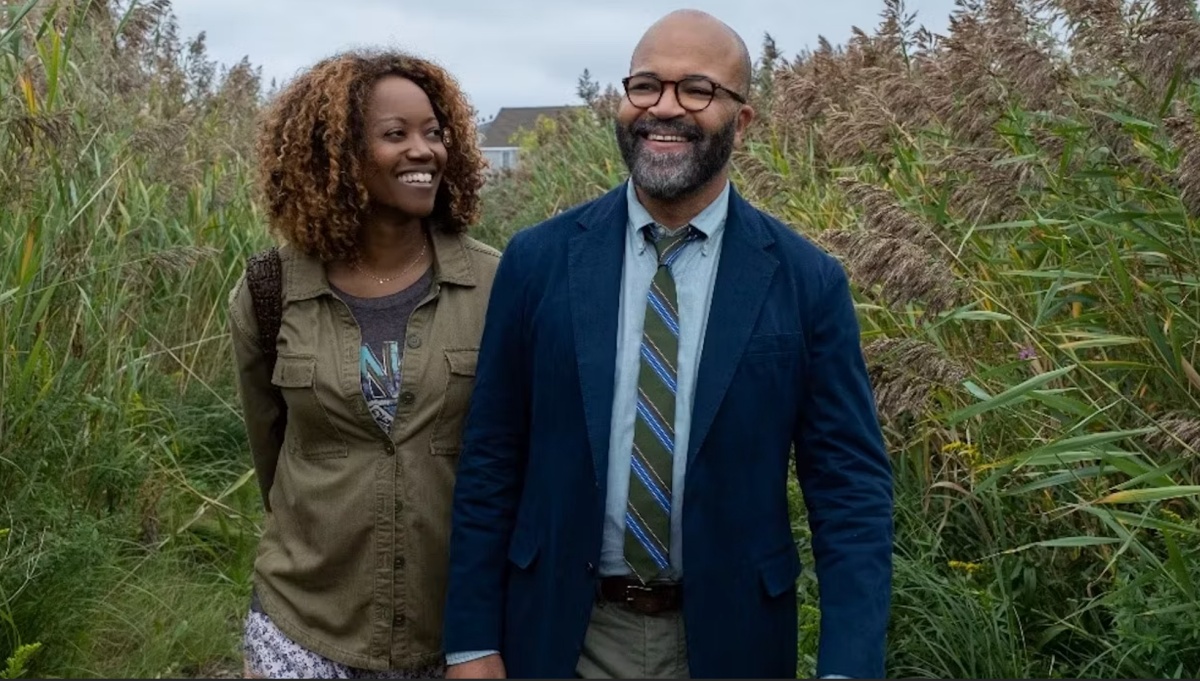

So how does “American Fiction” address race and racism? Primarily through Monk, who usually modernizes ancient Greek plays in his novels, which go mainly unread.
American Fiction (2023), along with the novel Erasure (2001) from which it is broadly adapted, have been reviewed on this site before—by Gary Karasik. So the present review will attempt not to repeat much of what he has written of the film, but instead present my own personal slant on it. And readers can still profit from reading Karasik’s review of it, as well as his insights regarding Erasure.
We often like films that seem to resonate with us personally, and in “American Fiction” many of the experiences that author and professor Thelonious Ellison (Jeffrey Wright) has I’ve also had happen to me. For example, being an author and professor; having a mother who suffered from dementia, ended up in a care facility, and mistook me for my brother when I visited her once; having a member of my family die and disposing of her ashes so that they ended up in the Atlantic Ocean; and witnessing a wedding on the shores of that same ocean. Monk (as Thelonious is usually called) even hears himself compared to a three-legged dog, and I have such a pet. But—and it’s a big “but”—I am not Black. And “American Fiction” is primarily about race and U. S. racism.
Early in the movie, Monk tells his books’ agent, Arthur (John Ortiz), “Do you know that I don't even really believe in race?” But Arthur responds, “Yeah. The problem is that everyone else does.” (Film quotes are from the filmscript.) But both men are partly correct.
The American Anthropological Association website has declared that “race is not a scientifically valid biological category,” and also that the concept of race “became a strategy for dividing, ranking, and controlling colonized people used by colonial powers everywhere.”
Yet Arthur’s response, “everyone else does” believe that races exist, also is close to the truth. Maybe not everyone, but certainly most people. And about racism there is no doubt. Our entire U. S. history testifies to it.
So how does “American Fiction” address race and racism? Primarily through Monk, who usually modernizes ancient Greek plays in his novels, which go mainly unread. But now he writes a novel, spoofing “Black literature.” It’s called “My Pafology.” He thinks that’s the type of Black literature that appeals to Whites. And instead of having it appear under his own name, he uses a pseudonym, Stagg R. Leigh—which is close to the name of that old folk song villian “Stagolee,” a St. Louis African-American pimp who killed a man in 1895.
Monk often makes clear to others, starting with agent Arthur, what his real intention is in writing his spoofing novel. Take this scene where he is talking on the phone to Arthur, who reads from the novel: "I be standin' outside in the night. A police chopper go by and shine some lights in some backyards and I think, shine that light on me mufucka. Shine me some fuckin' light so I can see where the fuck I be at." When Arthur objects that he “ can’t send this out,” Monk responds, “You said you wanted black stuff. What’s blacker than that? It's got deadbeat dads, rappers, crack—and he's killed by the cops in the end. I mean, that’s black, right?”And he then asks, “How’s that book so different from some of the other garbage they put there?” Later on he tells Arthur that his novel “is trash.”
Throughout most of the movie, Monk continues to rant against such “garbage”—and to being pigeonholed as an African-American writer. At one point, he tells a bookstore clerk that his “books have nothing to do with African-American studies. They’re just literature.”
Regarding “pigeonholing,” as Shakespeare had Hamlet say, “ay, there's the rub.” That’s what really sets Monk off. And he’s right to take offense at being so constantly thought of, of being regarded as only another Black writer.
In his Identity and Violence the Indian-born economist Amartya Sen is correct in noting that all humans have multiple identities and share common numerous human qualities. (He is also right in observing that much modern violence is encouraged by rigidly classifying people according to a single classification, such as race, ethnicity, nationality, or religion—for example, think of hate crimes and all the ethnic violence.) As so many of us do, he also quotes Shakespeare, only this time Shylock’s lines from “The Merchant of Venice” (Act III, Scene 1): “Hath not a Jew eyes? hath not a Jew hands, organs, dimensions, senses, affections, passions? fed with the same food, hurt with the same weapons, subject to the same diseases, healed by the same means, warmed and cooled by the same winter and summer, as a Christian is?”
Similarly about Monk we can ask, “Has not a Black man a family to deal with? Has he not disease, death, infidelity, and divorce among his family members to encounter? Has he not professional problems he must face? Has he not romance issues that he must sort out?” And the answer to each of these queries is “yes,” Monk must deal with all of these concerns.
The movie satirizes both White publishers, critics, and readers who fall too easily for clichés and hackneyed thinking, and Black writers like the film’s Sintara Golden (Issa Rae) who pander to such a trite approach. (Monk says about her best-selling novel, “Books like this reduce us, and they do it over and over again, because too many white people—and people, apparently, like you [his girlfriend Coraline]—devour this slop like pigs at a dumpster to stay current at fucking cocktail parties or whatever.”)
But who among us is an original, imaginative thinker? Aren’t most of us parroting, or at least reflecting, the common ideas that circulate among us? Or at least among the group or groups, including the media, we choose to follow? Are U. S. advertisers really wasting their money or are their ads invading our brains and helping determine our behavior?
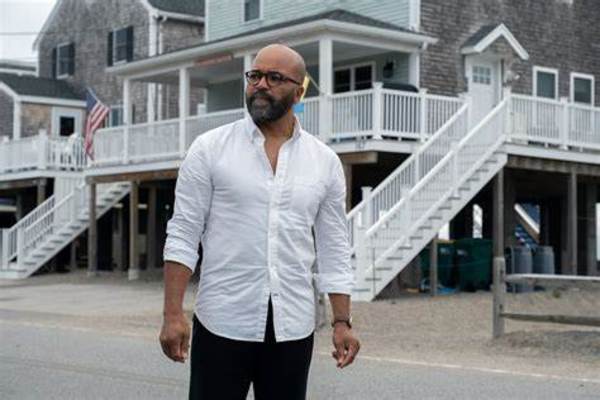
And it’s not like Monk has all the answers. He’s right about our failure to regard other human beings as unique individuals, to look beyond the color of another’s skin and see someone else in all his or her mysterious complexity. His brother Cliff, himself complex in being Black, gay, a dermatologist, and much more, comes close to identifying a central failure of Monk.
They are conversing and Monk tells Cliff that he irritated Coraline. “Did you shut her out?” Cliff asks. Monk admits that he did, and Cliff says that their dad did the same thing, and “he never knew the entirety of me,” never knew that Cliff was gay. Cliff believes that people should get to know and accept full human beings in all their complexity, and he tells Monk that “people want to love you. . . . You should let them love all of you.”
Monk’s central failure is that he is too wrapped up in his own private world. Thus, he represses part of himself. He fails to lovingly reach out to others. The family’s housekeeper, Lorraine, who tenderly cares for Monk’s mom, Agnes, until she is put into a care facility, more truly demonstrates such love. On the day she is to be joined in marriage in a ceremony along the ocean, she discovers Cliff at the family’s beachside home. He indicates that he forgot about the wedding and that he’ll vacate the home, not wishing to impose. Lorraine replies, “You can’t impose. You’re family.” And she hugs Cliff.
So as not to need any spoiler alerts, I’ll not reveal much about the film ending except to say that a movie director offers $4 million for the rights to adapt Monk’s spoofing novel, and at first he’s not pleased with a few endings that Monk suggests. But finally Monk comes up with one he likes and he says, “It’s perfect. Yes! That is perfect.”
The director is about as clueless as the White publishers and critics satirized in the film. But the ending he considers “perfect” is in keeping with his cluelessness and seems an appropriate ending to a film that demonstrates that as a society we still have a long way to go before reaching racial harmony. Or indeed, social harmony in general.
Overall, American Fiction is an excellent film and has won many awards including the 2023 People's Choice Award at the Toronto International Film Festival. I especially enjoyed the acting, particularly that of Jeffery Wright (also excellent earlier in 2023 in Asteroid City); Leslie Uggams (a leading actress and singer since she won a Tony in 1968 for Best Actress in a Musical) as his mom, Agnes; and the frequent award-winning Sterling K. Brown as his gay brother Cliff.
