

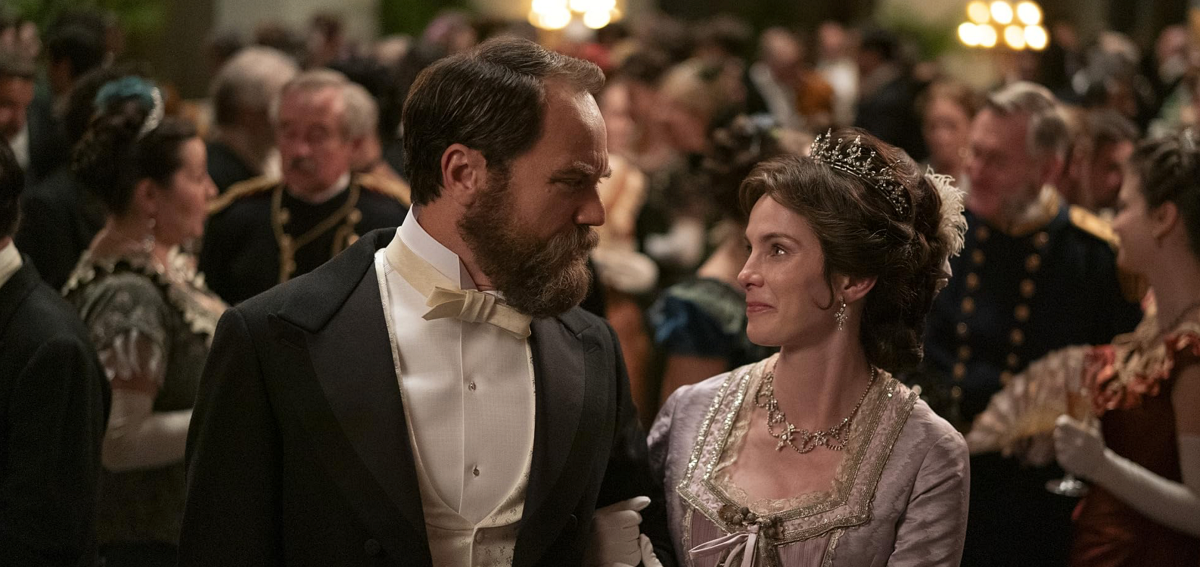

During the time he was being considered and selected as the Republican presidential candidate in 1880 (on the 36th ballot), he tried to have his name removed from consideration.
Netflix’s new four-part series “Death by Lightning” is about the assassination in 1881 of U.S. President James Garfield (Michael Shannon). Although one 2021 position ranking by presidential historians has him only 27th (out of 44), that low to middling position is partly due to his short presidential stint—less than a half-year before he was shot—and there are recent indications that he has been underrated. One of these signals is Candice Millard’s “Destiny of the Republic (2012), on which the Netflix series is based.
One article on Millard’s book points out:
- During the Civil War, Garfield became the Union’s youngest general:
- he was elected to the U. S. House of Representatives at age 31 and served 17 years before being elected to the presidency;
- “he was filled with an unstoppable curiosity about the world around him”;
- “he fought for the creation of the federal Department of Education as one of the reforms necessary for a maturing country”;
- “he was the only member of the Military Affairs Committee who supported equal pay for White and Black soldiers.” He supported “Reconstruction, fighting back as Southern Democrats and the Klan unwound the short-lived progress of Black politicians in the South.” Despite his deeply-held beliefs, he was “a sensible pragmatist...more interested in dealmaking than enemy-making.”
As an indication of his support for Blacks, he was backed by the most famous Black of his day, Frederick Douglass, who campaigned for him during the 1880 presidential election and whom Garfield appointed as the Recorder of Deeds for the District of Columbia.
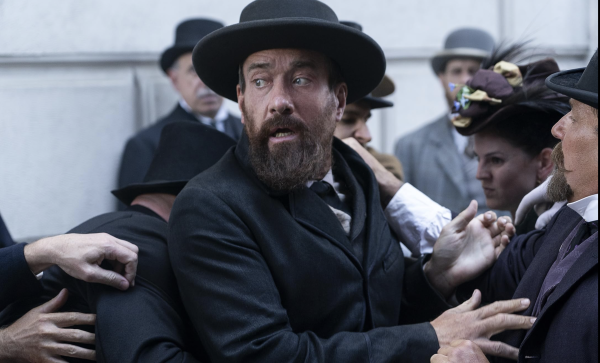 Matthew Macfadeyen
A review of this excellent series in the Los Angeles Times points out another characteristic of Garfield—his humility—writing “he was self-effacing and humble and not out for personal gain.” Right before this quoted phrase are the following words, “unlike some politicians one might name.” The series indicates that during the time he was being considered and selected as the Republican presidential candidate in 1880 (on the 36th ballot), he tried to have his name removed from consideration.
Moreover, in an interview, Shannon indicated that he preferred Garfield to Trump. The actor said that taking the role of Garfield seemed a “way to use artistic expression to say a bunch of stuff that I’d like to say anyway: that the President is a public servant, not a king.” And he added that “I don’t think the person currently doing it [being president] is qualified. Garfield was qualified. If you could somehow reanimate James Garfield...that’s who I would want to be president.”
Shannon also spoke of the relevance of the way Garfield died—“the blindness of the medical establishment back then, their refusal to actually believe that germs existed”—and the present “tailspin that the medical industry is being thrown into by the current health secretary, who’s saying all kinds of insane garbage.” Finally, Shannon reveals his own noble thoughts when he says, “There’s no situation that can’t be helped with a little more compassion and empathy.”
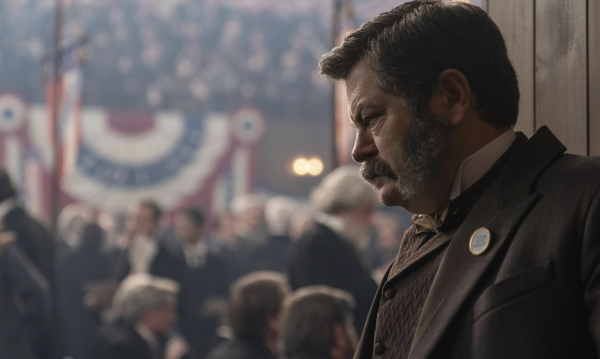 Nick Offerman
In fact, in many other ways the two presidents divided by almost a century and a half are also opposites, as much so as Frederick Douglass and Trump are different. Garfield was earlier a general, Trump avoided military service; the former with 17 years in Congress and Trump with no political position before assuming the presidency; Garfield being one of our youngest presidents (age 49) when he was sworn in versus Trump the oldest, both when sworn in 2017 and again in 2025; Garfield a “pragmatist....more interested in dealmaking than enemy-making,” Trump not averse to making enemies; also, as Garfield’s wife said in the series, “my husband is a famously poor hater,” as opposed to Trump, who in mid 2025 commented about Congressional Democrats: “I hate them, too. You know that? I really do, I hate them. I cannot stand them”; and finally, Garfield an opponent of white racism, while Trump is often accused of abetting it. (All film quotes are taken from the four-part series script.)
A few years ago my "Conflicting Values Key to Political Differences" was posted on LA Progressive. In that piece I quoted Barack Obama, who wrote that empathy “is at the heart of my moral code, and it is how I understand the Golden Rule—not simply as a call to sympathy or charity, but as something more demanding, a call to stand in somebody else's shoes and see through their eyes.” I also wrote that “Love, kindness toward others, should be at the top of our hierarchy of values. And developing and living by such a hierarchy should be central to our existence.” Values don’t necessarily come from religion, but they often do. And Garfield was a religious man—he had earlier been a preacher in the Disciples of Christ, a Protestant denomination.
In contrast, as former Clinton Secretary of Labor Robert Reich has written, Trump’s DOGE “has already destroyed almost every empathetic part of the U.S. government.” Regarding the present Trump administration he adds, “It’s the opposite of empathy—treating people as if they aren’t human, as if they’re the ‘other.’”
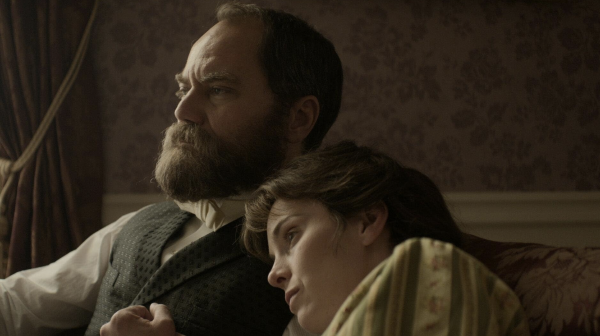 Michael Shannon and Betty Gilpin
In many ways, Garfield was also the opposite of the man, Charlie Guiteau (TV’s “Succession” Matthew MacFadyen), who shot him. If the former was “self-effacing and humble,” Guiteau was self-centered and strove for glory. For about a half decade he was a member of the Oneida Community, which had unusual ideas regarding marriage. Later, in 1880—and more pertinent to his character—he tells a judicial panel, “Here and only here, a man can be anyone. He can amass a fortune. He can influence millions...his name ringing down through the ages...Hell...under the right conditions, he might even be made president.” His “American Dream” was to “make it,” to become successful. That seemed to be his most important value. Near the beginning of Episode 3, he tells a group, “Mark my words. My name will be known one day all across this country.”
Although supporting Garfield once he became the Republican nominee, after repeated attempts to receive an appointment from him are rebuffed, at the end of Episode 3 Guiteau sits down and writes a letter to the president.
Mr. President, I write you tonight as a citizen, deeply troubled.
As you are well aware, I’m a day one stalwart of yours.
And I have been trying to be your friend.
But I do not think that you appreciate it.
You’ve chosen to surround yourself with wicked, vindictive men, coldhearted men, who
would sooner spit on those under them than offer any sort of leg up.
Was this your great vision?
More of the same?
At the expense of those poor, hardworking souls who trusted you with their vote?
Has it been so long that you do not know that you were once one of them?
You were supposed to be the one who finally changed things.
A president for the people.
I shouted your name in the streets for months until my voice ran hoarse.
I fought for you, desperately.
But you lied to us.
All you’ve done is reinforce the gates.
And what is more, the blame lies in part with me.
I helped sell you.
[cheering]
The worst mistake I ever made in my life was believing in you.
It’s as you said in your speech.
“We stand now at a critical precipice.”
And I know history will remember us for what we do in this moment.
And I see now that God has granted me a special purpose all along.
A destiny waiting to be fulfilled.
Our nation cries out for help.
If its president refuses to heed the call, if he will not fix us, then perhaps…
Perhaps it’s the president himself who needs fixing most.
At the end of Episode 3, Guiteau goes out and buys a pistol.
At the beginning of Episode 4 Garfield tells a group of Congressman and others that he made “a vow to end the rot in our government. Spoils, patronage, call it what you want. It’s no good. Do-nothings siphoning taxpayer money for jobs that don’t even exist! Elected officials brazenly peddling their influence at auction. This is not how democracy endures. This is wrong.” A chief opponent of Garfield’s—and patron of the “spoils system”—was Senator Roscoe Conkling of New York, who the series shows frequently opposing Garfield.
Much of Episode 4 is concerned with Guiteau’s shooting of Garfield; the inept medical care the president received, which lasted several months before he died; and (in 1882) Guiteau’s hanging. When the series ends, we’re left with wondering about the strange phenomenon of assassinations—Alexander II, Tsar of Russia was also assassinated in 1881. Are the assassins mentally deranged or do they just have poor values? The answer in many cases is probably both, but add credence to the words of U.S. neuropsychologist and Nobel laureate Roger Sperry—“Human value priorities...stand out as the most strategically powerful causal control now shaping world events.”
