


I knew that by having them on his show, Sullivan helped introduce U.S. audiences to Elvis Presley and The Beatles, but I had no idea that he was such a civil rights pioneer.
As Otis Williams, founder and lead singer of The Temptations. states in the documentary “Sunday Best: The Untold Story of Ed Sullivan” (Netflix, 2025), Sullivan “was a door opener, especially for Black artists. This man opened up his door and let artists come on his show.” (Quotes from the documentary are taken from the show’s script.) Or as Berry Gordy, founder of the Motown record label, said “For Motown, The Ed Sullivan Show, to us, was the ultimate.”
As a teen-ager in the 1950s, I remember sometimes watching “The Ed Sullivan Show” on Sunday nights—it ran for 24 seasons, from 1948 to 1971, and in its early years (up to 1955) was called “Toast of the Town.” I knew that by having them on his show, Sullivan helped introduce U.S. audiences to Elvis Presley and The Beatles, but I had no idea that he was such a civil rights pioneer.
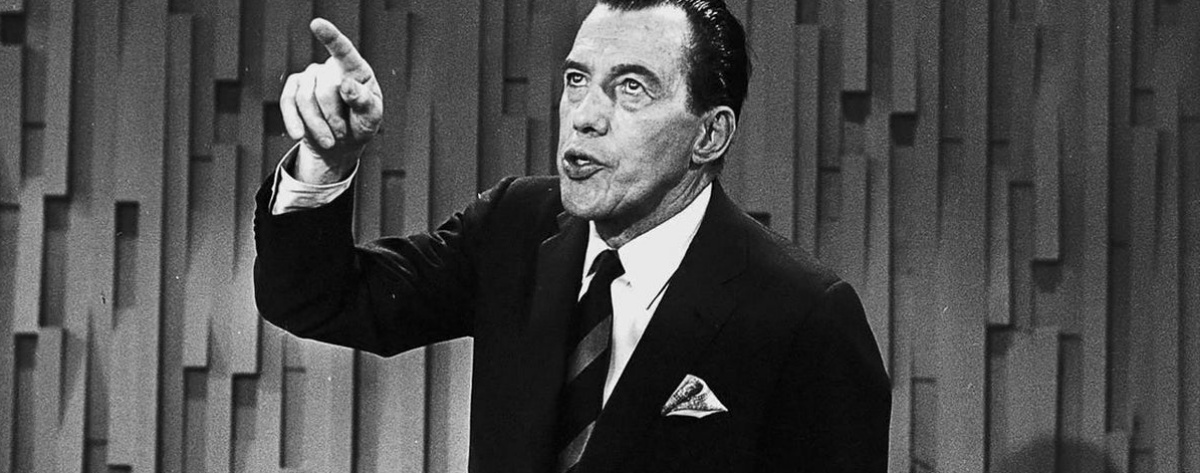
Looking stone-faced and stoical, he just always had a conservative look about him, but “Sunday Best” indicated just the opposite. Born in Harlem in 1901 of Irish ancestry, he recalled that the Irish “were all supposedly lazy, ignorant drunkards”—according to the prejudice against them—but his parents were “sensible” and knew that such talk was nonsense. He also played sports in high school, and some opposing teams included Blacks, and he realized even as a teenager that biased thinking was often based on misconceptions.
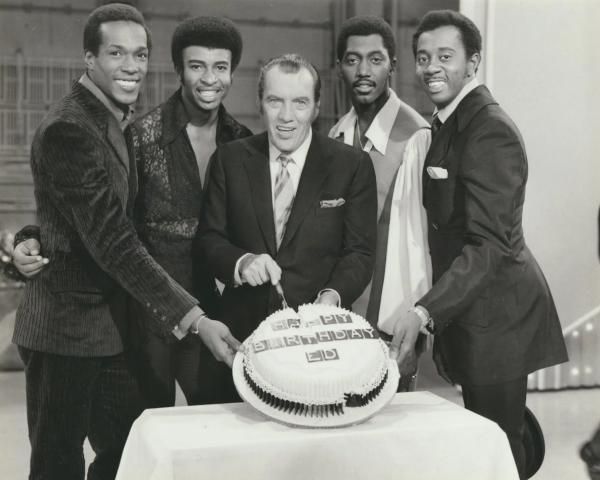 Ed Sullivan, center, with members of the Temptations including, from left, Eddie Kendricks, Dennis Edwards, Otis Williams and Melvin Franklin.
During the 1950s, with segregation still widespread throughout the South and few Blacks allowed to vote in some states like Mississippi, Sullivan frequently hosted Black entertainers on his show, despite sponsor (Lincoln/Mercury) fears that Southerners would not watch them. In 1952, it was Gospel singer Mahalia Jackson who made her first of numerous appearances on the show—it was her first national TV appearance. He also was the first to host Ike and Tina Turner, Stevie Wonder, Bo Jangles, Harry Belafonte, Diahann Carroll, Aretha Franklin, The Supremes, The Temptations, and The Jackson Five. After a Birmingham, Alabama attack on Nat King Cole in 1956 by Ku Klux Klan members, Sullivan had him on his program.
At various points in the documentary, Sullivan’s words are quoted. For example, “Bigotry and intolerance, racial or religious hate and discrimination, are spiritual acts of treason.” “Today we've been called upon to search our hearts and souls and cleanse them of unnatural hate and fear of our neighbors.” “We call upon all of you to join
in this great crusade for our brotherhood. Brotherhood means a united America, and a united America is perhaps the sole remaining hope for our shattered world.” After JFK was elected in 1960 Sullivan said, “I'm delighted that Jack Kennedy won.”
Now, when we sometimes get the feeling that many of our fellow citizens would like to go back to the 1950s and a time of white male supremacy, it is good to be reminded that the progress we made since then owed not only much to Black heroes like Martin Luther King Jr., but also to more background anti-racist individuals who were just decent human beings. People like Ed Sullivan.
Or as Harry Belafonte said on the documentary: “It is one thing to look at the transformation of the United States of America through the prism of what Dr. King brought to the table, the big Black rebellion, the Civil Rights Movement. But that movement would never have been able to sustain itself with the intensity that it did if there were not subtle forces at play. That subtle force was a moment like Ed Sullivan.”
