



By repeatedly displaying devises that help people survive in the scorching heat, viewers can feel how dire increased heat can be.
We are not doing enough to slow down climate change. Facing a continuing and growing emergency, media needs to help jolt us into acting. TV and films, like First Reformed, can help spark us.
Recently realizing that Apple TV + was now streaming an eight-part series, “Extrapolations,” which dealt with climate change, my hopes were high that it might provide just such a jolt. Especially since many well-known actors (at least to me) were to appear in the eight episodes—Meryl Streep, Kit Harington, Sienna Miller, Edward Norton, Matthew Rhys, David Schwimmer, Marion Cotillard, Diane Lane, Cherry Jones, Keri Russell, Judd Hirsch, Forest Whitaker, Tobey Maguire, Daveed Diggs, Leslie Uggams, and Michael Gandolfini (son of James, who played Tony Soprano).
Rather than summarize each of the eight episodes, running between 45 and 58 minutes, the remainder of this essay will mention the main concepts dealt with in the series, and then address the question asked in the title.
 Marion Cotillard
The first issue, which episodes 1 and 8 depict, is that meaningful actions to slow down climate change are likely to be impeded by those more interested in profiteering from it. In Episode 1, "2037: A Raven Story," a hologram begins by stating that in 2015 “scientists [in the Paris Agreement] told us...that if the average temperature on Earth increased beyond 1.5 degrees Celsius [compared to pre-industrial levels], there would be devastating consequences. And they were right...Yet here we are in 2037 considering the possibility of an increase of 2 degrees...What happens when the corporations that are destroying our world say that our economies will fail if we don't allow the temperatures to rise by 2.1 or 2.2 degrees?”
In this episode two characters especially epitomize the profit-seeking that threatens the planet. They are seen together dining in a St. Petersburg restaurant, real estate developer Junior (Matthew Rhys) and Nick Bilton (Kit Harington), CEO of the multi-faceted corporation Alpha.
Listen to Junior talking about protesters he views through a restaurant window: “Can you believe these people? Hard to imagine they can march with their heads up their asses. They say ice sheet in Greenland is gonna break down the middle. . . . Great, we'll build there next. They say three-meter sea level rise by the end of the century....They also said the same thing about Miami. All we did was make a fortune retrofitting the buildings. And guess what? When it goes up another couple of inches, we'll retro-fucking-fit again and make even more money. Here's what you need to know about global warmings. It will all go to shit at the end of the century. One hundred percent. We'll be dead. We'll have to miss it, but we'll be smiling in gold-plated coffins.” (All episode quotes are taken from the series transcripts.)
His companion, Bilton, is less obviously an impeder, but a more important one because of his great powers as CEO of Alpha. Most of Episode 8, "2070: Ecocide," revolves around his trial before the International Criminal Court at The Hague on the charge of ecocide. And he or his his corporation also figure prominently in most other episodes.
Here is part of his own defense for profiteering (in Episode 8): “The prosecutor here, would have you believe that I have gamed the system, profiteered from your circumstances. That I am some Satan forcing you to live lives you would never have chosen. To seek comforts you didn't actually want or....Or suppress information that you truly needed. But Nick Bilton did not create your God-given appetites. He merely noticed them and turned them into businesses. The rules I have played by are the rules set by your leaders. The ones you elected. The ones sworn to protect you. They did not. Instead, they traded away your children's future for just one more term, one more donation. And now, those leaders are not the ones on trial. I am. So allow me to point out the obvious. If I am guilty here today, then I am only guilty of winning a game started generations ago.” That “game” is unbridled capitalism, whose main aim is profit.
The chief problem with our ongoing human-caused climate change is, of course, that it is warming our planet, which in turn causes (or will cause) all sorts of disasters. This warming is most dramatically depicted in Episode 5, “2059 Part II: Nightbirds,” where the screen tells us at the beginning that the global temperature change (as of 2059) since pre-industrial times has been + 2.2 C.
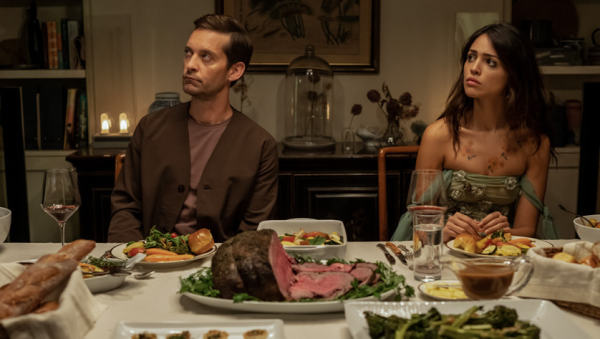 Eiza González and Tobey Maguire
The episode is set mainly in India, where the daytime temperature is often so hot that a curfew is in effect. The main job of two central characters, Gaurav and Neel, is transporting by truck stolen material from Mumbai northeasterly to Varanasi, about 921 miles away. Because of the daytime curfew they usually travel by night.
Their trip reminds me of Kim Stanley Robinson’s The Ministry for the Future: A Novel (2020), which opens with a heat wave that soon killed millions of people in India. As in the novel, so in this episode there is some discussion of wet-bulb temperature, which combines temperature and humidity readings. The woman Gaurav and Neel are working for tells them about a scientist they are to take to Varanasi with them: “Idiot was out collecting data during goddamn daylight when wet-bulb spiked to 35. He should be dead. He went into hyperthermic shock, and he went blind. Although, his eyesight is returning now. The worst part is the delirium. Our man could barely speak for two weeks. And now he's sometimes lucid. Sometimes he's a fսcking disaster.” In the novel we read, “a wet-bulb temperature of 35 will kill humans, even if unclothed and sitting in the shade; the combination of heat and humidity prevents sweating from dissipating heat, and death by hyperthermia soon results.”
By repeatedly displaying oxygen tanks and other devises that help people survive in the scorching heat—and showing the consequences of one boy who failed to take proper precautions—viewers can feel how debilitating, how dire, increased heat can be, how it can cause major changes in how they live and die. The Indian setting also helps us realize that climate change is a global phenomena, often affecting other nations of the earth even more than the USA.
One of the effects of increasing global heat is the faster melting of ice in areas such as the Arctic, Antarctic, and Greenland. This melting in turn will increase sea levels, which will threaten many islands and coastal sea areas from Shanghai to Miami. Such a threat is best shown in Episode 3, “2047: The Fifth Question.”
It is centered in Miami, which "due to the dangers of climate change....is rated by some as the most vulnerable coastal city in America for natural disasters." It deals primarily with Rabbi Marshall Zucker (Daveed Diggs, who won a 2016 Tony Award for his role in the musical Hamilton). He tells his congregants, "Our city is flooded one day out of every four. For many of us, it is a time of exodus. For others, it is a time to stand and fight for our homes. For me, this year, my prayer is simple: that our leaders in Tallahassee will save this building and that next year, we will all be together here in Miami." He also tells them that their "Temple Israel" was built a "hundred years ago....by Holocaust survivors who came to South Florida," and he "hopes that the Department of Sea Level Mitigation will look favorably upon our application for protection."
 Forest Whitaker, Eiza González, Tobey Maguire and Marion Cotillard
One of the persons who the rabbi deals with is 13-year-old Alana Goldblatt (Neska Rose) who in her bat-mitzvah speech was supposed to speak about the Biblical destruction of Sodom and Gomorrah, but soon turned her talk into a rant: "Did you think God was just going to let your behavior slide? No. There is flooding five days a week and houses on stilts because our city now floats on the bodies of the poor. So make no mistake. Category 4 retribution is coming at us at 153 miles an hour, and his name is Stan, the 41st storm of the year."
This Miami episode packs some emotional punch because we often see the climate-change effects—water on the temple floor, the rabbi and a female plumber rushing to the temple to gather up the Torah scrolls before the flooding reaches them, violent storms, etc.
Another major climate-change issue dealt with is the possibility of geoengineering, which is best depicted in Episode 4, "2059: Face of God." Several weeks ago ABC News ran a piece that announced that “geoengineering technologies could help combat the climate crisis.” Among the technologies it highlighted were “cloud seeding, solar geoengineering and carbon capture.”
Such methods of confronting climate change have a special appeal to many of us because we U. S. citizens often pride ourselves on our technological abilities. And such “fixes” fit in better with our capitalistic practices than do scaling-back methods. We would much prefer the former as opposed to abandoning fossil fuels and living simpler lives that would cut back purchasing.
Episode 4 revolves around a secret attempt to cloud seed using planes and drones to disperse calcium carbonate. The mastermind of this plan is Gita Mishra (Indira Varma), an ex-wife of Jonathan Chopin (Edward Norton). From her airplane she tells U. S. President Burdick (Cherry Jones) that “all it takes is two million tons of calcium carbonate dispersed into the atmosphere to begin to cool the planet.”
The president, however, sides with her ex-husband who used to believe in geoengineering but has changed his mind. “We were wrong. We were arrogant....We disrespected one of the most fundamental principles of scientific investigation, which is that an experiment has to be able to be replicated, uh, to get the same results, or based on the data, to change the experiment. Geoengineering doesn't allow for that, okay? You get one shot, and then you . . . you live with the results. That's not science. That's gambling.” He adds, “We've treated this planet like an all-you-can-eat buffet for 250 years since we started burning fossil fuels. And changing the chemical composition of the atmosphere is not going to fix it.” He believes Gita’s dispersal plan could lead to “changes in rainfall patterns that lead to crop failures and floods [and] . . . extreme weather events leading to mass migrations, social unrest, stress on infrastructure.”
President Burdick tells Gita “I will be signing....the Climate Intervention Treaty, and extending the moratorium on geoengineering or any act that seeks to artificially manipulate the climate.”
Still another climate-change issue dealt with in the series is the disappearance of species, the reduction of biodiversity. In his life-affirming A Life on Our Planet (2020), British natural historian David Attenborough writes of our present climate-change crisis and asks how we should deal with it. His answer? “To restore stability to our planet, we must restore its biodiversity. The very thing that we’ve removed. It’s the only way out of this crisis we have created. We must rewild the world.”
 Heather Graham
At the beginning of Episode 2, "2046: Whale Fall," the screen tells us that so far this century, 411,227 species have been lost. (According to the National Geographic website, “Scientists have estimated that there are around 8.7 million species of plants and animals in existence. However, only around 1.2 million species have been identified and described so far, most of which are insects.”)
In this second episode Rebecca (Sienna Miller) is the main character. She is a marine biologist, working for a corporation that advertises itself this way: “Using the latest genomic technology, Menagerie2100 will save what nature cannot. We are committed to gene-capturing the animals and plants you love, and the ones you never think about. We project that by the end of the century, Menagerie2100 will be able to maintain a vast library of all species, preparing for the day when they can be reintroduced to zoos, parks and someday even the w[ild].”
As the episode develops, we see Becca (as she is often referred to) become increasingly disenchanted with Menagerie2100. Her problem is the first one discussed above. Her company is more concerned with profits than the common good—or the welfare of the single remaining whale that Becca is tracking. Her last words to the whale are, “Warn them about us. You see what we can do, what we have already done. Tell them who we are.”
Thus, some of “Extrapolations” series deal with important questions. If I were still teaching—except now climate change classes in addition to my former history classes—I would have students watch portions of a few of the episodes and then discuss with them what they saw.
For example, I might have them view part of Episode 3, set in Miami in 2047. I would ask the students how realistic what the episode was, what is contributing to rising sea levels, what other cities in the world might be affected, and what could be done to help prevent such areas from being inundated.
But critics have not been kind to the series. In the Los Angeles Review of Books, for example, the reviewer begins by writing, “Extrapolations is, like climate change, bad. And like climate change, it’s bad in so many different ways at once that it defies easy summary.”
Thus, the answer is “not much” to my question “Will This TV Series Spark Climate-Change Action?” Very few readers will be moved enough by it to spring into action. The reasons are many. In no particular order, what follows are some of them:
- Most people will not identify with any of the characters.
- The extreme political polarization that characterizes the USA and some other countries will prevent many people from even watching any of the “Extrapolations” episodes.
- Most people do not consider climate change one of their top priorities.
- Many people turn to TV and films primarily for entertainment, and “Extrapolations” is not especially entertaining.
- Apple TV + is a streaming service, of which there are hundreds, and many households are not subscribed to it.
Despite my pessimism about the impact of “Extrapolations,” I still think at least one TV program, series, or film might some day help spark more people to climate-change action. But whatever form it takes, it must pack an emotional wallop, and it must contain a character, or characters, with whom many people can identify. We can only hope that such media appears sooner rather than later.
