




The former deals with making money and dating; the latter with two subjects we’d rather not think about—sickness and dying—matters which to most of us seem inexplicable.
Two 2023 Netflix films that looked interesting to me were Fair Play and Johnny.
According to what I read about them, they both dealt with a subject that I’ve written on before and continue to think is most important—love. But the types of love they deal with differ. The first movie revolves around romantic love, which can be, but is not always, wonderful; but the second one reflects agape, a “love that intentionally desires another’s highest good.” Love is complex—for example, in an essay on love and wisdom I also mentioned “spousal love,” which can include elements of romantic love, but should primarily be concerned with seeking the good of the other.
Fair Play begins with a Donna Summer 1975 song, "Love to Love You Baby." It reflects romantic love: “I love to love you, baby [often repeated] / When you're laying so close to me / There's no place I'd rather you be than with me.”
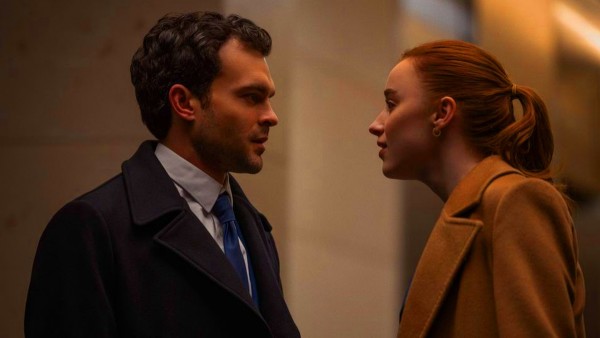 Fair Play
Within Fair Play’s first five minutes, Luke and Emily ( a couple hovering around 30) retreat to a restroom. He props her up on a sink, kneels down, and begins having oral sex with her. After it’s interrupted (never mind why) she discovers a ring on the floor, asks “what the f . . . is that?” (Both of them, and many of the other movie’s characters, often resort to that most infamous four letter word or its common adjectival form.) Luke gets back on his knees, picks up the ring, and asks, “Marry me?” After a few words from her, he rises and sandwiched around a kiss tells her, “I f . . . love you so f . . . much. I mean it. You’re everything to me.” Within another minute, she agrees to marry him, they kiss some more, and tell each other “I love you.” (All quotes are taken from the filmscript, which was adhered to in the movie.)
The main obstacle to their love is that they both work for the same hedge fund, and she gets promoted—becomes his boss—and he does not. They both attempt to handle the new reality in a loving way. He tells her, “I’m so f. . . proud of you.” And she tells him, “I’m gonna help you get the next promotion.” Ultimately, however, their love is not strong enough to surmount the new reality. And the movie ends ironically with another song, this time “There Is Love” by Charles Hodges, containing the lines “And there is love / Like my love for you / Oh forever so true / That no one . . . / On this earth could undo.”
Compared to Johnny—the second film to be considered here, which is a story of love triumphant—Fair Play is one of love defeated. Unlike some reviewers, however, I never became emotionally entangled in Luke and Emily’s “love.” And from the beginning I wondered how deep it was. Strong sexual attraction is not the same as love.
Here was Emily's background: At age 17 she had something published in The Wall Street Journal; she later graduated from Harvard, worked for Citibank and then Goldman Sachs before her present two-year-old position with Crest Capital. As for Luke, at one point he jokes with Emily (by then his fiancee) that if he had to choose between her and a promotion, he’d “sit and think about it, and probably still choose the promotion.” Before this, however, we’re not shown enough true love to become convinced that he isn’t half serious.
In the offices of Crest Capital and on their computers and cell phones, we see little evidence that any of the bosses and staff care about anything but buying and selling stocks so as to gain the most profit. Concern about customers? Concern about employees as individual human beings? Simply not evident.
The above negative comments are not meant to imply that Fair Play lacks positive qualities. The acting is good. Phoebe Dynevor as Emily and Alden Ehrenreich as Luke are convincing characters; and, as usual, the English actor Eddie Marsan is effective and believable as their boss Campbell. Moreover, the film plot engages us, and we move from scene to scene wondering how it will all work out.
Nevertheless, despite at least one four-star review for Fair Play, I much preferred the sub-titled Polish film Johnny. It is based on a true story which focuses on a Catholic priest named Father Jan Kaczkowski—at one point in the film he says you can also call him Johnny. It highlights his relationship with a young ex-con, Patryk Galewski, forced to do 360 hours of community service, which ends up being at the hospice that Fr. Jan founded and operates.
Here’s a quick summation of the plot. Fr. Jan is in his mid-30s and wears thick glasses, which he often touches. One of his heroes is another priest, Jerzy Popieluszko. According to Amazon, a film narrated by Martin Sheen was also made about this priest “whose faith, conviction and courage inspired the people of Poland to stand against the oppressive Communist rule of the 1980s....In 1984 at 35, he was kidnapped and killed by the Polish security police for his beliefs.”
About a quarter century later, Jan sometimes prays to him, for example asking his help in enabling him (Jan) to build and open the hospice he will direct. He also prays to Fr. Popieluszko for help in dealing with Glioblastoma, a brain tumor which shortens Jan’s life expectancy to about six more months.
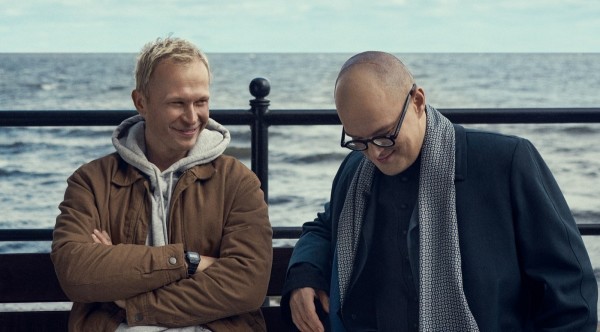 Johnny
Despite this prognosis, in his care for the hospice patients and in his words, we witness Fr. Jan’s agape—his love that primarily seeks the good of the other. At one point he goes on TV at a rock concert wearing a No War tee shirt—the film came out in Poland about 7 months after the Russian invasion of Ukraine. He says that what we should say to the terminally ill is not that it'll be OK, but instead "don't be afraid . . . . I'm not going to leave, because I love you. But in order for you to say that, you have to work on it...your whole life." And he adds, “Our time is the most precious thing we can give to others.”
But it is in his agape for Patryk that Jan’s love is most demonstrated. Shortly after Patryk first comes to him, Jan asks him what he likes to do. Patryk’s response? (As sub-titled) “Drink, f . . . and turn the radio up.” But by the end of the movie, though he has had some setbacks, Patryk emerges as a successful chef, and married with two children, the oldest of which is named Jan. In a major way this success is due to the love of Fr. Jan. But regarding the latter’s fate, I’ll leave it for viewers to find out for themselves.
No doubt my preference for Johnny over Fair Play reflects my own personal experiences. Although the former is more slow moving and has less dramatic action than Fair Play, I’m older than the average filmgoer, and this pace does not tax my patience as it would that of someone younger. Moreover, I often visited Poland, from where Johnny originated, including Gdansk, which is near Puck, the Polish town in which most of the film is set. And many scenes are inside the hospice, run by Fr. Jan. For various reasons—Nancy (my wife) was a nurse, she received hospice care, and for decades of learning and teaching I interacted with Catholic priests—I am sympathetic to workers that toil in the health care and religious fields. But with the whole world of hedge fund management and present-day dating practices, I have had no experiences. Moreover, I have often written critically of our society’s central focus on profit making, which is the bullseye that hedge funds target.
Besides that, the subject matter of the two films is such that many viewers might be drawn more to Fair Play than Johnny. The former deals with making money and dating; the latter with two subjects we’d rather not think about—sickness and dying—matters which to most of us seem inexplicable. A brain tumor for someone still in his thirties? How is that fair? But, and here’s the rub for those preferring the former film, Fair Play might start and end with songs about love, but it is in Johnny that we see love best depicted.
And oh do we need constantly to be reminded of what true love is. The type of love that transcends the romantic love of the dating scene, as fine and wondrous as that can sometimes be—but not in Fair Play. The love seen in Johnny is not only the kind that can enrich our daily lives, but also the type that could help prevent political polarization and terrible wars such as the ones now ongoing in Ukraine and the Middle East. The type of love than can spark our imaginations so that we seek (and find) concordances and peace, not strife and war.
In a previous review of another Polish film (Forgotten Love) I wrote, “For some reason, I’m a sucker for movies about good people. I know that all we humans are flawed....But it is refreshing to see people, who despite our common human nature, act in a loving, honorable, and heroic fashion.” It is that emphasis, one stemming from Fr. Jan’s values, primarily his unselfish love, that endeared Johnny to me. Although raised and educated as a Catholic, I now consider myself an agnostic and have no special bias in favor of Catholicism or Poland. No, it’s positive values that I now cherish, from wherever or whomever they spring. It’s the best kind of love that I esteem, not making money, a reputation, or war.
