

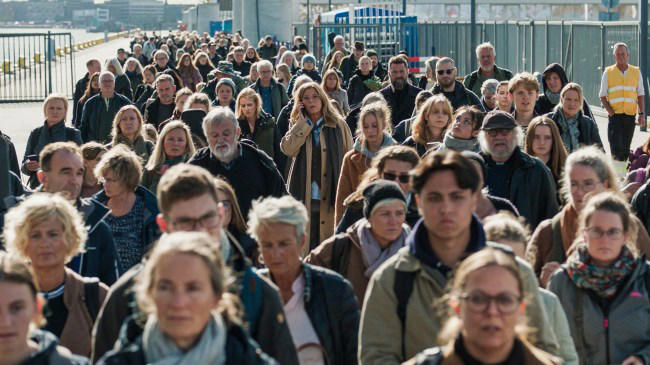

For those of us who have never faced refugee or immigrant status, the problems such a transition bring forth are almost unimaginable.
Two years ago I reviewed Apple TV +’s eight-part series “Extrapolations,” which dealt with various aspects of climate change, and I was pessimistic many people would be stimulated by it to become more active addressing that growing threat. This was despite the fact that it featured a cast including such outstanding actors as Meryl Streep, Edward Norton, and Forest Whitaker. One of the reasons for my pessimism was that “most people do not consider climate change one of their top priorities.”
Now another series, “Families Like Ours,” this time depicting just one catastrophe—rising sea waters forcing the evacuation of Denmark—comes to us via Netflix. Unfortunately, I again fear that it will have the same minimal galvanizing effect.
Nevertheless this series, directed and co-written by the Danish Thomas Vinterberg, is well done. It has seven episodes, each about 50 minutes, and the first one premiered in Denmark in October 2024.
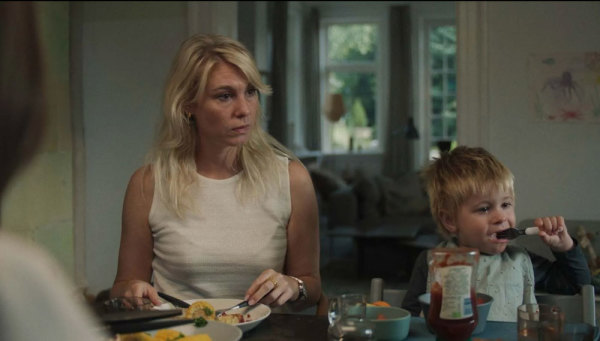
Moreover, it offers some useful insights. One I found most wise is what father Jacob tells daughter Laura—see below for more on these two. She is grieving because she is in Romania, and she has not heard from her boyfriend, Elías, who failed to meet her—as agreed—in Poland. She fears he may be dead. Her dad tells her (via something like a FaceTime call) that “grief is the price of love. If you lose something, it’s because you were given it once.” And he continues, “It might be good to exchange the thought of what you’ve lost to gratitude for what you got.”
I know this is wise advice because similar thinking has helped me. After my wife died, I truly realized that “grief is the price of love,” and it was “good to exchange the thought of what” I’d lost for “gratitude” for what I got—six decades of great love and happiness.
The basic plot of the film (and I’ll here reveal little more) is that because of rising waters bordering Copenhagen and much of the rest of Denmark, the government thinks it is best to evacuate the country. During the last episode, the news tells us that “an estimated 95 percent of Danes [population, c. 6 million] now live in another country,” and that UN troops will rescue the remaining Danes from rising waters.
Regarding the believability of the plot, no one knows for sure how likely the scenario depicted in the series is. But sometime in the future it cannot be ruled out. Facts: sea levels, partly due to melting glaciers, have been rising. Presently living within one meter of sea level are 230 million people. Low-lying nations like Denmark and island countries like Tuvalu, as well as cities like Miami and Shanghai, are especially at risk. Plus a recent report indicated that the 2015 Paris Agreement on climate change failed to realize how little change in temperature it would take to enhance “the catastrophic consequences of sea level rise due to melting glaciers.” Finally, measures to prevent rising waters from flooding areas can be expensive, and some governments might conclude that they are TOO expensive—thus mass migration, especially if the population is as low as Denmark’s.
But back to the series plot. The director centers it on just a few families. One is that of architect Jacob (Nikolaj Lie Kaas) and his daughter, Laura (Amaryllis August), who is 20 at series end. There is also Laura’s mother Fanny (Paprika Steen), Jacob’s first wife, and his second wife, Amalie (Helene Reingaard Neumann) and their infant son. The other important couple is Amalie’s brother, Nikolaj (Esben Smed), a government employee, and his gay husband, Henrik, (Magnus Millang). One more separate family, that of Christel (Asta Kamma August) and her pre-teen soccer-playing son Lucas (Max Kaysen Høyrup), completes the major families. But Laura’s romantic involvement with Elías (Albert Rudbeck Lindhardt), Henrik’s relationship with his homophobic brother Peter (David Dencik), and Fanny’s with her brother, Holger (Thomas Bo Larsen), are also dramatized.
Many of the actors are familiar ones to Danish viewers, and the series involves us emotionally in their plights as they search for somewhere to settle now that they are being forced to leave Denmark. Understandably, many countries set limits and restrictions on the numbers of Danes they are willing to accept.
Many governments (including that of the USA) are not willing to follow the late Pope Francis’s advice: “Our response to the challenges posed by contemporary migration can be summed up in four verbs: welcome, protect, promote and integrate.” As I wrote earlier this year, “If there is one issue that unites the far Right today (in both the USA and Europe) it is opposition to too many immigrants and refugees.”
For those of us who have never faced refugee or immigrant status, the problems such a transition bring forth are almost unimaginable. How can we get a decent price for our property when everyone is leaving our country? Which new nation will accept us? What kind of a new job can we get? (Architect Jacob by series end is doing janitorial work; his daughter, Laura, who had been admitted to France’s Sorbonne—but wanted to be with her mother in Bucharest—is a waitress in that same city.) What do we do if part of your family is accepted by a foreign country, but part of it is not? (Such is the plight of Christel and her soccer-playing son Lucas.) And, of course, amid all the confusion and precariousness of such a major transition for the Danes, there is increased crime, which further complicates life.
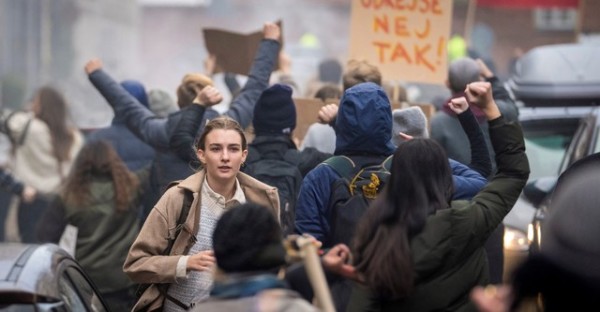
The whole predicament reminds me of all the uncertainty and tragedy of Jewish people during the Holocaust. True, countless lives are not being lost in the series due to the rising waters, but there is still all the confusion regarding what the future will bring and the removal of all of yesterday’s routines and normalities.
With such a future (or worse) a possibility for many of us if we do not address our present global warming, one can only scratch one’s head and wonder why. Why we do not do more to address the climate-change problem. Why in each of his presidential terms Donald Trump has ordered the U.S. withdrawal from the Paris Climate Agreement. Why he is in the process of gutting the Environmental Protection Agency (EPA).
Of course, the problem is not just Trump. It is also all those people who put him in office—and for a second term. The issue is a complicated one, but part of the answer is that “voters are simply not very good at assessing the dangers of complex issues like gradual global warming. Concrete issues like grocery-price increases have much greater impact.”
