



Without French backing, his diplomacy may well have failed because some members of the Congress were very critical of him.
Benjamin Franklin is known for many things. Along with Washington, Adams, Jefferson, and others he is among our “Founding Fathers.” One of the signers of our Declaration of Independence (1776), he was also one of the editors of Jefferson’s draft of it. But by the signing he had already reached age 70, thus becoming the oldest of the 56 signatories. Wikipedia sums up his contributions concisely: “An American polymath, a leading writer, scientist, inventor, statesman, diplomat, printer, publisher, and political philosopher. Among the most influential intellectuals of his time.”
Although receiving little formal education, in 1762 he was given an honorary doctorate by Oxford University. Thus, the many series references to him as “Doctor Franklin.”
In an earlier essay, I signaled Franklin out as someone who throughout his long life appreciated a quality insufficiently valued today--wisdom. (Historian Edmund S. Morgan observed that Franklin was “a man with a wisdom about himself that comes only to the great of heart.”) But it wasn’t until after recently watching Apple TV+’s eight-part series Franklin, plus doing some more research on him, that I realized something new. It was that what U. S. historian Gordon Wood said in his The Americanization of Benjamin Franklin--“He was the greatest diplomat America has ever had”--may have been no exaggeration.
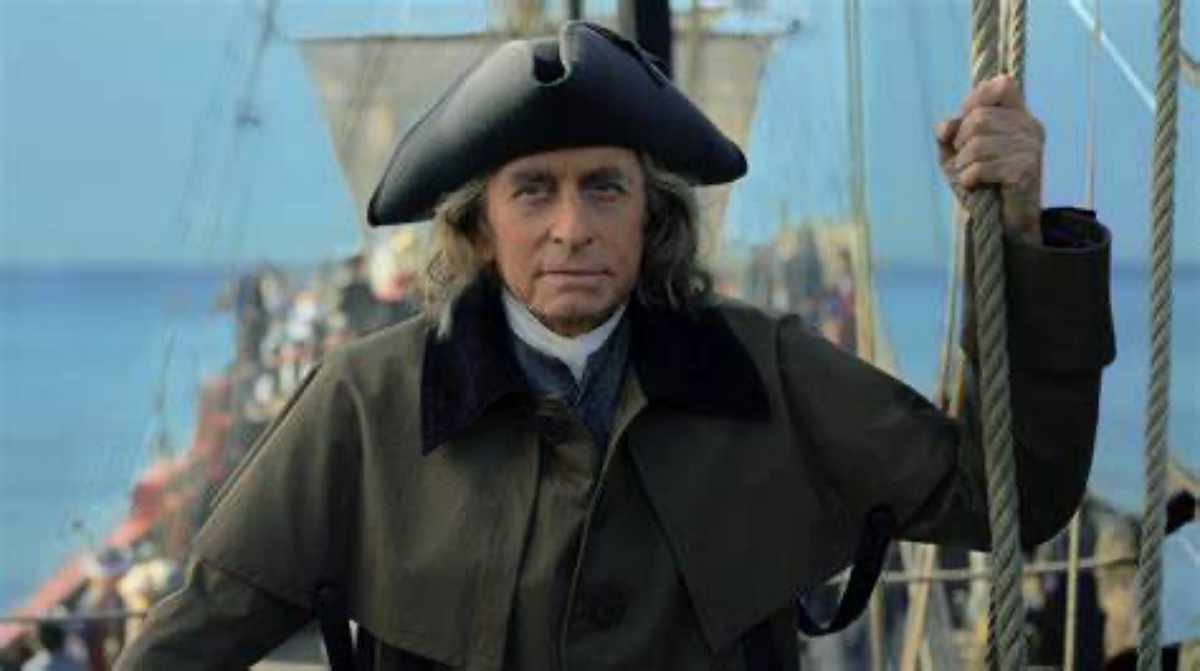
This is because Apple’s series deals with Franklin (well played by 79-year-old Michael Douglas) as a diplomat in France from December 1776 to the end of his ambassadorship in May 1785. The approximately one-hour segments are loosely based on Stacy Schiff's 2005 book, A Great Improvisation: Franklin, France, and the Birth of America. And sort of like Ukraine today facing Russia, our 13 colonies back in the years 1775-1783 were fighting for independence but needed outside help. And it was Franklin’s job to obtain as much as he could from France.
And he obtained plenty. As historian Wood has written, “he had to request loan after loan from France, and time after time [French foreign minister] Vergennes came through for him.... [The war] eventually cost France over one billion livres,” which would have been about two billion dollars in 1980s purchasing power. In addition, France eventually also sent arms, ammunition, and troops. Franklin was able to be so successful “because he always maintained the overwhelming support of Vergennes and the French public. . . . Indeed, that adulation by the French public, enabled him to weather every storm and every difficulty during these turbulent years. His reputation with the French was the greatest source of his political support in the Continental Congress.”
Without French backing, his diplomacy may well have failed because some members of the Congress were very critical of him, especially John Adams (Eddie Marsan). The Apple series demonstrates this well once Adams arrives, at the Congress’s behest, in France in mid 1778. Early in Episode 5 Adams states, “I cannot abide Franklin.” And throughout most of the rest of the series, we see these two outstanding leaders differing, both in regard to dealing with France and more generally.
In 1783, the year in which the Treaty of Paris formally ended the American Revolutionary War against Great Britain, Franklin wrote of Adams, “I am persuaded, however, that he means well for his Country, is always an honest Man, often a wise one, but sometimes, and in some things, absolutely out of his senses.” About a decade and a half later, Jefferson would write about him: “Mr. Adams is vain, irritable, stubborn, endowed with excessive self-love, and still suffering pique at the preference accorded Franklin over him in Paris.” (Both quotes reproduced in Schiff’s book.)
In addition to the rift between Franklin and Adams, the series provides ample air time to various other aspects of Franklin’s almost decade-long service in France, where he lived near Paris on the estate of a noble. Among the most notable facets were his relationship with women, especially the married Madame Anne Louise Brillon de Jouy (1744-1824) and the widowed Anne-Catherine de Ligniville (Madame Helvétius). As Schiff notes in her book, Helvétius was “as unfettered by nerves or convention as Madame Brillon was a prisoner of both.”
By the time he landed on French shores at the end of 1776, Franklin was a widower, and thus could not be accused of being unfaithful to any wife. Nevertheless, the middle-aged Adams thought that the womanizing of the older Franklin was scandalous. No doubt, the septuagenarian like to flirt and did so with Madame Brillon and the widowed Madame Helvétius, but there is no proof (and the series does not indicate otherwise) that Franklin and either woman consummated any sexual relationship.
Earlier episodes of the series indicate considerable intrigue surrounding relations between Britain, France, and the American colonies. In France, Britain had agents and spies including Franklin’s good friend the U. S. physician Edward Bancroft.
We also witness others besides Foreign Minister Vergennes who wish to help Franklin and the rebelling colonies. Chief among them are the French playwright Pierre-Augustin Caron de Beaumarchais, author of “The Barber of Seville” and “The Marriage of Figaro,” and Gilbert du Motier de Lafayette, a French nobleman who became a U.S. general at age 19 and commanded troops at the decisive siege of Yorktown in 1781.
Latter episodes of the series testify to some of the aging Franklin’s health problems, especially his gout and kidney stones. Battling these ailments, we see him negotiating, along with John Adams and John Jay, with British representatives to end the revolutionary war. Finally, with the Treaty of Paris (officially ratified, September, 1783), it ends, and the U. S. gains lands east of the Mississippi (north of present-day Florida and south of present-day Canada).
Throughout the whole series, much is made of Franklin’s relationship with his grandson Temple (Noah Jupe), one of two grandsons he took with him to France. When they arrived in France Temple, the illegitimate son of Franklin’s own illegitimate son William, was only 16. (The other grandson, Benny, the son of his daughter Sarah, was only 7.)
In addition to Temple’s secretarial assistance to Franklin, we witness his friendship with Lafayette and many other young people, as well as his partying and womanizing. These Temple activities do not add much to the series--except perhaps for some young people who might find them interesting. But in her book on Franklin in France, author Schiff also furnishes many such details. For example, “He [grandson Temple] came of age in a city that could try any young man’s morals, and he did it justice. His friends wished that he could join them in their travels, where they met women even looser than those in Paris, ‘which was saying a good deal.’ . . . August 1783 found him utterly infatuated with Aldegonde Brillon, and also tangling with a cuckolded husband. Early in August Sir James Nicolson, a wealthy Scot, called on Franklin to register a complaint about Temple’s attentions to Lady Nicolson. . . . In 1784, Temple had a torrid affair with Blanchette Caillot, one that would preserve a family tradition. In February 1785 Madame Caillot bore Franklin’s illegitimate son’s illegitimate son an illegitimate son.” Thus, by weaving such Temple adventures into the TV series, its director (Tim Van Patten) is not excessively deviating from the book of a Pulitzer-Prize winning biographer (in 2000 for Schiff’s Vera, Mrs. Vladimir Nabokov).
During the last episode in the series, Franklin is still in France, from which he does not leave until 1785, just five years before his death at age 84. The final scene we witness is him on a ship on the ocean on his way back home to Philadelphia.
In his final years, Franklin attended the Constitutional Convention in 1787--again being the oldest delegate--and continued to demonstrate his interest in wisdom. Shortly before the beginning of convention, he wrote to Jefferson: “The Delegates generally appointed as far as I have heard of them are Men of Character for Prudence and Ability, so that I hope Good from their Meeting. Indeed if it does not do Good it must do Harm, as it will show that we have not Wisdom enough among us to govern ourselves.” And during the convention itself he said, “We indeed seem to feel our own want of political wisdom, since we have been running all about in search of it.”
The same year as the convention, he became president of the Pennsylvania Society for Promoting the Abolition of Slavery. Although like many other wealthy men of his time, he had owned a household slave or two throughout many of his adult years—ten percent of Philadelphia’s people were slaves in 1760—by 1787 he had evolved, as the petition to Congress he presented in behalf of the society he headed demonstrated. It called on Congress to “countenance the Restoration of liberty to those unhappy Men [slaves], who alone, in this land of Freedom, are degraded into perpetual Bondage, and who, amidst the general Joy of surrounding Freemen, are groaning in Servile Subjection, that you will devise means for removing this Inconsistency from the Character of the American People, that you will promote mercy and Justice towards this distressed Race, & that you will Step to the very verge of the Powers vested in you for discouraging every Species of Traffick in the Persons of our fellow men.”
Besides what historian Wood said about Franklin being the “greatest diplomat” in our history, another expert on this “Founding Father,” Walter Isaacson, wrote about Franklin’s great skill at the Constitutional Convention. To Franklin “compromise was not only a practical approach but a moral one. Tolerance, humility and a respect for others required it. The near perfect document [the Constitution] that arose from his compromise could not have been approved if the hall had contained only crusaders who stood on unwavering principle. Compromisers may not make great heroes, but they do make great democracies.”
A man of principle, but also one with great diplomatic skills and a willingness to compromise. A fine combination that now, more than two centuries after the death of that wisdom-loving Benjamin Franklin and with our divided democracy imperiled, needed more than ever.
