

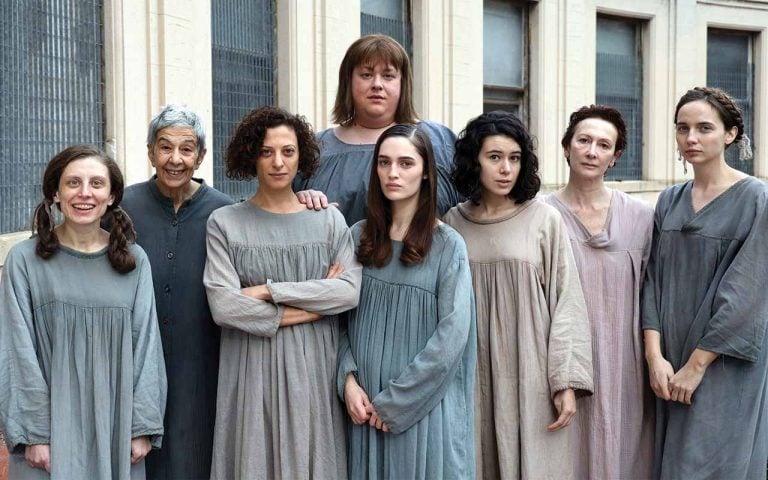

The series is set mainly in WWII and is of interest for primarily two reasons: psychiatric history and Fascist rule.
The six-part series (each about one hour) “Free Women” (2026) is loosely based on a 1953 novel (“The Free Women of Magliano”) by Italian psychiatrist and writer Dr. Mario Tobino. (An eight-page English translation of part of the novel can be read here.) For almost forty years, starting in Fascist Italy in World War II, Tobino (Lino Guanciale) worked and later directed the women’s division of the asylum near Magliano--itself near the the larger Tuscan city of Lucca. The series is set mainly in WWII and is of interest for primarily two reasons: psychiatric history and Fascist rule.
Before turning to those two factors, however, it should be noted that the series is very well acted and directed, and furnishes us with many insights into psychiatric conditions. We are also kept guessing until the final episode which of two women Mario is going to end up with: his Jewish, anti-Fascist first love, Paola Levi (Gaia Messerklinger), or his psychiatric patient Margherita Lenz (Gracjela Kicaj).
In dealing with Margherita and the other patients, Dr. Mario reminds us somewhat of another WW II doctor--Doctor Zhivago in Pasternak’s famous novel of that name. (First published in Italy, only four years later than Tobino’s novel.) Like Zhivago, Mario is also a poet, and like Lara in “Doctor Zhivago,” Paola inspires some of his poetry. And although both novels occur partly in WW II (“Free Women” almost exclusively), they are also partly love stories.
Margherita has been placed in the asylum by her oppressive husband, who wishes to confiscate her inherited wealth. In this plot, he is aided by his mother and sisters, and Mario spends some time trying to prove their conspiracy. He correctly believes that Margherita does not deserve to be in the institution, but the asylum’s conditions make it difficult to be sure--at least in the beginning.
Since WW II, psychiatry has made some important advances. In 1978, Italy passed the Italian Mental Health Act (also called the Basaglia Law), which contained directives for eventually “closing down of all psychiatric hospitals” and “led to their gradual replaement with a whole range of community-based services.” (“The Law has had worldwide impact as other countries took up widely the Italian model.”)
But during WW II, the Magliano asylum was still practicing lobotamies--one online entry on lobotamies notes that “from the 1930s until the 1970s, the treatment was used for handling psychiatric disorders as a mainstream procedure in some countries. A preoccupation with the ability to work and personal responsibility over patient well-being were contributing factors to the prevalence of lobotomies in the United States.”
At the Magliano asylum, the main advocate of lobotomies was Dr. Gianmassimo Parisi (Massimo Nicolini), who was also a Nazi sympathizer. (In addition to the doctors, the main caregivers are nuns, but German Nazi troops were also sometimes seen on asylum grounds.)
With the German Nazis overseeing Mussolini’s Italy in the last few years of WW II, anti-Nazis had to be careful. Realizing that his first-love Paola is Jewish and anti-Nazi, Mario kept his anti-Nazism muffled, as did other anti-Nazis, including the medical director of the asylum, who was hiding a Jewish woman among his patients.
Psychiatric conditions, the operations of love, how to express dissent under oppressive conditions--a lot to think about in this enjoyable series.
