


What’s the best way of dealing with all the difficulties of life—including death, divorce, and raising kids—no one knows, really knows, for sure.
I just finished watching the streaming eight-part series “It’s Not Like That” on Amazon Prime, and it prompted some new thoughts on a main theme of the series—adjusting to life after a major disruption, like the death of a loved one or a divorce. Four years ago, just months after the death of Nancy, my wife of 58 years, I wrote "Thoughts about Death and Faith: A Pragmatic Approach." And my present review, along with reviewing the series now on Prime, revisits the views expressed then.
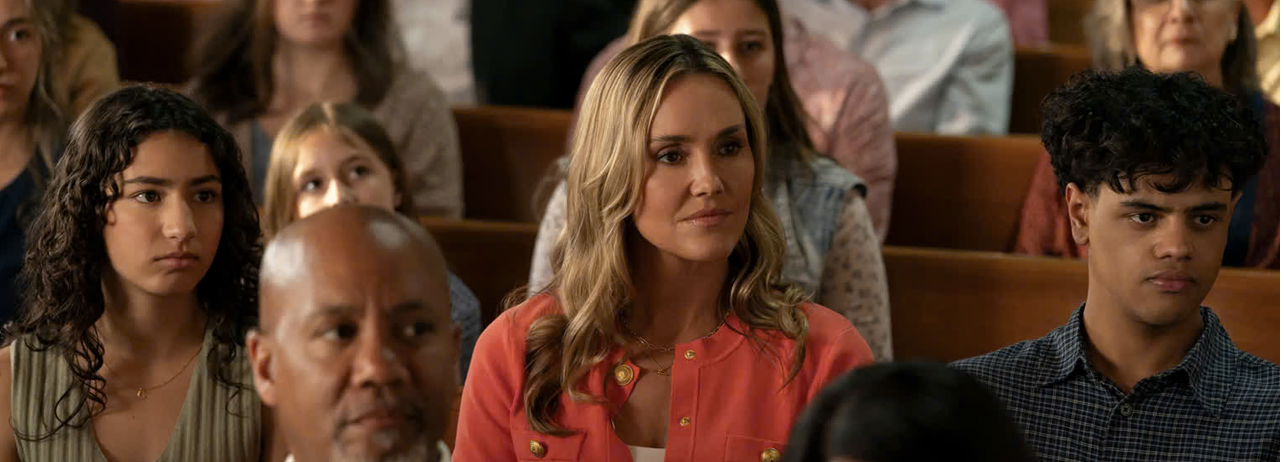
The main adjustment that the film’s central characters, widower Malcolm (Scott Foley) and newly-divorced Lori (Erinn Hayes), need to make is adjusting to their new situations. They are neighbors, and Lori was Malcolm’s wife (Jenny’s) best friend, and their families—Malcolm has three children and Lori, two—were very close. Throughout much of the eight-part series, we are kept guessing whether Malcolm and Lori—already good friends—are going to become more intimate.
The essay I wrote four years ago had “Faith” in its title. And in it I stated:
After decades of reading and thinking about previous theologians’ and philosophers’ ideas about God, all I can say is “the jury is still out.” Whether a God—however we might define he, she, or it—exists or not, no one can say for sure. We can believe or hope there is a God, but that’s all we can do. In spite of thousands of years of religious and philosophic inquiry, that’s all we got. No matter how intense one’s faith or hope is, if there is no God, believing or hoping will not create one. Conversely, no matter how ardently one insists that there is no God, such insistence will mean nothing if one does actually exist.
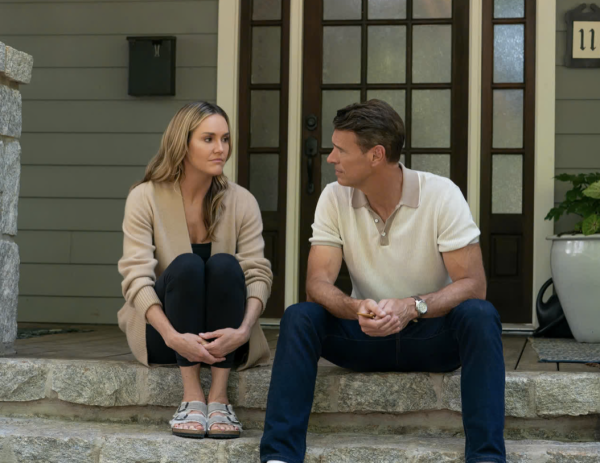 Erinn Hayes and Scott Foley
Such thoughts are especially relevant to “It’s Not Like That” because Malcolm is a Protestant minister. And how intimate he should become, outside of marriage, with Lori—or any other woman—is affected by his faith. At one point, he says to another woman (the teacher Ms. Grace Colasante) whom he is dating, “It is my belief, my personal belief, that sex is a sacrament that God created for marriage.” To which she responds, “I like you, Malcolm, but marrying you isn’t really on my radar—just yet.” But “having sex with you is. That's usually the order in which I think about these things.” Malcolm replies, “I get it. And that's that's totally normal. I'm not asking you to change the way you live your life for me, or something.” (Film dialogue is taken from the series scripts.)
A series in which one of the two main characters is a minister might be off-putting to some progressive readers, but it shouldn’t be—at least to my mind. Malcolm is a believer, but a tolerant one who participates with those of other faiths, such as Judaism and Islam, to do good works for his community, apparently in Atlanta. In fact, one reviewer complained that its Christianity was too “thin and generic.” It “feels like the progressive-leaning, inclusive Christianity that Hollywood would like to see normalized.”
The series also should not be renounced because a progressive viewer might have less conservative values than pastor Malcolm, but welcomed because Malcolm understands what are some of the most important ones. More than a dozen years ago, I wrote that love was the greatest wisdom virtue, and since then it has remained (for me) the greatest of all virtues. At one point Malcolm explains that when he was 15, he “felt a calling.This unrelenting pull to see people. And love them. Right where they are. I think that's the best way to describe what it means to be a pastor.” Besides love, Malcolm also embraces and demonstrates other important values like tolerance, empathy, and humility.
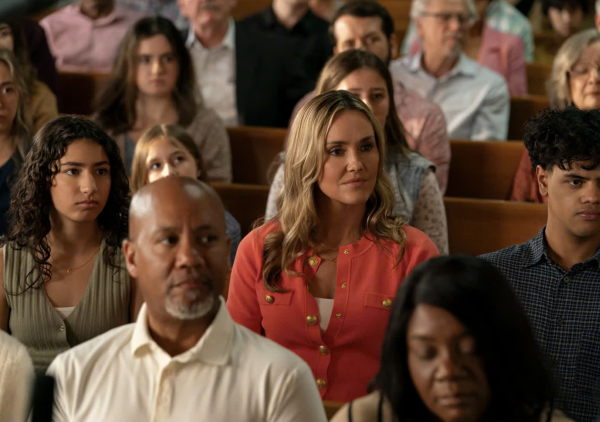 Erinn Hayes
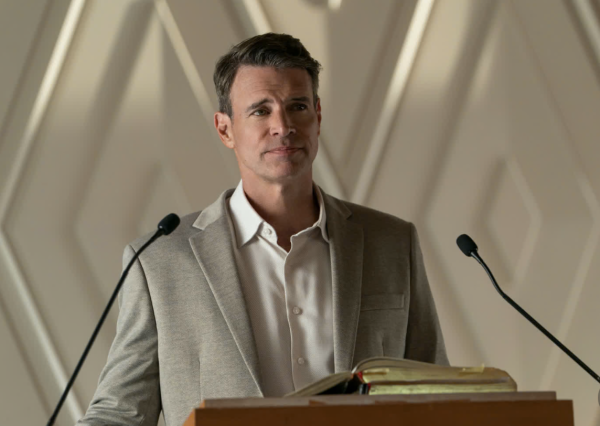 Scott Foley
Another reason that the series should be welcomed by progressives—and others—is that the problems that Malcolm and/or Lori deal with are faced by many adults—grieving the death of a spouse; reorienting oneself after such a death (or in Lori’s case, after a divorce); raising children as a single parent. (A good deal of the series deals with these five children and their problems, including not only with their parents, but with each other, at school, and with their friends. In other words, it deals with universal problems to which almost any parent can relate.)
In a press release about the series, its creators (Ian Deitchman and Kristin Robinson) stated that it “reflects the fact that people are more complex than our surface assumptions, carrying burdens and pain we can’t always see. . . . Everyone you meet is battling something you don’t know about. . . . There is always a deeper, more complex story, one that requires an extension of grace.” I’ve often quoted the similar words, “Be kind, for everyone you meet is fighting a hard battle,” often mis-attributed to Philo of Alexandria.
What’s the best way of dealing with all the difficulties of life—including death, divorce, and raising kids—no one knows, really knows, for sure. At the end of the last episode, after Malcolm confesses his love to Lori, she replies, “I am so confused, Malcolm. I don't know what to do. On the one hand, I have this new guy, Joe [who she found on an Internet dating site], and he's totally into me, and, you know, I'm pretty into him, too. . . . He's, like, all potential. You know? Like, an unknown. . . . But I slept with David [her former husband] the other night. . . . It was totally fear-based. And, probably, like, self-destructive. . . . He is the father of my children. Right? And he is a known quantity. . . . Maybe it's not too late for us to be a family again?” And, although she does not say it, Malcolm knows that she has deep feelings for him, and on an earlier occasion they had kissed.
All a befuddled Malcolm can say is “Lori . . . I can't tell you what to do.” To which she replies, “No, I know. But could you, anyway?” To which, he responds, “Trust yourself. You'll find your way forward.”
Although many viewers are hoping for a Season 2 so they can discover the fate of Lori and Malcolm’s relationship, the creators of this excellent series have not yet committed, one way or another.
