


The Peacock series makes for riveting viewing. Throughout its episodes, viewers keep asking themselves “Who was responsible for the Pam Am bombing?”
In the five-part series “Lockerbie: A Search for Truth,” now streaming on Peacock, the subtitle is as important as the main title, “Lockerbie.” Because in this era of false information galore—thanks in large part to its gushing forth from social media and Donald Trump—truth seems harder than ever to find. (As Martin Baron, outgoing editor of The Washington Post, said in 2023, “the fact that the public can't agree on a common set of facts and can't agree on how to even establish that something is a fact is clearly the biggest challenge that we face.”)
Not that it has ever been easy. In an Epistle to the Corinthians, St. Paul wrote about seeing “through a glass, darkly” and only knowing in part. And before Copernicus in 1543 most people believed that the sun revolved around the earth instead of vice versa.
The 18th century Enlightenment advanced a commitment to truth-seeking, as Steven Pinker has emphasized, but one that involved only a small number of people, primarily those involved in scientific activities.
A major impediment to truth-seeking had been modern advertising, which emphasizes gaining a profit rather than concern with the truth. As U.S. humorist Dave Barry once said, “Television's message has always been that the need for truth... pales by comparison with the need for a toothpaste that offers whiter teeth and fresher breath.” From 1865 to 1900, U.S. advertising expenditures increased at least tenfold and continued to skyrocket thereafter. In the U.S. and increasingly in other cultures, profiteering—or alternatively, state propaganda—has often been more prioritized than truth.
There have been exceptions, of course, but they are rare indeed. One of the most notable was the apostle of non-violent resistance, Mohandas Gandhi. To begin with, we should note that his autobiography, completed almost a quarter century before his assassination in 1948, is subtitled “The Story of My Experiments with Truth.” Also, most importantly, his main doctrine of Satyagraha, usually rendered as non-violent resistance, literally means “insistence on truth.” He also stated that “in the application of Satyagraha, I discovered, in the earliest stages, that pursuit of Truth did not admit of violence being inflicted on one's opponent, but that he must be weaned from error by patience and sympathy. For, what appears to be truth to the one may appear to be error to the other.”
To appreciate how important truth was to him, consider a few of these quotes from his autobiography:
[About his teen years in India:] But one thing took deep root in me the conviction that morality is the basis of things, and that truth is the substance of all morality. Truth became my sole objective.
All my life, though, the very insistence on truth has taught me to appreciate the beauty of compromise.
In the march towards Truth, anger, selfishness, hatred, etc., naturally give way, for otherwise Truth would be impossible to attain.
But already, a little less than two decades after Gandhi’s assassination in 1948, Hannah Arendt’s essay “Truth and Politics” stated that “factual truth, if it happens to oppose a given group’s profit or pleasure, is greeted today with greater hostility than ever before.” And “no one has ever doubted that truth and politics are on rather bad terms with each other, and no one, as far as I know, has ever counted truthfulness among the political virtues.”
She also suspects that politics may “be at war with truth in all its forms.” Her essay bemoans the political image-makers who have “learned more than a few tricks from business practices and Madison Avenue methods” and helped politicians to weave a “web of deceptions.” The popularity of Joe McGinniss’s The Selling of the President—published in 1969, just two years after Arendt’s essay—underlined her insight that campaigning for the presidency had taken on many of the aspects of modern ad campaigns. She also states that the opposite of factual truth is “the deliberate falsehood, or lie” and warns us about the effectiveness of lying politicians.
She notes that “since the liar is free to fashion his ‘facts’ to fit the profit and pleasure, or even the mere expectations, of his audience, the chances are that he will be more persuasive than the truthteller.” (And this was about a half century before conservative columnist Peter Wehner wrote that even before becoming president Trump’s goal “was to annihilate the distinction between truth and falsity . . . to overwhelm people with misinformation and disinformation.”!)
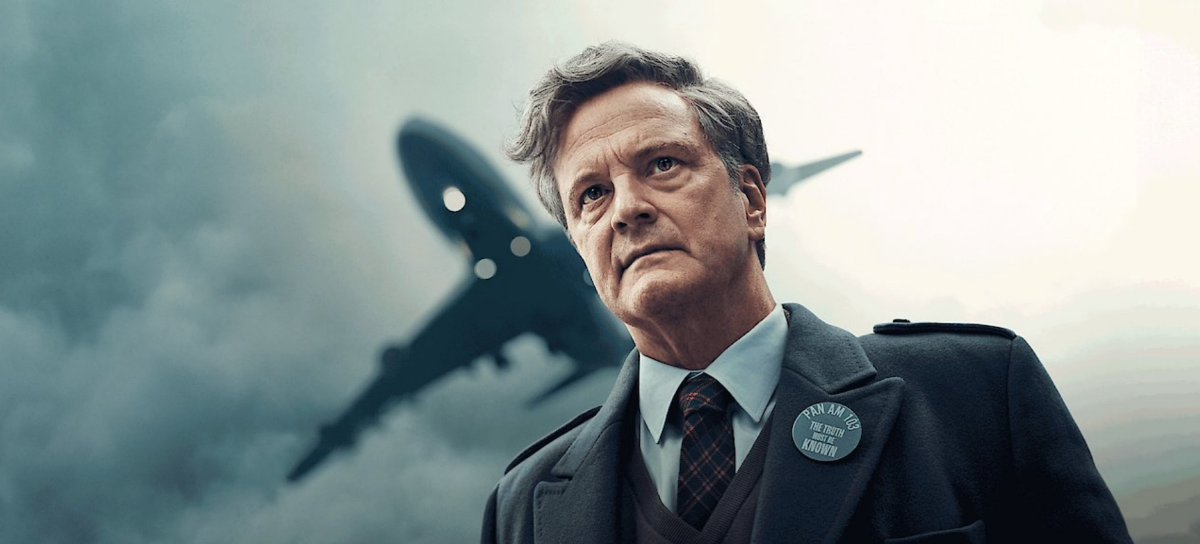
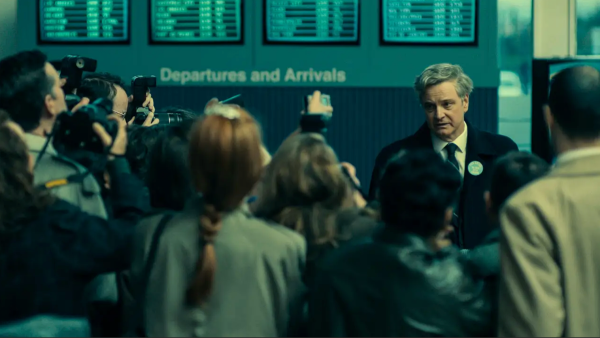
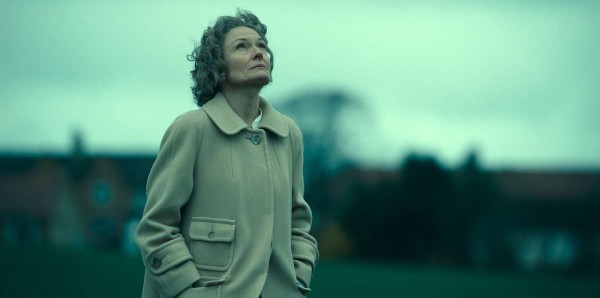
The basic story in the well-acted “Lockerbie” series—especially by Colin Firth as Scottish Doctor Jim Swire, Catherine McCormack as his wife Jane, and Ardalan Esmaili Abdel Basset as convicted culprit Ali al-Megrahi—is of Jim Swire’s obsessive and decades-long determination to discover the truth about the 1988 terrorist bombing of Pan Am Flight 103. An act that killed his daughter and a total of 269 other passengers, crew, and Lockerbie, Scotland residents. Jim’s determination is often demonstrated by the badge pinned to his coat, “Lockerbie, The Truth Must Be Known.”
The series is based mainly on Swire’s 2021 book (co-written with Peter Biddulph) The Lockerbie Bombing: A Father's Search for Justice. It starts off with these words, “This book is partly the story of over thirty years of my life.” And Swire asks himself, “How could initial faith in the establishment take thirty years to convert into distrust towards all those touched by that addictive drug we call power?” Later on he writes, “After many years running the British Empire, we have evolved all sorts of subtle ways of concealing truth when it is inconvenient for government to admit failure. . . . There seems no sign of conscience or even knowledge of right and wrong. My daughter and all those who died with her deserve better.”
The TV series, however, is less sure than Swire’s book is about a cover-up by the British government and its U.S. ally. It leaves open the possibility of agreeing with words uttered near the end of the last episode (the fifth) by Jim’s wife, Jane: “Sometimes I think we're no closer to the truth now than we were then. Maybe the only truth is... we'll never really know what happened. And that breaks my heart. But once I started to accept that I may never get an answer, I may never know . . . it meant that I could go on. And I will.” (Episode quotes are taken from each episode's script.)
In the last episode, WikiLeaks is mentioned, and it reminds us of the the whole question of government secrecy and truth. Is the secrecy, as Dr. Swire indicates in his book, a way “of concealing truth when it is inconvenient for a government to admit failure”? Or is it sometimes necessary to protect secret sources and for national security?
Having once worked for the U.S. Defense Intelligence Agency and coordinated with the CIA—whose Langley, VA lobby features the Biblical inscription “And ye shall know the truth and the truth shall make you free” (John 8:32)—I think the answer is “both.” Secrecy can be used for either purpose (or both), i.e., to hide government screw-ups—and thus be contrary to truth—or for more legitimate reasons.
Whatever the case, the Peacock series makes for riveting viewing. Throughout its episodes, viewers keep asking themselves “Who was responsible for the Pam Am bombing?” As Jim’s tenacious pursuit of the truth evolves, his views also change. In Episode 5, a Scottish reporter, who has long been digging into the case tells him regarding who was responsible, “Just because it was a sham trial, it doesn't make Megrahi innocent. It was Libya. It was also Iran. And Syria. And the Palestinians.” Or maybe Jim’s wife, Jane, is right—"we'll never really know what happened.”
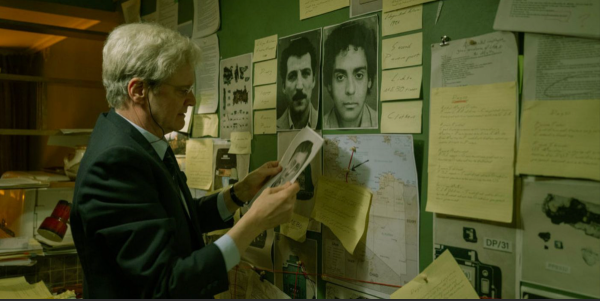
As we watch the series all sorts of reactions and questions race through our minds. The almost unbearable grief of the family members of the victims. Why do bad things happen to innocent people? How do family members deal with the grief forced upon them? Did Jim, as his wife thinks, become too obsessed—and for decades—with his daughter’s death? Is arriving at 100 percent truth ever possible—what with confirmation bias and all sorts of other biases constantly affecting us? How do we commit, how do we act, on political or other convictions, if we are seldom sure of being 100 percent correct?
At the very end of the series, Jane Swire says to husband Jim that it was only once she “started to accept that I may never get an answer” that she “could go on.” But almost immediately afterwards, she tells him that she understands he “can't give up [seeking the truth].”
Perhaps amid her own confusion, she hints at the only truth we can know: Although we can seldom be 100% sure we know the whole truth, we must always be truth-seekers. And then we must humbly act on whatever truth—even if it’s not the whole truth—we have been able to discover.
