

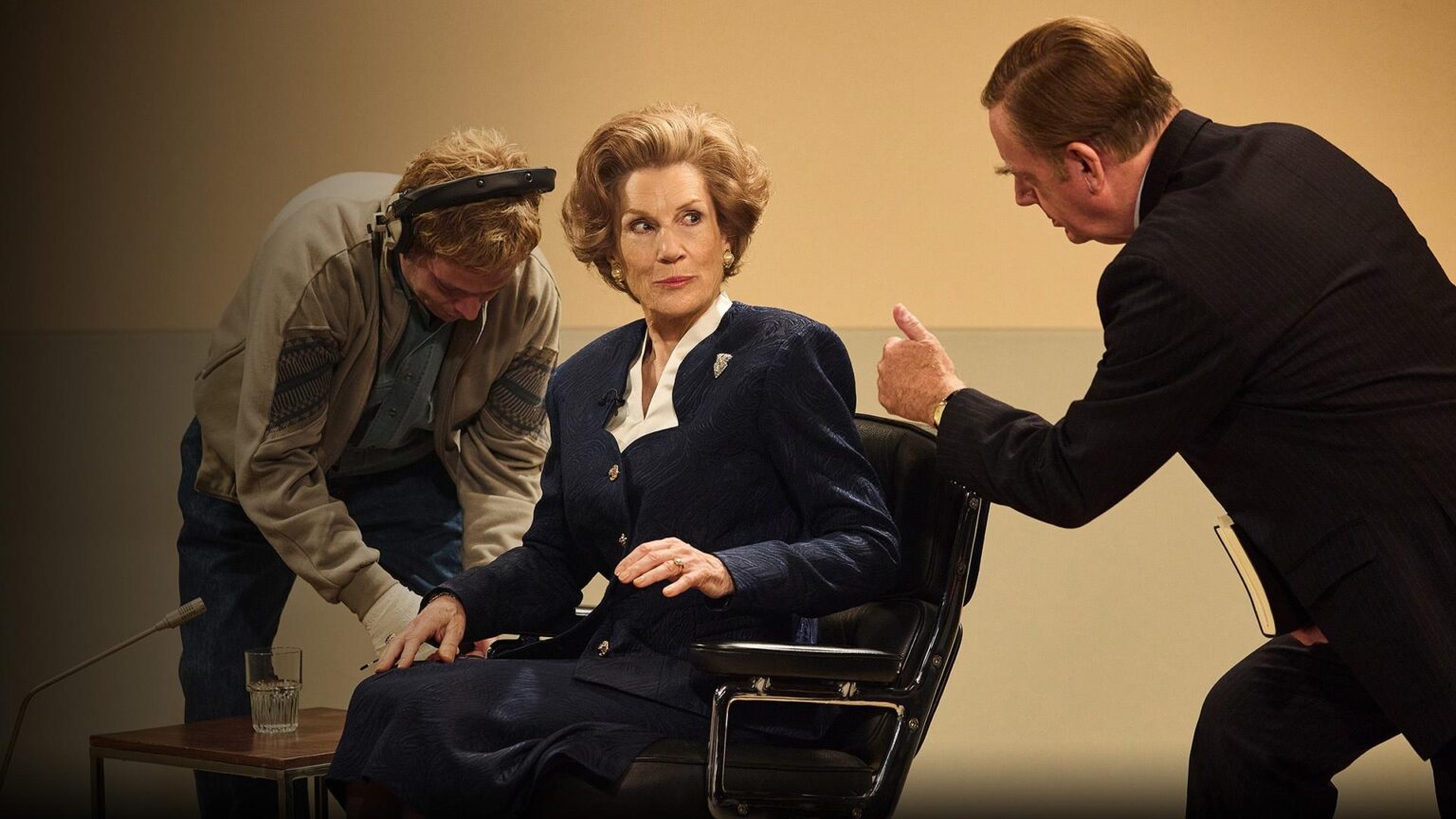

Watching the series reminded me of how similar the second term presidency of Donald Trump has been to what came to be known as Thatcherism.
A local PBS station (in Detroit) recently aired Episode 1 of “Brian and Maggie.” Both of the series’ two episodes are also available on PBS Passport, membership to which is available for contributions to PBS–now more necessary than before since the Trump administration has ended federal funding for PBS. The two mentioned episodes are about the relationship between former-Labour-Party-representative-turned-TV-interrogator Brian Walden (Steve Coogan) and Conservative British Prime Minister (1979-1990) Margaret Thatcher (Harriet Walter).
Watching the series reminded me of how similar the second term presidency of Donald Trump has been to what came to be known as Thatcherism. Not only were there domestic similarities, but also ones in foreign policy: Both leaders could be described as nationalists.
But similarities are not identical to carbon copies. As the political philosopher Isaiah Berlin once reminded us, “What matters is to understand a particular situation in its full uniqueness, the particular men and events and dangers, the particular hopes and fears which are actively at work in a particular place at a particular time.”
Thus, as well as similarities between Thatcher and Trump, there are differences. To begin with, she was much less privileged than Trump, who spent most of his childhood in a 23-room, 9-bathroom mansion. She, like her countryman Walden, came from a non-privileged background–she was the daughter of a grocer and he the son of a glass blower, whose wife died when Brian was 12. But through hard work, they both became scholarship students at Oxford U. and later successful in their professions.
Most importantly, she was more of an ideologue than Trump, one who believed fervently in a capitalism that operated without much government oversight, one which rewarded those who operated successfully in the capitalist arena and largely ignored those who were unsuccessful in such a competitive society. Ruling in mostly the same period as the U. S. President Reagan (mainly the 1980s), she was sort of an ideological twin. Trump, on the other hand, is less an ideologue and more of an opportunistic egotist. As I’ve mentioned before, “Unless it serves his ego, Trump will dismiss any ideology that fails to serve it.”
Nevertheless, both Thatcher and Trump have railed against–and cut–“big government.” And, like Trump later, she was radical about it. She claimed that under her “state-owned industry had been reduced by some 60 percent . . . [ and ] over six hundred thousand jobs had passed from the public to the private sector.”
In mid-February 2025, the Brookings Institute reported that “for weeks, the Department of Government Efficiency [DOGE], led by Elon Musk, the world’s richest man and a special government employee, has conducted a campaign to radically downsize the [U. S.] federal government and terminate numerous agency employees.” By early October, with a government shutdown in effect, the downsizing kept accelerating.
On a recent PBS News Hour, David Brooks said that Trump’s MAGA (Make America Great Again) movement has been “part of a conservative movement that for the last 50 years has said government is too big, the left has too much control. And they have wanted to defund the left since Ronald Reagan. And they haven't really done it. Donald Trump comes in term two and starts to do it under DOGE...Now Russell Vought, the budget director, is going to restart the engines. And he's going to restart them in a way that we have never seen before. He's been waiting his whole life at this moment.”
Coupled with cutting the government has been cutting taxes, which under both Thatcher and Trump benefited primarily the rich. At one point in Episode 2 of “Brian and Maggie,” one of her supporters points out that she cut the top tax rate from 83 percent to 60 percent–later on she proposed even further cuts for the rich. In response to Brian’s question about the greater prosperity she seeks causing greater inequality, she admits it will. But unlike Nobel-Prize-winning economist Joseph Stiglitz in his The Price of Inequality: How Today's Divided Society Endangers Our Future (2012), this gap that will increase does not bother her. Nor does she contest a point made in Episode 2–that by 1989 the gap between the richest 10 percent and the poorest 10 percent had greatly widened.
Early on, in Episode 1, Brian comments that she has Victorian values–Queen Victoria’s reign (1837-1901) being one of a more unbridled capitalism. She admits to that, but insists that those were the values when Britain became great. (The post-WW2 drift towards collectivism, as she perceived it, greatly irritated her.) Like conservative historian Gertrude Himmelfarb, she believed government welfare policies had helped create a culture of dependency. She also faulted political and cultural leaders, fearful of seeming to make moral judgments, for failing to champion virtues that would strengthen society.
Thatcher was much like Trump would later be. In Peter Edelman’s So Rich, So Poor: Why It’s So Hard to End Poverty in America (2013), he indicates that “throughout history there has been an instinctive belief among some [like Thatcher and Trump] that the poor have no one to blame but themselves.” He suggests that certain U. S. developments have contributed to this belief: America’s pioneer spirit, rugged individualism, and the “Horatio Alger mythology that one makes it (or doesn’t) on his or her own.” In other words, if you’re not successful in the USA, the “land of opportunity,” you must be lazy. In 1985, Fred Trump (Donald’s dad, who greatly influenced his thinking) was honored as the year’s Horatio Alger Award winner.
Finally, near the end of Episode 2, Brian prepares for a late 1989 interview with Thatcher. Although their common non-privileged, hard-working success stories had brought them closer together, by this point he has become more critical of her, especially of her acceptance of Chancellor of the Exchequer Nigel Lawson’s resignation. He wonders if it’s true that she can not get on with anyone but yes-men. And he’s troubled by her refusal to identify anyone as her successor, and that she will want to lead her party into the 1991 elections, “even into those of 1995.”
In Trump’s case, there has been similar speculation, and Trump himself has thrown out hints that he might be willing to serve a third term–“I suspect I won’t be running again unless you say, ‘He’s so good we’ve got to figure something else out.’”
Brian’s interview with Thatcher catches her off guard. She feels betrayed by him (and they never talk to each other again). The interview, plus growing economic problems, others with the Common Market, and an unpopular “poll tax” led her to resign in 1990–she died in 2013.
Margaret Thatcher, A Trump Precursor: Reflections on “Brian and Maggie”In the late 20th century she was often compared to her U. S. counterpart Ronald Reagan. But now, especially in Trump’s second term, a comparison with our latest president also seems in order.
