




What comes to mind is the tremendous importance of love and the complexity of it, as well as all the types of it.
“Modern Love Tokyo” is a series of seven short films (each between 30 and 41 minutes) within Amazon Prime’s larger “Modern Love” collection—see my Amazon’s “Modern Love Amsterdam” and Varieties of Love for more on the collection. Readers can also read more on how individual episodes are adapted from some 900 essays collected at The New York Times as part of their “Modern Love” column archive.
Having now watched 21 episodes in three different series in the collection and occurring in five different countries, I am reminded of poet Carl Sandburg’s words in the photo collection The Family of Man. “Everywhere is love and love-making, weddings and babies from generation to generation keeping the family of Man alive and continuing...Alike and ever alike we are on all continents in the need of love.”
What also comes to mind is the tremendous importance of love and the complexity of it, as well as all the types of it—romantic, spousal, paternal, charitable, same-sex, young and old, etc.
As in the other “Modern Love” series I have watched, I have my favorites, due in part no doubt to my age, gender, and lifetime experiences. Depending on their own unique personalities, others will probably have different preferences.
I found “My Hibernating Wife” (Episode 4) the most thought provoking because it deals with a husband, Kengo (about 30), whose wife, Mai, suddenly comes down with a severe case of depression. She takes a medical leave from her work as a designer and lays around her home all day. Kengo loves her deeply, but he is not sure how best to help her even though he reads up on depression.
What makes the episode so pertinent and relevant is that almost any of us who love someone might suddenly be faced with how best to help that individual when he/she undergoes some sort of mental crisis or disorder. There has been much reporting recently on an increase in mental afflictions being experienced by youth, including increased thoughts of suicide. At the other end of the age spectrum there are often various types of dementia, including Alzheimer’s, which bring about their own mental problems.
But even on a lesser scale, those who love must often deal with the mental insecurities, fears, and irrational behavior of those they love. As that great caretaker of the poor and afflicted, Dorothy Day, once wrote about love, “It is a hard, hard doctrine.” And indeed, though it can also be incredibly wonderful, it often is very difficult.
Kengo’s main problem is that, like most of us, he has no training in dealing with mental disorders and so he must just proceed by trial and error. And Mai is even more handicapped because her depression greatly hinders her from exercising any marital love.
Kengo’s problem of not being sure of how to help a loved one with mental problems extends beyond spousal love to all sorts of other love also. New York Times David Brooks recently described his failures to help a close friend: “I was confronted with a question for which I had no preparation: How do you serve a friend who is hit with this illness [depression]? I tried the best I could, but Pete succumbed to suicide last April.”
After I puzzled over the difficult question of dealing with depression, a fresh breeze arrived in Episode 6, “He Saved His Last Lesson For Me.” The two main characters are Emma who is British but lives in Los Angeles and teaches English online to international students. She appears to be in her late twenties and has a charming smile featuring very white teeth. She has just broken up with a guy who cheated on her, but her new romance with a Tokyo student, Mamoru, has all the charm of romantic love, spiced up by lovers from two very different cultures, who first meet each other in person when she flies in to Tokyo.
He is fascinated with growing corn, and does so on the roof of his Tokyo apartment complex. While the couple are online early in this episode, he asks Emma what love means to her, she says that’s a tough question and asks him if he has a definition, he responds that people are like corn, “We have to give attention to our love every day in order to improve it or it will die, just like the corn. So, I think, love is about effort.” Perhaps thinking of her experience with her cheating ex boyfriend, she asks, “What if the love doesn’t grow no matter how much effort you put into it?” Mamoru replies, “Maybe it was a bad seed.”
Perhaps in part because all the “Modern Love” series are set in big cities, which have become more similar in the past half century, because the series are all adapted from New York Times columns, and because media impacts have become more alike, most of what occurs in Tokyo (or in Amsterdam) could have happened in New York. Especially ubiquitous are cell phones, computers, social media, and the Internet—all of which were not available six decades ago when I spent six months in a France that was still very different than the USA.
There is one funny scene where Mamoru (in Tokyo) uses Instagram to text Emma (in LA) and asks if he can call her. She answers yes, but instead he FaceTimes her, sending her into a semi-panic because she is not prepared for such a visual call—“I look like shit.” I’m sure more than one viewer in various places in various countries can identify with Emma’s semi-panic.
Judging by the seven episodes in “Modern Love Japan,” dating apps especially enjoy a wide popularity in Japan. Main characters in Episodes 2 (What I’ve Learned from Sleeping with Married Men, 3 (How My Worst Date Ever Became My Best), and 5 (For 13 Days, I Believed Him) all use them.
In Episode 2 Kana Sato, a university professor in her mid-thirties who has been divorced from her husband for about 6 months asks herself whether she grew apart from him because they stopped having sex, or whether they stopped having sex because they first grew apart?” And she adds, “Now, having sex without love is my rehabilitation.”
We then see her in bed with various men, whom she sometimes meets using a dating app and asks them why they are cheating on their wives—she prefers married men because she wants to avoid any kind of committed relationship. (Warning: a few minor spoilers ahead.)
In the end, after getting together several times with here ex-husband, she discovers a truth that most of us would not argue with: “I learned the reason for not having sex varies from couple to couple. Just like there are many reasons for divorce and many types of love, there are many types of couples.” Standing on a bridge, she tells Keisuke that she wants him back in her life and adds, “We had a great relationship, but our sex life just wasn’t very good. Right?” He agrees. In the final scene she stands on the bridge (in the rain) waiting for Keisuke to catch up with her and tells us, “If we’re honest about our feelings and don’t try to conform to someone else’s ideas of sex, we’ll be okay.”
Episode 3 offers a refreshing change in that it deals with two people dating who are apparently in their sixties—overwhelmingly “Modern Love” deals with younger couples. We know that she, Natsuko, is a 63-year-old art curator; and he, partly retired interior designer Kosuke, looks about the same age. She has been divorced for about three years; he is a widower. They meet at a restaurant, and sitting next to them is a younger couple, who apparently were also brought together by a dating app.
Judging by this episode one of the things you don’t want to do on an app-arranged first date (or maybe any first date) is talk about yourself too much. At one point the younger woman sitting next to Natsuko and Kosuke says to the man she is first meeting, “You know how much women hate men like you. Learn to shut your mouth.” She then adds, “Let’s just say, we didn’t hit it off at all. OK?” and gets up and leaves.
Similarly while Natsuko was separated from her husband 30 years ago, she had an arranged date with a guy, and (in her words) it was a “disaster.” “He just spoke only about himself...He kept trying to make me feel inferior to him.” Kosuke tells her that he doesn’t think that was the guy’s intention. That he was probably just nervous and didn’t know what else to say. As Natsuko continues to talk about that long-ago date, Kosuke realizes that it was his younger self that had that date with her.
This conversation reinforced a conviction I have long had: too often couples misinterpret each other’s words and actions. Seldom do we know for sure what another person is thinking, even a loved one, but we often jump to conclusions like Natsuko did when she said, “He kept trying to make me feel inferior.”
One thing that Natsuko did that many U. S. women could identity with is discuss her date with a female friend (Karou). This friend talked her into dating—“You need romance”—sent her a dating app, talked with her on a cell phone while Natsuko was on her way to meet Kosuke, and then (as prearranged) called Natsuko while she is at the restaurant with her date. And all the while they are discussing the date and Karou is providing advice.
Episode 5 also involves a couple meeting at a restaurant on a dating-club arranged date. Momoko is a television reporter, perhaps in her 40s. The man she meets is supposed to be Yoji Suzuki, but we later learn that he is really an impostor, a homeless man who discovered information about the date and decides to show up for it acting like he was Yoji. (Momoko later discovers the real Yoji, and he tells her he had lost the information mentioned above.)
Momoko gets together at least several times more with the Yoji impostor even after she discovers that he is not the real Yoji. On one occasion she goes to a homeless shelter looking for him.
This episode did prompt my curiosity about homelessness in Japan, and I discovered that even though Tokyo (just the city itself) is more than three times the size of LA, it has a great deal less homelessness.
Something else I discovered was the original American basis for the story. It was written by actress Zuzanna Szadkowski who played Dorota on “Gossip Girl” for six seasons. Comparing the original essay with the Japanese screen adaption was interesting.
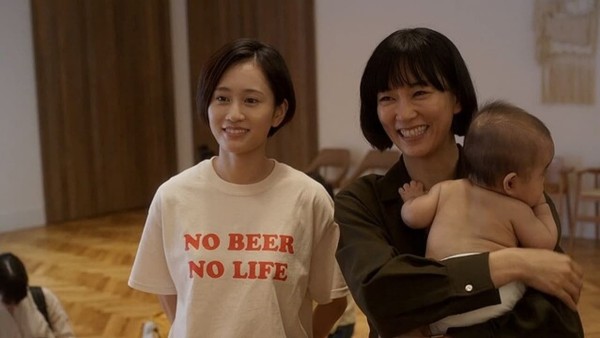
The only two remaining episodes are the first and the last (#7). The first is entitled Nursing My Son, and Some Grievances and deals with paternal love, specifically that of a mother nursing her infant son. Like some other episodes in the “Modern Love” collection this one also touches on same-sex love because Mari’s partner in raising her daughter and infant son is another woman, Sayaka.
When Mari has to go on a business trip to Singapore—she is director of Environmental Development at a company—she asks her mother to help Sayaka look after the two children, and she stocks the refrigerator with breast-pumped milk for use when she is gone.
Her mother says she fails to understand why she can’t just use formula while Mari is away and asks, “Why are you so obsessed with using breast milk?” And adds, “You didn’t drink it and you’re totally fine.” Mari answers with words many a grown daughter might say to a mother, “You and I see things differently.” Grandmother also expresses doubts about the wisdom of Mari going back to her job so soon after giving birth to her son (he is now a little over three months old).
Watching this episode about a mother’s absorption with feeding her son and a grandmother’s willingness to spend extra time with her grandchildren reminded me of how different the love of most women is from that of most men when it comes to children and grandchildren. My wife, Nancy, always seemed to continue carrying our three children in her heart, even after they were grown and moved to different cities. I continued to love them—at least I hope I did—but her love was more heartfelt.
And regarding grandchildren, on her 66th birthday, I wrote a poem that included these lines about her turning out blankets and other gifts for them: “Countless hours have you spent / Over cross-stitching and knitting bent, / As birth mementos and blankets you turn out, / Symbols of your love continuing to spout.”
On her trip Mari continues to pump breast milk—even in an airplane restroom where a waiting flyer becomes upset with how long she’s in there—and save it for when she returns to Tokyo, but she also talks to some other mothers, one of whom tell her that parents will always feel somewhat guilty no matter what they do, so she should just relax a little.
And by the time she returns home, she has apparently become less obsessive because after discovering her mother has been feeding her son formula, her final words ro her mom in the episode are, “I just wanted to say thanks.”
Episode 7 is entitled He’s Playing Our Song. And the Japanese director apparently wishes to convey the following message, which is spoken in the final scene by Tamami, a woman of about 30: “Music is like a chest of drawers storing your heart’s memories and just like that the drawer can be opened and the memories all come flooding right back.” The music in this case is the 1979 song “You May Dream” by Sheena and the Rokkets, a Japanese rock band.
To me, however, the main impression left by this brief film is how important a type of love is that is seldom mentioned—self-love. It is a kind of love that can easily be misunderstood. It is not to be equated with egotism or too high a regard for oneself. But it is the opposite of a defect that Tamami reflects throughout much of her youth, especially in high school, and young adulthood. At one point she says, “I got nothing going for me,” and at another, “I bet I’ll just end up as some old lady without ever becoming somebody.”
The high school years can be especially hard for young people, especially in this age of social media, and many of them need all the empathy and compassion that adults can provide. We should want the young to display these virtues towards others, but also to themselves.
A final word about this episode: It is the only one of the seven that is animated. Given the importance of anime in Japanese culture, including film, it seems entirely appropriate that at least one of the seven episodes should take this form.
Like the Amsterdam series, the Tokyo version of “Modern Love” features good acting and directing, and “provides additional perspective” on various types of love and their importance. And both series, despite their many similarities to U.S. episodes, provide some insights into foreign cultures and views of two vibrant cities. Unlike the Amsterdam series, however, the English language provided for us is in the Tokyo collection is dubbed, with the words not always matching the speakers’ lips. I prefer subtitles.
