

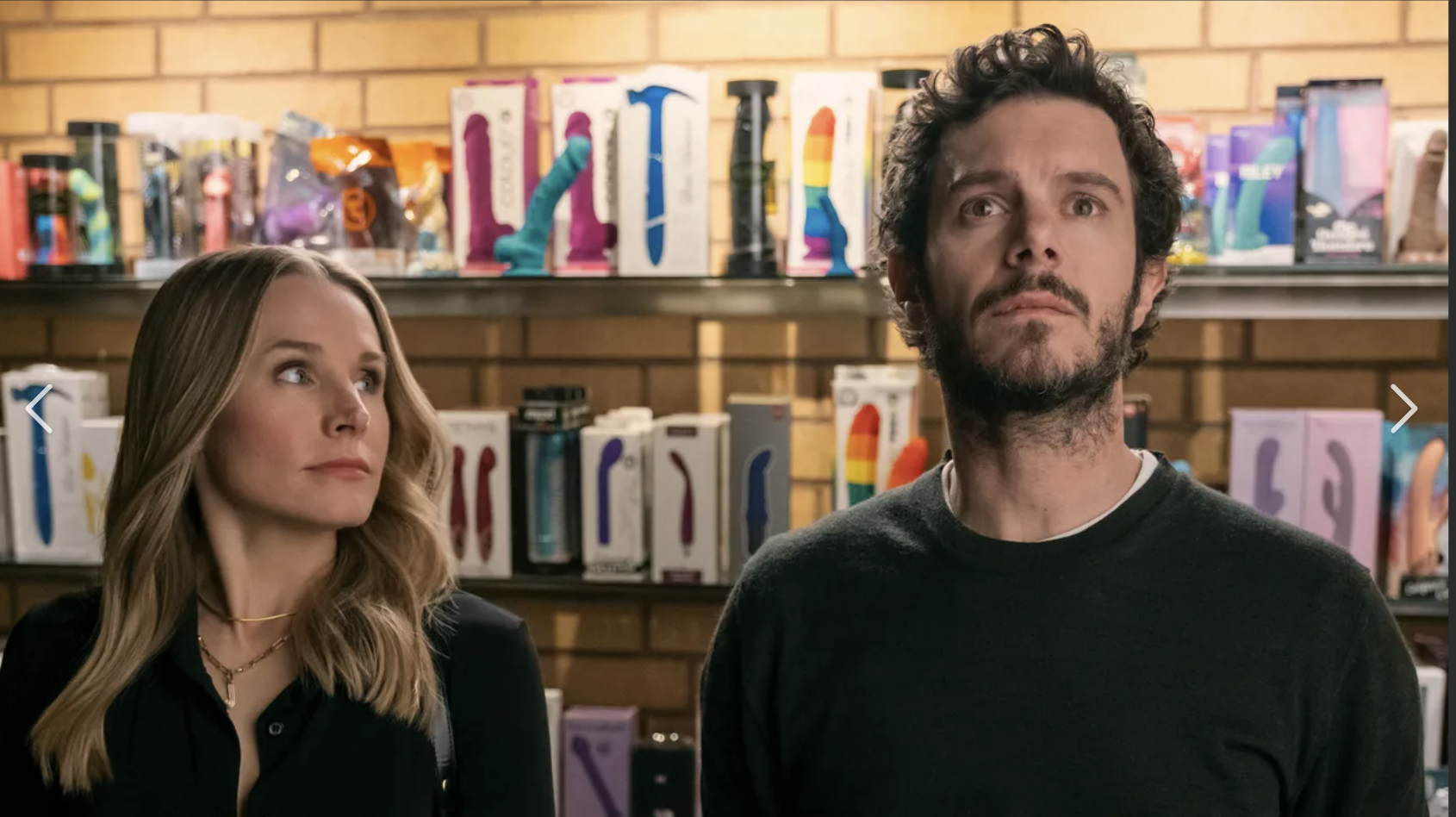
Nobody Wants This

Review of Netflix 10-Part Series Set in LA
The New York Times reviewer of the 10-part (21-31 minutes each ) Netflix series “Nobody Wants This” is Mike Hale, whose opinions I value. But I disagree when he writes, “The knock on ‘Nobody Wants This,’ and it is a legitimate one, is that it’s paper thin.” Differences in belief in God, the complications of love, and family pressures seem weighty enough to me.
Despite Hale’s comments about it being “paper thin,” the rest of his review is overall quite positive. For example, “It’s not bad. The jokes land. The story hums along. The people in it are real-ish—they may do cartoonish things, but they are not cartoons. Kristen Bell and Adam Brody [no relation to the better known Adrien Brody], who play the central couple, are charming and work well together. Care has been taken in the depiction of a swoony, twilight Los Angeles that calls back to an indeterminate earlier era . . . the ’70s, the ’90s, somewhere in there.” (As Hale also notes, “the series was created by [Erin] Foster’s own experiences as a podcaster and as a participant in the Los Angeles dating scene.”)
Hale also praises some of the other acting in the series, especially that of Justine Lupe as Joanne’s sister and fellow podcaster Morgan and Timothy Simons as Noah’s married brother, Sasha. Lupe was previously seen as Willa Ferreyra in the award-winning TV series “Succession,” and Simmons as the very abrasive--but funny--Jonah on another award-winning series, “Veep,” staring Julia Louis-Dreyfus (I also enjoyed watching Tovah Feldshuh as Bina, Noah’s mother.)
With all of Hale’s positive comments I agree, but let’s move on to whether the series has any real substance. Whether we believe in God or not can be one of the most influential decisions of our life. And the series’ main romantic characters, Joanne (Bell) and Noah (Brody) are very different. She tells Noah, “I don’t believe in God,” and he’s a rabbi, though apparently of the more liberal Reform Judaism, as opposed to the Orthodox or Conservative variety.
In Episode 9, Noah’s mother (Bina) asks Joanne, “What exactly is your religion?” To which Joanne responds, “Well, I guess, um, religion was never really anything I grew up with. We celebrated Christmas, but that was the only holiday I can ever remember my parents getting into.” To make matters worse, at least with Bina, to her question about whether Joanne’s parents are now divorced, Joanne answers, “No, they're separated. Uh, but it's probably permanent since my dad is gay.” (Transcripts for all 10 episodes can be accessed here.)
By the time we reach this episode, Noah is being considered for the position of head rabbi at his temple, the current Rabbi Cohen, soon to retire. And Noah has asked Joanne if she would consider converting to Judaism--to avoid a spoiler, I’ll not reveal her answer.
In addition to the whole question of God and religion, there’s the whole matter of love and dating. Despite the fact that I have not done any of the latter for over six decades, I remember dating my now deceased wife, Nancy, in the early 1960s—and others before her--and much of the pondering about each other that occurs between Joanne and Noah occurred between Nancy and myself.
One of the most important questions facing dating couples, whether decades ago or today, is that of values. With Noah as a rabbi the series lets us know that his values are generally in keeping with his Reform Judaism, though the rather quick entanglement of Noah and Joanne in premarital sex raises a number of questions. Joanne’s values, however, are not clearly indicated except to suggest that she has probably not thought them out much and that she sees herself as a good and tolerant person, tolerating, for example, her father’s gayness and relationship with a male partner. Yet values, whether shared or opposing by a couple, are much more important, especially in a marriage, than many dating couples realize.
What the series does clearly indicate, however, is how quirky romantic attraction can be. At one point, Joanne is told that she and Noah are a “weird pair.” But after meeting him at a party, she is simply attracted to him—and he to her. And such attractions are hard to explain. Why these feelings occur we don’t know. They just do. And when they do, we often go with such feelings. Sometimes listening to our hearts rather than our brains can be disastrous, but sometimes such reliance can work out okay.
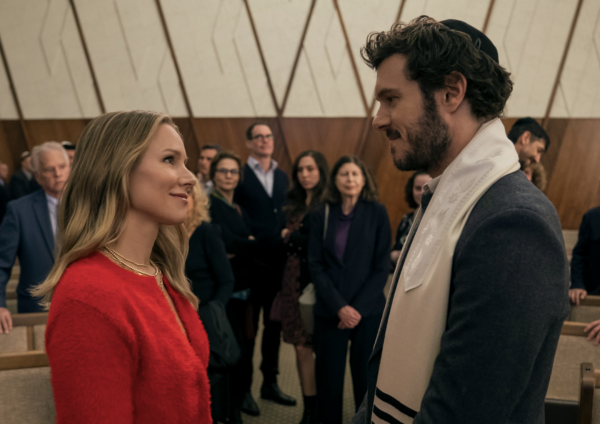
The series also does a good job in depicting how complicated (and funny) family relationships can be, especially when a new romantic entanglement of one of its members occurs and when the new love interest is perceived as being an “outsider,” as Joanne is by Noah’s family.
In Episode 3 in a hospital waiting room, Noah’s family is gathered together because his previous girlfriend, the Jewish Rebecca, ran her car “into the back of a parked bus and . . . broke her wrist.” Rebecca’s parents are also there. It is suggested the heartbroken Rebecca had the accident because Noah had broken up with her. Noah’s mom says to him tell us “that your heart is open to a reunion,” but Sasha’s wife, Esther, explains that Noah “got himself a shiksa.”
Later on, in Episode 9, Joanne asks Noah if its “true what they say about Jewish boys and their moms,” and if he still kisses his mom on the lips. In that same episode Joanne comes to dinner at Noah’s parents’ house, along with Sasha and wife Esther. Noah’s mom’s question to Joanne about her religious beliefs has already been mentioned, but there are also some other uncomfortable, but funny, moments that happen on that occasion. One relates to Joanne's introduction to Noah’s parents. After Joanne calls his dad Mr. Roklov, he says “Please, call me Ilan.” But after Noah introduces his mother, Bina, and Joanne says, “It's a pleasure to meet you, Bina,” the more standoffish mom replies, “Please, call me Mrs. Roklov.”
There’s also the problem with “the gift” Joanne brings to the dinner--prosciutto. After Bina asks if its pork (which Judaism forbids), Joanne responds “no, no, no, no, no,” and that it was made from “fancy Italian beef.” After she is corrected, Bina orders that the prosciutto be thrown in the trash.
During dinner, there’s this exchange between Joanne and Bina that reflects not only different religious and cultural traditions, but also generational divisions. When asked what the podcasts she and sister Morgan are about, Joanne responds they’re “about sеx and relationships in the modern world.” Bina then asks, “And this is how you make money? Talking about what you do behind closed doors with sеx and men in front of the whole world? I mean, people actually pay to hear this?” Joanne responds testily, “Yeah. That's how I make money. Uh-huh. How do you make money?” Bina then comes back with, “Well, I was busy. . . raising children, which I know is not as important as talking about all my former lovers for public consumption. Honestly, it's embarrassing. No woman should act this way.”
After Noah injects, “Mom, enough,” and Bina gets up and storms into the kitchen, Joanne goes in to patch things up, and what does she find? Bina eating the prohibited prosciutto! (But she then earns Bina’s gratitude by lying to the family about what she saw.)
Nevertheless, as Noah and Joanne are about to leave after the dinner and Bina tells Joanne, “I like you so much more than I thought I would,” she also whispers “you're never gonna end up with my son.”
Religious, ethnic, and generational differences, as well as opposing family traditions, all treated with humor. Thus, there’s plenty of figurative “meat” here, and it’s not pork.
