


Philosophers have long been concerned with “How Does One Lead a Good Life?” And it is a question that not enough people probe deeply.
I like films that make me think. “Perfect Days,” a 2023 film of famous German film director Wim Wenders, is such a movie. I have not seen many of his previous productions, but I do remember seeing his Wings of Desire (1987), which I enjoyed very much. Two angels (literally) in Berlin are among its central characters. One of the angels, Daniel (the great Swiss actor Bruno Ganz), falls in love with a beautiful trapeze artist, and he therefore chooses to become mortal so that he can have human experiences like romantic love.
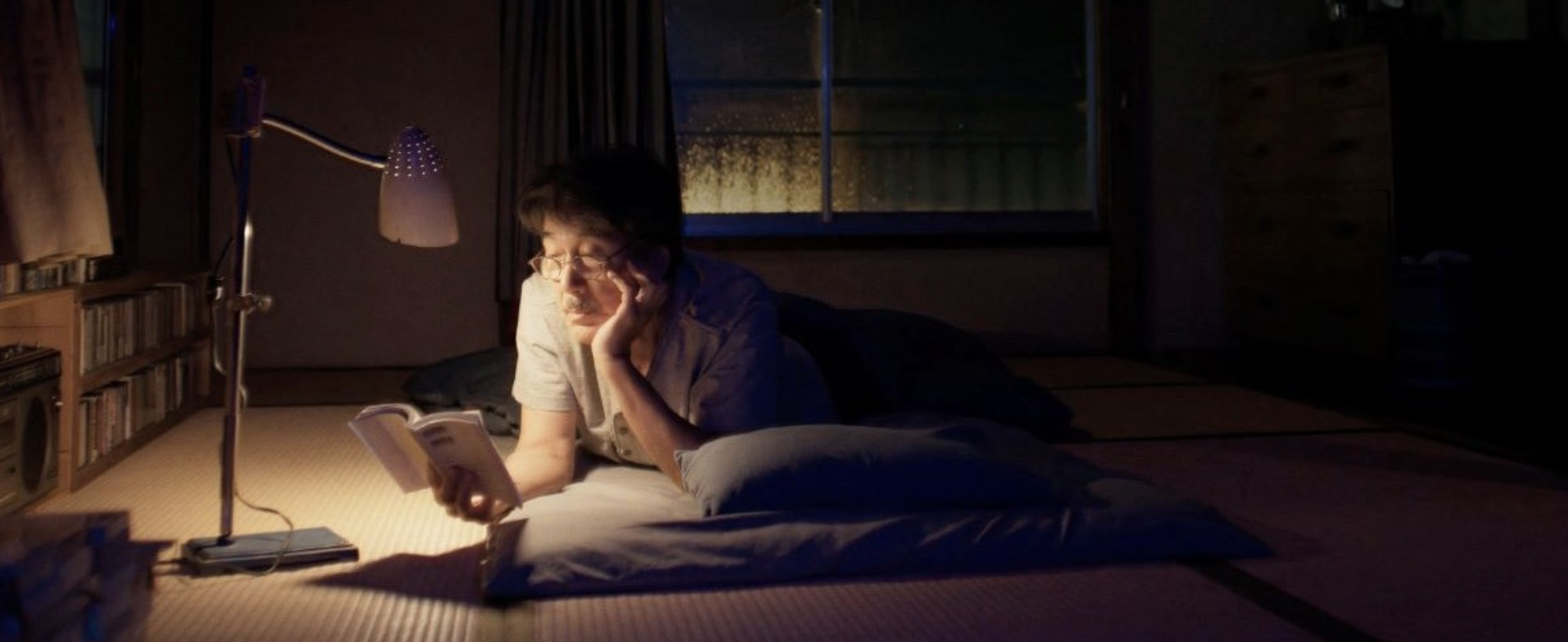
“Perfect Days,” however, goes in a somewhat opposite direction. Its central character is Hirayama (an excellent Koji Yakusho), a middle-aged man who cleans public toilets in Tokyo. He is unmarried and has no romantic love in his life. And yet, unlike the angel Daniel in Wings of Desire after falling for the trapeze artist, Hirayama seems fully content with his existence. Like the Stoics, he seems to have accepted the fact that he can’t control many external events, but that he can control his own “thoughts, opinions, decisions and duties.”
Philosophers have long been concerned with “How Does One Lead a Good Life?” And it is a question that not enough people probe deeply. It is also a question that the great Russian writer Anton Chekhov had two of his characters debate in his short story “In Exile.”
The debate, which occurs in late 19th century Russia, is between “Semyon, an old man of sixty” and a Tatar of “not more than twenty five” who has been exiled so that he is now separated from his wife. Semyon’s philosophy is, “If you want to be happy . . . the chief thing is not to want anything.” The Tatar’s response is that if his “wife came to him for one day, even for one hour, that for such happiness he would be ready to bear any suffering and to thank God. Better one day of happiness than nothing.” And a little later he adds, “God created man to be alive, and to have joy and grief and sorrow; but you [Semyon] want nothing, so you are not alive, you are stone, clay! A stone wants nothing and you want nothing. You are a stone, and God does not love you.”
Although Chekhov does not tell us if the old man has been influenced by any religious beliefs, he sounds sort of like a Buddhist. One Buddhist site declares that the Four Noble Truths “are perhaps the most basic formulation of the Buddha's teaching.” And two of those truths, numbers 2 and 3, sound similar to Semyon’s thinking. Number 2 is that the cause of suffering is craving or desire, and Number 3 is that the cessation of suffering comes from ceasing to crave or want.
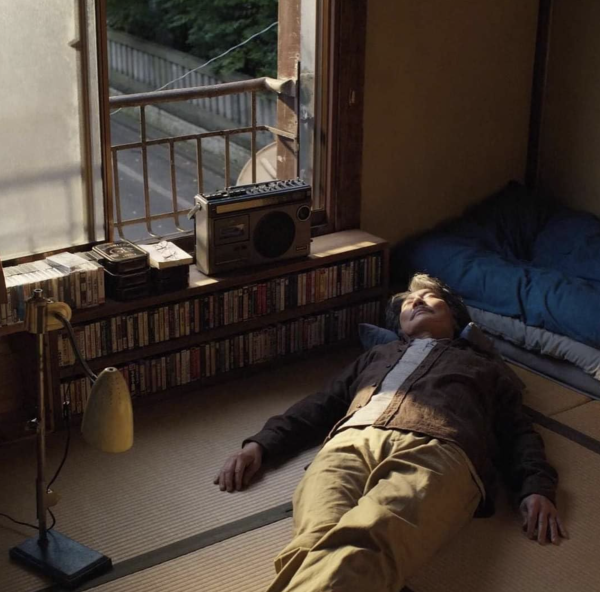
Before going further, however, here is a summary of “Perfect Days.” It begins with a depiction of Hirayama getting up in the morning and going to work. He sleeps on a mat upstairs in an old-fashioned dwelling near the center of Tokyo. We see a book near the mat, which he puts away, and he folds up his mat and puts it in a corner. The room is simple and neat.
Before he gets in his van and drives to work, he goes down steps to a small room with a sink where he brushes his teeth, washes his face, and trims his mustache. After going back up stairs, he waters his plants and then puts on coveralls with the words “The Tokyo Toilet” on the back. Going outside, he looks up at the sky with a smile on his face, and buys a can of coffee from a vending machine. After getting in his van, he takes a drink and inserts a cassette tap in his van’s tape deck.
We see this routine repeated several times in the film, and Hirayama is a man who seems to enjoy his life’s simple routines. Especially meaningful is his choice of cassette music, most of it from English-speaking individuals or groups, like Lou Reed’s “Perfect Day,” whose title reflects what Wenders wishes to say about Hirayama’s days. Between the song and the film, however, there is one crucial difference, but more on that later.
The song that plays the longest (for several minutes) and that we hear the most of comes near the movie’s end. It is "Feeling Good," which was written for a 1964 British musical. Its most significant words—sometimes followed by “You know how I feel. It’s a new dawn. It’s a new day”—are “Birds flying high...Sun in the sky...Breeze driftin’ on . . . It’s a new dawn...Fish in the sea...River running free ...Blossom on a tree...Dragonfly out in the sun ..Butterflies all havin’ fun...Sleep in peace when day is done...And this old world is a new world and a bold world for me . . . Stars when you shine...Scent of the pine...Oh freedom is mine...I’m feeling good.” While he is listening to the tape, we sometimes see Hirayama smiling broadly, and near the end of it the sun rises along the Tokyo skyline.
Once he arrives at work, he cleans the public toilets, sinks, and mirrors with gusto. As in his home, so at his places of work, everything is neat and clean. The toilets are often set in attractive areas with trees surrounding the public facilities. During his lunch break, in which he eats a sandwich, he often takes out a small camera and takes a picture of the tops of trees and the the sky beyond.
To all he comes into contact with—a young co-worker, Takashi; restaurant, bookstore, and music store employees; people he encounters at a bathhouse; and others he meets as he pedals around Tokyo on his bike—he is polite and considerate. He even gives Takashi money so he can spend it with his girlfriend.
But there is only one person in Perfect Days that Hirayama seems close to, and that is his teenage niece, Niko, who comes to stay with him for a few days. As would be expected from such a kind man, he relinquishes his sleeping mat and space to her, while he retreats to a more cramped and uncomfortable area.

Niko is the daughter of his sister Keiko, and Niko ran away from her to stay with Hirayama, and for a few days she accompanies him to work and as he bikes around town. But a few days later her chauffeured mom comes to pick her up. Niko says that her mom says that she and Hirayama live in “a different world,” and his sister asks him (we sense disapprovingly), “Are you really cleaning toilets?”
Earlier, I mentioned that there was “one crucial difference” between Lou Reed’s “Perfect Day” and Hirayama’s days and that I would deal with it later. Well, here it is: In Reed’s song after the words “it's such a perfect day” we hear “I'm glad I spent it with you” and “You just keep me hanging on.” We imagine a romantic relationship, and indeed Reed wrote the song after a day spent with his fiancée.
I once knew a middle-aged single man who, like Hirayama, seemed happy and to be leading a good life. But I wondered sometimes if his single life did not lead to his feeling lonely at times. Loneliness is a serious problem in the U. S., one I have addressed and indicated that one way of dealing with it is for us to realize our oneness with other living beings. Both human and non-human ones, like those “found in nature, whether they be in the animal or non-animal world like the sun, moon, flowers, or trees.”
But I have also frequently stated that I think love is the most important phenomenon in the world. And even though there are many different kinds of love and Hirayama certainly displayed some of them—e.g., love of other human beings and of nature—he did not have another person (like a wife) whom he could love day after day.
Of course, all of us are unique individuals and have different needs and opportunities. Thus, it is possible that Hirayama was not only enjoying life, but leading the best life that he could. But having experienced the single life until I was 25 and again now as a widower, the best years of my life were the six decades in which I had Nancy (my now deceased wife) to love. Thus for me a “perfect day” was not one spent like Hirayama spent most of his days, but more like Lou Reed who could sing, “Oh, it's such a perfect day / I'm glad I spent it with you” (i. e., for me, Nancy).
