

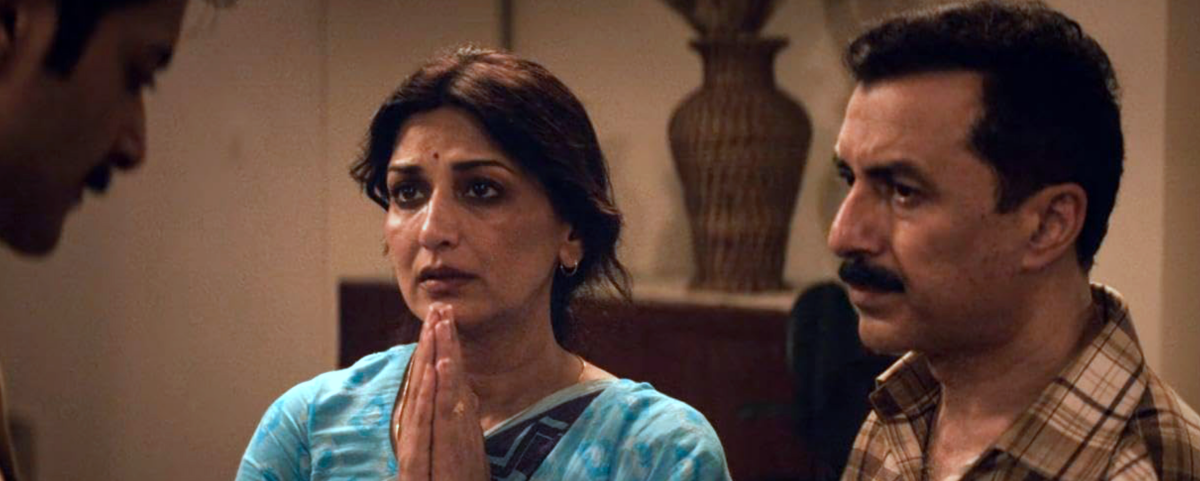


The main focus of the film is the murder of the two young teenagers, the attempt to find their killers, and the grieving of the brother and sister’s parents.
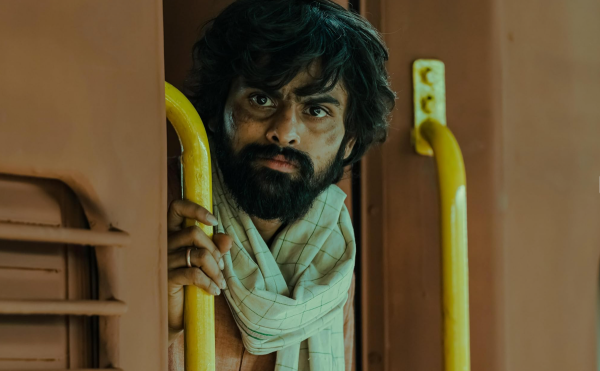
The eight-part series (37-48 minutes each) “Raakh” (a Hindi word meaning ash) is loosely based on a famous 1978 case that shocked India and the way it regarded crime. As retold in this subtitled series, the perpetrators were two young men who murdered two young teenagers (a brother and sister), as well as a few others. One of the criminals, Bapu (Akash Makhija) clearly dominated the other, Rajjo (Ramandeep Yadav), and at times challenged his manhood, which sometimes led Rajjo to try to prove himself and win Bapu’s approval.
The kidnapping and murder of the brother and sister occur in Episode 1, and so the remainder of the series mainly involves the tracking down of the killers and the grieving of the deceased's parents. The main person who hunts down Bapu and Rajjo is Delhi policeman Sub Inspector Jayprakash Jatav (Ali Fazal).
Since most Western viewers will not be aware of much about Indian society, they are liable to miss some of the film’s subtleties. But what they tell us about the makeup of Indian society is important. Take, for example, the question of Dalits (sometimes referred to as untouchables). In 1999, they numbered about 160 million people, and had long been “outcastes,” that is below the lowest cast in the Indian caste system. Both Gandhi and India’s first prime minister (after achieving independence from Great Britain in 1947), Jawaharlal Nehru, opposed such discrimination, and Martin Luther King Jr., in a 1959 trip to India, talked to Nehru and noted similarities between the treatment of Dalits and U. S. Blacks.
The hero of “Raakh,” police officer Jayprakash, has the same name as “a prolific Hindi Dalit writer,” Dr. Jai Prakash Kardam, and most Indians from this and other signals would recognize the Dalit backgroround of the story’s hero.
Another subtlety in the movie is the relationship between Jayprakash and the female reporter Nisar. Again, most Western viewers would be unaware that she is of Muslim background, but the name Nisar is a Muslim or Arabic one and means one who sacrifices oneself. The division between Hindus and Muslims in India has been important in Indian history, leading to the division of British India into today’s India and Pakistan. (Due to a secessionist war, with India aiding Bangledesh in 1971, there was a further split again into Pakistan and Bangledesh.) In the 2011 Indian census, 172.2 million people identified as Islamic, making it the third-largest Muslim country in the world.
In an earlier review of another Indian film, I have mentioned how Hindu-Muslim antagonism led to conflict in the disputed area of Kashmir, and eventually to the 1948 assassination of Gandhi. I also alluded to the present intolerance of Indian Muslims by Hindu nationalist Prime Minister N. Modi.
But the main focus of the film is the murder of the two young teenagers, the attempt to find their killers, and the grieving of the brother and sister’s parents. As so often happens when coming across other major tragedies—for example, the Holocaust—we ask ourselves, “How could people be so evil as to perpetrate such crimes?”
In a review late last year, I suggested that poor values were perhaps the best explanation for such radical evil as the Holocaust. I quoted U.S. neuropsychologist and Nobel laureate Roger Sperry, “Human value priorities . . . stand out as the most strategically powerful causal control now shaping world events. More than any other causal system with which science now concerns itself, it is variables in human value systems that will determine the future.” I also cited economist/environmentalist E. F. Schumacher’s quote that education failed to answer questions like “What is our purpose in life?” and “What are our ethical obligations?”
Although conservatives have often stressed values, they have also often neglected ones like tolerance, empathy, humility, and love that are important for democratic well-being. Partly because conservatives emphasize value issues such as abortion, pornography, illegitimacy, infidelity, and homosexuality—see, e.g., Ben Wattenberg’s Values Matter Most(1995)—many liberals and progressives neglected to address the question of values. At least until Barack Obama, in his The Audacity of Hope (2006), wrote that the question of values should be at “the heart of our politics.”
In “Raakh” (Episode 3) Bapu tells Rajjo that he’s been a hot head since youth, but he can’t help it. He never had a father, and his mother was burned to death in a kitchen. But Bapu is an unreliable narrator. In Episode 6 Jayprakash visits Bapu’s mother in a hospital, where we see her with a terribly burned face. She tells him that Bapu ruined her life; that he’s a “monster”; and that he burned down everything, including their house and a baby girl. Later, while still a young boy, he broke open a beehive, releasing the bees on another young boy, whom he prevented from running away by locking the bee-infested room so the bees could sting him until he died. Later, from 1966 until 1972, Bapu was incarcerated in a Juvenile Correction Home.
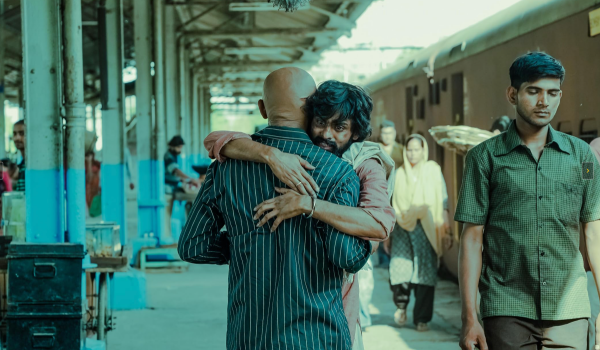
Rajjo has a different story. He grew up in a village before making his way to Bombay and Delhi. He seems to have lacked confidence and fell under the dominating influence of Bapu.
Besides the kidnapping and murder of the two young teenagers, the two criminals committ various other heinous acts, including murdering others, with only Rajjo occasioally acting squimishly about them.
Besides demonstrating the evil of the two criminals, the series is also good at depicting the great grief of the victims’ parents. For a long period after their deaths, their mother, Mona (Sonali Bendre), refuses to accept what happened to them and insists they are still alive. Their father, Ashok (Aamir Bashir), a 1971 war-hero officer, is more stoic, but also deeply troubled by the senseless killing of his two children. (We see him grieving already at the beginning of Episode 2, but the circumstances of their killing, when they accepted a ride to a radio station in driving rain, is not depicted until the final episode.)
Even more attention is paid to the relentless pursuit of the killers by officer Jayprakash, who finally captures them, thanks in part to forensic evidence, in Episode 7. In the final episode, he says that the killers “weren’t thinking at all . . . of what is right and what is wrong.”
Jayprakash and his friend, female reporter Nisar, offer the moral underpinning of the series. At one point (in Episode 8), she says that the crimes of Bapu and Rajjo changed Delhi forever, and although the savagery of humans remains, dealing with their crimes was “also the story of voices calling for justice. . . . hope that in days to come . . . Delhi will recover its lost humanity.” A little later Jayprakash says “the real fight is not to lose hope” and “these are the words of a very dear friend.”
Earlier I mentioned Obama’s The Audacity of Hope, and in these Trumpian times I have written of the great importance of hope. Thus, like Jayprakash, I believe we must keep hope alive, and like him doggedly pursue justice.
In summary, “Raakh” is not only an extremely well-written (by Anusha Nandakumar and Sandeep Saket), directed (by Prosit Roy), and acted series, but also gives us much to think about, such as the causes of evil and the need for hope.
