

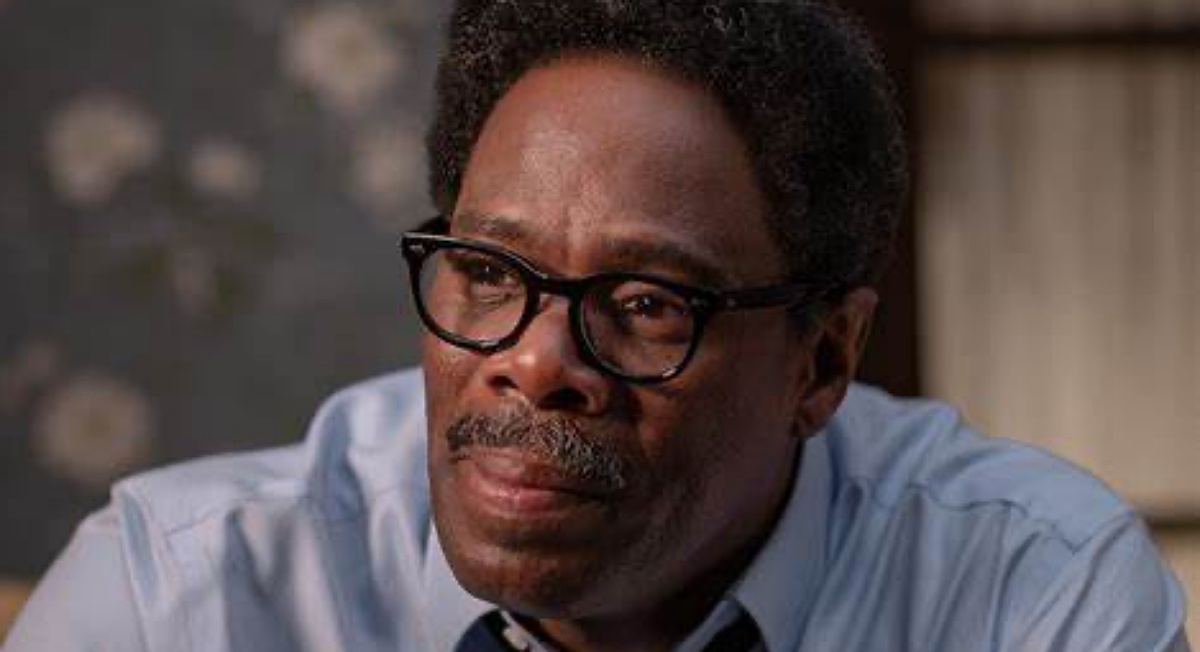

With Rustin battling various foes to the march he works so hard to put on, plus all the prejudice against a gay man, there’s plenty of drama.
For those of us who admired Martin Luther King in the 1960s, when some (like FBI director J. Edgar Hoover and South Carolina Sen. Strom Thurmond) erroneously believed he was spewing communist propaganda, the new Netflix film “Rustin” is a joy to watch.
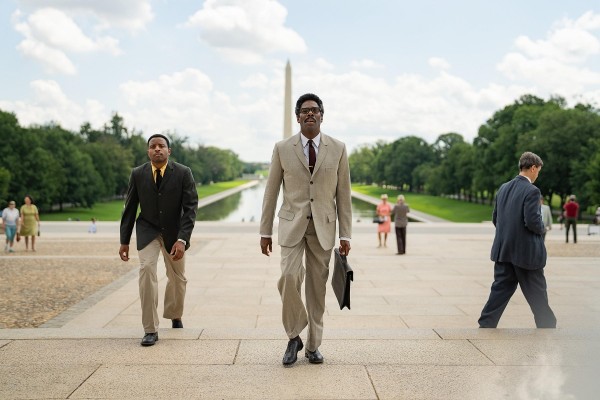
It concentrates mainly on Bayard Rustin’s chief role in organizing the March on Washington for Jobs and Freedom (August 28, 1963). It was on that occasion that Martin Luther King, Jr. (MLK) delivered his famous , part of which is depicted near the end of the film (We will be able to speed up that day when all of God's children, black men and white men, Jews and Gentiles, Protestants and Catholics, will be able to join hands and sing in the words of the old Negro spiritual, Free at last! Free at last! Thank God almighty, we are free at last!)
Bayard Rustin (1912-1987) was a Black leader who was a generation older than MLK, but in the early 1960s an important adviser to him. Among the general public, however, Rustin is little known, which is unfortunate, but the “Rustin” film may help correct that.
He was not only the chief planner of the 1963 march and an adviser to King, but also a pacifist (influenced by the Quakers and Gandhi) and a gay man. Although the film about him emphasizes more thoroughly Rustin’s important work regarding Black rights, his homosexuality is frankly acknowledged, often by depicting his complex relationship with two younger men, Tom Kahn (Gus Halper) and the fictional Elias Taylor (Johnny Ramey).
At one point Rustin says, “On the day I was born Black, I was also born homosexual. You either believe in freedom of justice for all or you do not.”
At one point Rustin says, “On the day I was born Black, I was also born homosexual. You either believe in freedom of justice for all or you do not.” However, Rustin did not publicly push for gay rights until the 1980s.
Yet, with the right-wing counter attack against such rights occurring at present, the topic remains important, as does Rustin’s frank acknowledgment of his own gayness.
Among those who wrote, produced, directed, and acted in “Rustin” not only do Blacks play leading roles, but so too do gays, especially Emmy-award-winner Colman Domingo, who plays Rustin. As late as 1986, only a year before his death, a Supreme Court ruling (Bowers v. Hardwick) upheld a Georgia law outlawing sodomy. (In the USA homosexual sexual acts were usually prohibited by sodomy laws, and in the 1980s more than 70 percent of those polled in the USA thought it was “wrong for same-sex adults to have sexual relations”—today the percentage has dropped to a little less than 30 percent.) In the 1950s, Senator Joseph McCarthy attacked not only communists, but also homosexuals and often referred to a 1950 Senate report entitled “Employment of Homosexuals and Other Sex Perverts in Government.”
The mention of communists above is here relevant because from 1936 to 1941 Rustin was a member of the Young Communist League, not an uncommon occurrence (as the 1949 book “The God that Failed” indicates) for leftist intellectuals. In “Rustin” NAACP head Roy Wilkens (played by Chris Rock), who often thought Rustin too militant, refers to him as a “former communist Quaker.”
Besides Wilkens, the other chief Black leader whom the film often pits Rustin against is Rep. Adam Clayton Powell Jr. (Jeffrey Wright), who in one scene keeps mysteriously referring to Pasadena, where in 1953 Rustin was arrested for having sex with two men in a parked car. (A little later the film airs Sen. Thurmond mentioning this charge on the radio, and in 2020 it was pardoned by California Gov. Gavin Newsom.)
As words on the screen tell us at the end of the film, “250,000 people attended the March on Washington, making it the largest peaceful protest to date. Nine months later, The Civil Rights Act...was passed by Congress.” In his biography of Robert Kennedy, Arthur Schlesinger Jr. writes, “Certainly that afternoon in August had a purity that no one present can ever forget.” (Although I was by 1962-63 in D. C. for graduate school at Georgetown, at the time of the march I was fulfilling obligatory two-week military reserve duty in Kentucky.)
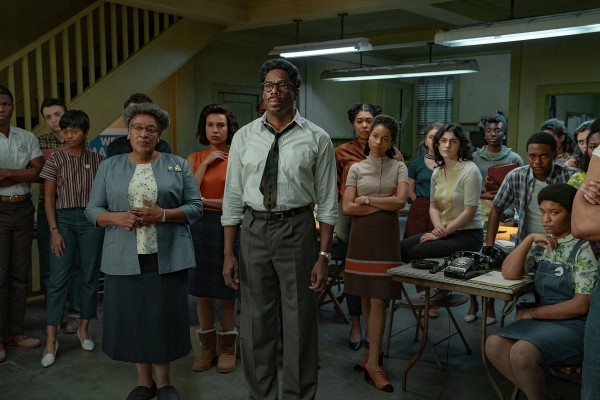
Schlesinger also noted the multi-racial cooperation that existed leading up to the march. And even though the film makes clear the Black leadership of Rustin, aided by other Blacks like King (Aml Ameen) and A. Philip Randolph (Glynn Turman), as well as all the Blacks who helped plan the march, it also depicts the help that White workers provided. (As MLK noted in 1966, “There’s going to have to be a coalition of conscience and we aren’t going to be free here in Mississippi and anywhere in the United States until there is a committed empathy on the part of the white man.”)
The film also depicts the help, albeit fitfully and too slowly at times, that the Kennedy administration provided. But a few months after the march JFK was assassinated, and in 1968 so were MLK and Robert Kennedy (RFK), and earlier MLK was sharply critical of the Vietnam War, conducted by the new president, Lyndon Johnson. By the end of 1968 with JFK, MLK, and RFK all gone from the scene and Richard Nixon the president-elect the “glory days” of the earlier 1960s were indeed gone.
Moreover, “Rustin” ends with Rustin helping to clean up after the enormous crowd facing the Lincoln Memorial had departed. It does, however, mention that “in 1977 Bayard fell in love with Walter Naegle [a White man] and they were together until Bayard passed away in 1987.” And it also states that 50 years after the march, Rustin was posthumously awarded the Presidential Medal of Freedom—presented to Naegle on August 8, 2013 by President Obama.
As an entertaining and educational film, “Rustin” is first class. As Rustin, Colman Domingo is terrific, and the rest of the cast includes many fine actors—e.g., Jeffrey Wright (as Powell), Audra McDonald (as Ella Baker), and Glen Turman (as Randolph)—who do a good job. With Rustin battling various foes to the march he works so hard to put on, plus all the prejudice against a gay man, there’s plenty of drama.
Favorite scenes usually reflect personal taste but two of mine were in June 1963 when Rustin goes to MLK’s home in Atlanta. He is greeted by King’s wife Coretta, whom he had previously known. As they’re in the kitchen—baby Bernice being held by Coretta and the King’s other three children shucking corn on the cob—Rustin encourages Coretta to join him in singing the African American spiritual “This little light of mine, I’m gonna let it shine.” Both Rustin who went to college on a music scholarship and Coretta, who once had planned to become an opera singer, had excellent voices, and it’s a delight to hear them singing, along with the three older children who join in.
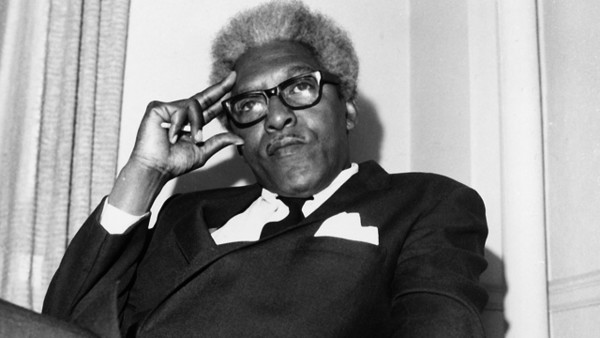 Bayard Rustin
My other favorite scene is when one of Rustin’s workers planning for the march reads from cards phrases to which attendees at the speeches were asked to pledge. Here are some of the words he reads, which are only slightly different than those which the enormous crowd in the front of the Lincoln Memorial were asked to assent to, “[I will] pledge my heart, mind, and body, unequivocally and without regard to personal sacrifice, to the achievement of social peace through social justice. I pledge to carry the message of the March to my friends and neighbors back home and to arouse them to an equal commitment and an equal effort. I will march, and I will write letters. I will demonstrate and I will vote. I will work to make sure that my voice and those of my brothers ring clear and determined from every corner of this land.”
As in real life but not in the film, Rustin told the crowd, “Our job has just begun. You pledge to return home to carry on” the work. It is to our national shame that today, 60 years later, with Trumpism still a threat, much of that work remains to be done.
