

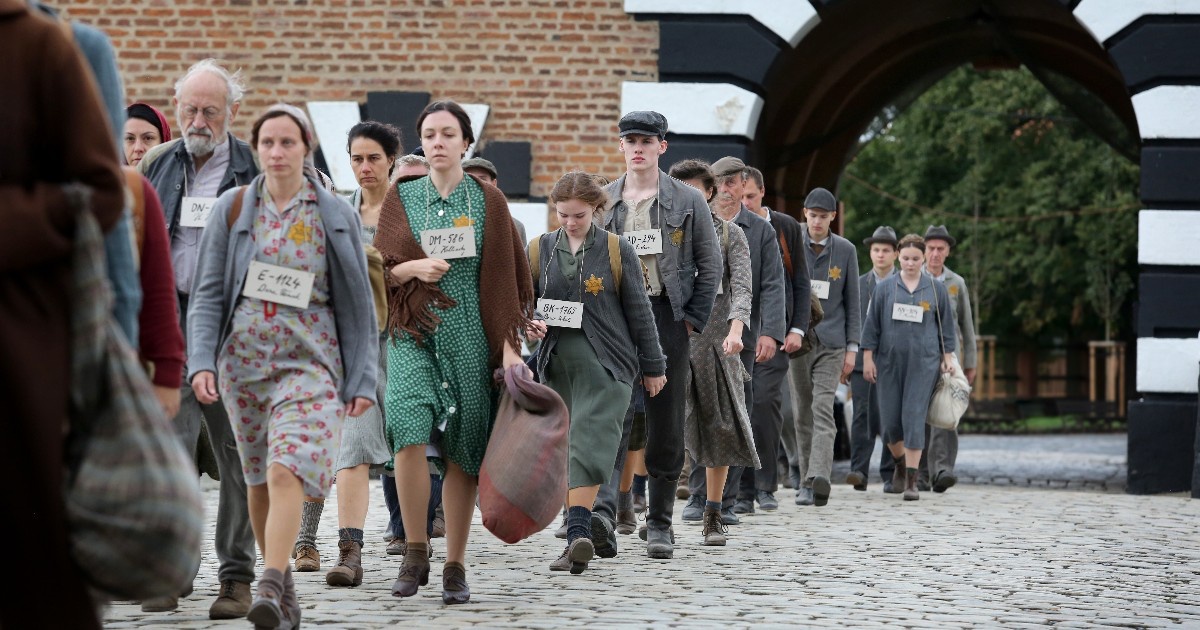

Nothing is as heart wrenching as seeing children in a makeshift classroom drawing pictures and then reading that “less than one percent” of all the children in the camp survived.
“Terezin” is a sad 2024 movie about a Nazi prison camp—Terezin. So why should anyone watch it? Primarily because life can be sad. For example, we all have to die. And many of us have to see some of those we love die. To grapple with such sadness as the end of life, we need to be thinking about how we approach it, and films like Terezin can stimulate such thinking.
About a decade ago I wrote that the famous Russian writer Leo Tolstoy wrote in his My Confession how “nothing from the outer world has any interest,” how he was “strongly tempted [in the late 1870s] to end his own life.” And I asked, “If such thoughts can come to someone like Tolstoy with all his talents, wealth, health, fame, and devoted family, what hope is there for us less fortunate humans?”
I noted that religion comforts some, but does not work for all, and suggested that transcendence, which involves the central intuition of our unity with nature and others (and maybe God and maybe not), might be another answer. I also indicated that for me it has come primarily from three sources of beauty: nature, the arts, and love.
First, some words about the Terezin prison camp. It was located about 35 miles north of Prague. One Czech website devoted to the camp states this: “It held primarily Jews from Czechoslovakia, as well as tens of thousands of Jews deported chiefly from Germany and Austria, as well as hundreds from the Netherlands and Denmark. More than 150,000 Jews were sent there, including 15,000 children, and held there for months or years, before being sent by rail transports to their deaths at Treblinka and Auschwitz extermination camps in occupied Poland, as well as to smaller camps elsewhere. Less than 150 children survived.”
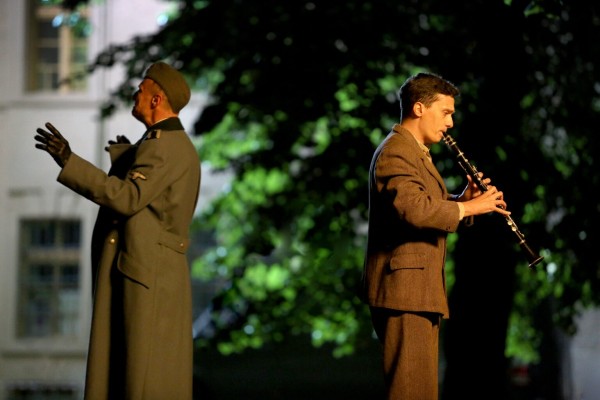
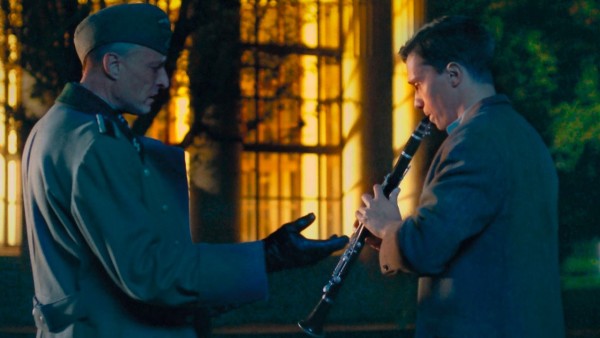
What distinguishes the present Terezin movie from other Holocaust films is its emphasis on music. The two main characters are Antonio, a clarinetist and Italian who had come to Prague to study music and then remained, and Martina, a Czechoslovak violinist, who became his lover. At one point, Antonio tells the camp’s musical conductor, “music is the most important thing we have.”
Another point the film makes—and its related to the camp’s musical connection—is the Nazi determination to disguise the horrendous conditions inflicted on the Terezin prisoners and fool outside visitors. (Such false depictions were also common in other totalitarian countries like the Stalinist Soviet Union.)
Receiving special attention in the movie is an International Red Cross (IRC) visit in June 1944. Elaborate preparations were made for it, among which was temporarily halting “the activity of the corpse incinerator. For at least three days beforehand. The air will become less smelly,” says the camp commandant. For the IRC, special musical performances were also performed including the playing and singing of the Italian composer Giuseppe Verdi’s “Requiem.”
Several websites are devoted to music at Terezin, and one suggests why the Nazis permitted it. As one prisoner wrote:
Terezín eventually bloomed (more openly and with little Nazi interference) into a place of recitals, lectures and readings, theatre and jazz, performed by well-known artists, who found themselves here like the rest of us. They all seemed superb to me. No doubt the display of their talents—as long as the Nazis allowed them to perform—eased their own despair and briefly turned Terezín into a small but vigorous cultural center. At the height of its creativity, operas and operatic works were regularly produced, among them Mozart’s Magic Flute, Verdi’s Requiem, Bizet’s Carmen.
On looking back, it still remains somewhat of a mystery to me how it happened that such performances and such works were permitted. Obviously the Germans needed at that time to maintain a showplace for propaganda purposes. . . . [my bolding] At one point, the Germans even agreed to allow the International Red Cross to inspect Terezín. Blatant charade though it was, it meant some additional comforts. . . . : All this at the very same time that hundreds were dying within Terezín’s walls and thousands were being deported at regular intervals to outlying death camps. It was quite possible for a pianist to be performing at Terezín’s city hall at the exact moment that a member of his family was being put on a “transport” to Auschwitz.
One such person transported to another prison camp shortly before the musical performances for the IRA was Antonio’s love, Martina. After she leaves, Antonio reads her letter which states, “My name has been added to the list and I have to leave you. I don’t know what awaits me nor where they’re taking me. All I know is that the love we have for each other will give me the strength to wait. And you to look for me and find me. I’m looking at the star studded sky of Terezin. And in the face of so much beauty I can’t be afraid. Be strong, as I will be. Yours forever, Martina.” (I’ll leave it to potential viewers to discover for themselves whether or not the lovers are ever reunited.)
One final fact that the movie does reveal—by words on the screen at the end—is that “during her detention in Terezin, Friedl Dicker-Brandeis, a talented Austrian art teacher, began a drawing class for the detained children. The result was a collection of over 4.387 drawings which were hidden in suitcases, and only found man years after the ghetto’s liberation. Today, they are kept and displayed in the Jewish Museum in Prague.”
Of all the tragedies depicted in the movie, nothing is as heart wrenching as seeing children in a makeshift classroom drawing pictures—Martina worked with the kids—and then reading that “less than one percent” of all the children in the camp survived. One famous Jew who left Germany before the camps could imprison her was Hannah Arendt, and she later wrote on the nature of evil, including that displayed in the Nazi camps. There are no easy answers to explain such evil. But in 2013, Pope Francis pointed to one explanation—ideology, which he called “a serious illness.” He criticized “Christians who lose the faith and prefer the ideologies.” It makes them “rigid, moralistic, ethical, but without kindness.” And Francis is right. Any ideology, whether of the Right or Left, that makes us rigid and reduces our kindness to our fellow human beings is harmful.
But back to transcendence. In my decade-old essay on it, I cited numerous examples of how music, art, and love can help lift us above the evils—even the senseless killings—that occur too frequently around us. One of the great benefits of viewing “Terezin” is that even in the midst of great evil it reminds us of that truth.
