

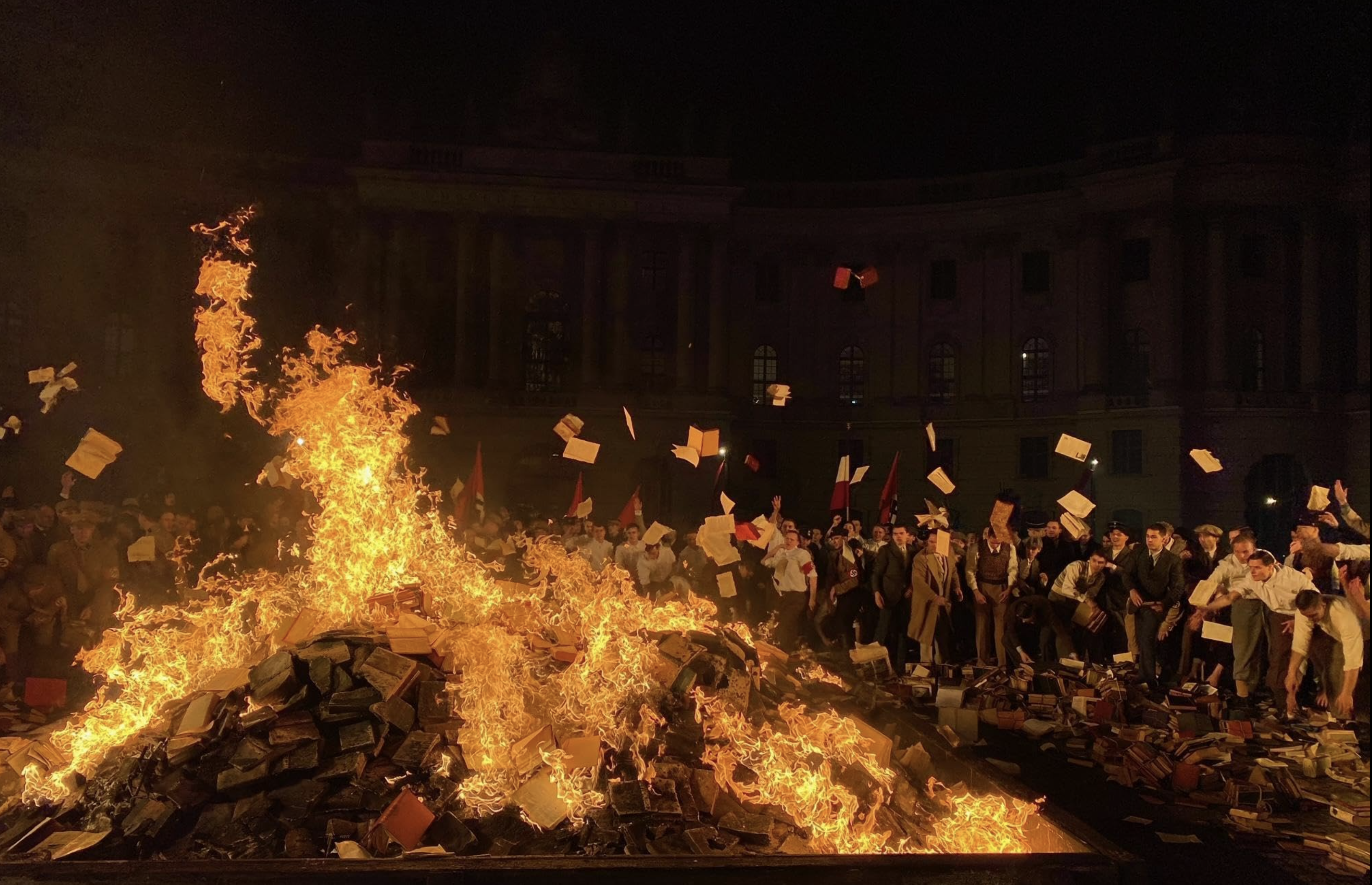

To understand the similarity of discrimination against Jews in Nazi Germany, Dalits in India, and Blacks in the USA, Wilkerson and DuVernay prefer to target the caste system as opposed to race.
The director of the 2023 film Origin, Ava DuVernay, is a talented woman who has directed other films such as Selma (2014). And a reviewer in The New York Times described the book DuVernay has chosen to use as a basis for her new film, Isabel Wilkerson’s Caste: The Origins of Our Discontents (2020), as an “Instant American Classic.”
In it what Wilkerson does by exploring the concept of caste is broaden our understanding of racism. She helps us to see its similarity with the Nazi’s treatment of Jews or India’s discrimination against Dalits, formerly called “untouchables.” But neither Jews nor Dalits are a race, and thus discriminating against them is not really “racism.”
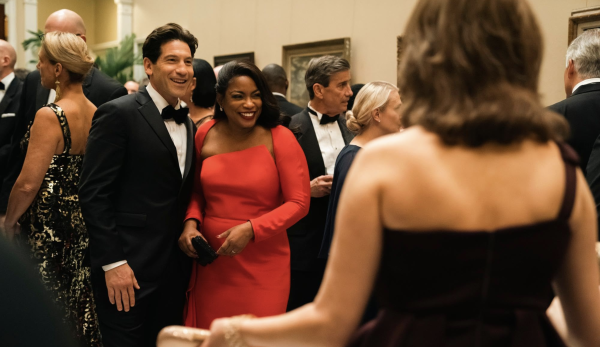 Aunjanue Ellis-Taylor and Jon Bernthal
While that latter term means something, and most of us in the USA know what it is, “race” is not so clear. Toward the end of the twentieth century, the Executive Board of the American Anthropological Association issued a statement that declared: “With the vast expansion of scientific knowledge in this century, however, it has become clear that human populations are not unambiguous, clearly demarcated, biologically distinct groups... There is greater variation within ‘racial’ groups than between them...‘Race’ thus evolved as a worldview, a body of prejudgments that distorts our ideas about human differences and group behavior.” Moreover, it added that the concept of race “became a strategy for dividing, ranking, and controlling colonized people used by colonial powers everywhere.”
To understand the similarity of discrimination against Jews in Nazi Germany, Dalits in India, and Blacks in the USA, Wilkerson and DuVernay prefer to target the caste system as opposed to race. Because as Wilkerson (Aunjanue Ellis) says in the film. “Racism is not the same as caste.” (Film quotes are taken from a filmscript, which adheres very closely to film dialogue.)
So far in this review/essay, Wilkerson and DuVernay seem to be on target, but the quality of Origin as a film and as a work of art has to be explored further. To begin with, the director’s approach is unusual, for her film is primarily the story of Wilkerson writing her book mixed together with her personal life as she goes through the process. We see her traveling to Germany and India and becoming more convinced of the merit of “caste”—as opposed to racism—as an all-encompassing concept for explaining discrimination.
As the concept and its usefulness becomes more fixed in her mind, she becomes more preachy, and the film teeters on the brink of becoming too didactic—and at 2 hours and 20 minutes too drawn out and long. (Some viewers will no doubt conclude that some of the scenes depicting Wilkerson typing at her keyboard could have been cut.) Also it goes too far sometimes in linking Nazi, India, and USA discriminatory occurrences, some of the horrors of which DuVernay depicts on the screen.
One saving grace, however, is that Wilkerson’s mental path to discoveries about caste, her research and writing, is interwoven with her own personal suffering—the death of her husband, Brett, still in his forties, her mother, and her best friend and cousin, Marion. At the end of the film (except for credits, some images, and Stan Walker’s song “I Am”) the following words appear on the screen: “To the memory of my parents who survived the caste system and to the memory of Brett who defied it.”
Perhaps because I recently had to cope with the death of Nancy, my wife of 58 years, and also found research and writing a useful coping mechanism, I found Wilkerson’s struggles meaningful and empathized with her.
I also liked her emphasis on love, tolerance, and freedom. Talking by phone from India to her dying cousin Marion, Isabel tells her, “I love you. I love you. I love you.” And almost at film’s end, she links overcoming caste with freedom. This victory would provide, “Freedom to love whoever you want to love. Freedom to go wherever you want to go. Freedom to express yourself however you want to express yourself. Freedom to resist and fight for your human right to do so.”
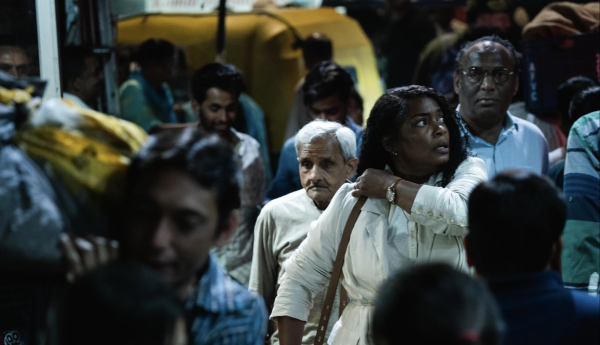 Aunjanue Ellis-Taylor
In linking freedom to overcoming caste, Wilkerson and DuVernay follow the example of Martin Luther King Jr.—whose trip to India and reflections on caste are mentioned in the film. He ended his famous “I Have a Dream” speech with “when we allow freedom to ring, when we let it ring from every village and every hamlet, from every state and every city, we will be able to speed up that day when all of God's children, black men and white men, Jews and Gentiles, Protestants and Catholics, will be able to join hands and sing in the words of the old Negro spiritual: Free at last! Free at last! Thank God Almighty, we are free at last!”
One difference between the book and the film is mention of the presidential election of 2016 and of Donald Trump. In the book we have a criticism of the Electoral College, which handed Trump a victory in 2016. “Inexplicably to many outside the United States, the outcome would turn not on the popular vote, but on the Electoral College, an American invention from the founding era of slavery by which each state has a say in declaring the winner based on the electoral votes assigned them.” And then this:
The election would set the United States on a course toward isolationism, tribalism, the walling in and protecting of one’s own, the worship of wealth and acquisition at the expense of others, even of the planet itself. After the votes had been counted and the billionaire [Trump] declared the winner, to the shock of the world and of those perhaps less steeped in the country’s racial and political history, a man on a golf course in Georgia could feel freer to express himself. He was a son of the Confederacy, which had gone to war against the United States for the right to enslave other humans. The election was a victory for him and for the social order he had been born to. He said to those around him, “I remember a time when everybody knew their place. Time we got back to that.” . .
The sentiment of returning to an old order of things, the closed hierarchy of the ancestors, soon spread across the land in a headline-grabbing wave of hate crime and mass violence. . . .
The year 2017 would become the deadliest to date for mass shootings in modern American history. . . .
. . . As the new president pulled out of treaties and entreated dictators, many observers despaired of the end of democracy and feared for the republic. . . .
Soon, a group of leading psychiatrists . . . took the extraordinary step of forewarning the American public that the newly installed leader of the free world was a malignant narcissist, a danger to the public. By the second year of the administration, brown children were behind bars at the southern border, separated from their parents as they sought asylum. . . .
[Many] feared riling up the billionaire’s base, in part because, though it represented a minority of the electorate, his base was made up overwhelmingly of people in the dominant caste. The single-mindedness of the president’s followers and the anguish of the opposition seemed to compromise the system of checks and balances thought to be built into the foundation.
In DuVernay’s film, however, there is no mention of the dangers of Trumpism, a danger that seems much greater today than when the movie first appeared last September at the Venice International Film Festival.

The film does, however, feature some fine acting. In addition to Aunjanue Ellis playing Wilkerson, it’s pleasurable to see some familiar faces of actors such as Blair Underwood (first seen many years ago on the TV drama “LA Law”), Niecy Nash as Marion, and the talented actress (and wonderful singer) Audra McDonald.
Another plus of DuVernay’s latest effort is calling our attention to what the film refers to as “perhaps the most comprehensive study, to this day, of the American caste system,” the book Deep South, first published in 1941 and a “landmark experiment in interracial scholarship.”
Finally, in getting us to rethink race, racism, and caste, and to contemplate the similarities of Jews, Dalits, and Blacks, DuVernay has provided always-needed reminders of our shameful past. She not only puts before our eyes many of the horrors of discrimination—lynching in the USA, aspects of the Holocaust in Germany, and Dalits mired in human wastes they are cleaning with their hands in India—but even provides scenes of lesser stupid and harmful practices like prohibiting a Black boy from swimming in the same pool as Whites.
Towards the film’s end, Wilkerson says, “People say I had nothing to do with how this all started. I never owned slaves. I didn’t mistreat untouchables. I didn’t gas Jews,” but these legacies “are ours to deal with now. The cracks won’t fix themselves. Any more deterioration is on our watch.”
Now, in this summer of 2024, we can only hope and work toward a prevention of “more deterioration... on our watch,” a deterioration that Wilkerson chronicled in her book, one that came in 2016 with the election of Donald Trump, and one that again threatens to strengthen cast-like discrimination.
