



What led Norway to the fictional isolationism depicted in “The Fortress”? The answer? A deadly global virus that the government insists was brought to it by refugees.
As I was watching the 2023 seven-part Norwegian series “The Fortress” (each about 45 minutes), a thought kept flashing in my brain. What it was I’ll reveal at the end of this review. But first some details about Norway and about the series, which is currently streaming on Viaplay (available through Amazon Prime).
Norway, with a total population of about 5.5 million people, is one of the world’s most democratic countries. It ranked first in 2019 in press freedom, and in the following year achieved maximum points in "political rights" and "civil liberties" in a Freedom in the World report.
The current prime minister is Jonas Gahr Støre, who has been the leader of Norway’s center-left Labour Party since 2014 and the prime minister since 2021. Like many European governments, Norway’s present one is a coalition government, and like some others, it has a monarch, Harald V, who performs primarily ceremonial duties. As head of the Labour Party, Støre succeeded Jens Stoltenberg, who had held that position from 2002 to 2014 while also being prime minister from 2005 to 2014. (Since 2014, Stoltenberg has been the secretary general of NATO, Norway having been a member since its inception in 1949.) In the spring of 2024, Norway announced that it would give Ukraine funds (valued at $103 million) to help repair its energy sector and secure its supply. Also it recognized Palestine as a sovereign state (much to the dismay of Israel, which occupies Arab Palestinian territory.)
One last item in regard to present-day Norway—its immigration and refugee policy. In a 2024 report, the UN Refugee Agency noted that “Norway has a strong national asylum and integration system and has made commendable contributions to international refugee protection globally.” An earlier (Nov. 2021) report, however, did indicate that “legislative and policy changes in recent years in the field of border control have made access to the Norwegian territory and asylum procedures more difficult for asylum-seekers.” But in 2022 refugees to Norway that were granted asylum, the largest number being from Ukraine, increased by 64 percent.
All of the above background helps us to realize that the series “The Fortress,” which is set in 2037 Norway—after a decade behind a wall isolating it from other countries—has not in reality been an isolationist country, but one of Europe’s most progressive. So what led it to the fictional isolationism depicted in “The Fortress”? The answer? A deadly global virus that the government insists was brought to it by refugees.
In Episode 2 of the series, the Secretary of Health says, “Norwegian food is in
general very healthy. The bacteria that afflicted the salmon came with the ocean currents. So, the source of the problem lies outside our borders. . . . To ask for outside help would create even bigger problems. Norway is safer on its own, history has proved that repeatedly.” In response to a question about asking the World Health Organization for help, the secretary dismisses the idea. (Film quotes are taken from the series transcripts.)
In the series, the head of Norway’s government is Grieg Amund Heyerdahl (Tobias Santelmann), who has been prime minister of a coalition government for a dozen years. Up until late in the series, he seems to believe that the deadly virus which has come to Norway has arrived from “the outside,” and thus the necessity of the wall and other isolationist measures. But he relies for much of his information on chief adviser Ingvild Kamfjord (Rebekka Nystabakk), who is unscrupulous and willing to take any measures to keep their coalition (Our Way) in power. (Whether or not she is also a minister from another party in the coalition is not made clear.)
Throughout most of the series, it does not seem like there is much opposition to Our Way’s isolationist policies. But one voice that does oppose them is that of Charlie Oldman (English actor Russell Tovey). He is a British refugee, permitted into Norway along with his baby, but not his wife, who has to attempt an illegal entry. In Episode 3, Charlie says that he’d tear down every wall and face the virus together, with nations helping each other. His view is also that of the chief writer of the series, who said in an interview, “Our main theme is that to solve the world’s problems, everybody needs everybody. We can’t just say, ‘That’s not our problem.’ We have to work together and decide that we can relate to problems in other countries that are not at our doorstep.”
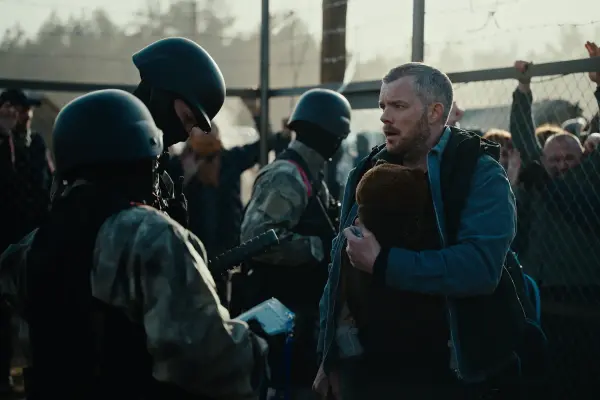 Russell Tovey plays a refugee from England who is hunted by the military because he knows too much.Credit...Lukas Salna/Viaplay Streaming Service
More importantly, the chief truth seeker and teller—and the hero of the series—Esther Winter, head of strategic planning for the Norwegian Food Safety Authority. Her truth telling, however, gets her in trouble, and she spends some time in prison, where she is visited by Major, a powerful man who cooperates with adviser Ingvild Kamfjord. He tells Esther, “You studied at Johns Hopkins. At 23, you were one of the recipients of a great prize in the US for your work in developing vaccines. And I have tried, I have really tried, but I haven't found anyone better qualified in Norway than you.” Because of her expertise, she is eventually released so as to continue her research for a vaccine.
Selome Emnetu, the actress who plays Esther, was born in 1981 in Norway, but is of Eritrean descent—earlier an Italian African colony and then part of Ethiopia, Eritrea received its independence in 1993. In the series, Esther is married to a man (Leo) who, more than a decade earlier, fled England—with a fake vaccine passport—in order to enter Norway. (An Emergency Powers Act provides that all asylum seekers without a verified health record are to be deported.) The couple have a mixed-race son, who late in the series contracts the deadly virus (from a rat bite), and Esther’s desperate search for a vaccine is heightened by the desire to save her son.
It is only in Episode 6, the next to last one, that Esther is able to convince the prime minister that the virus did not come from outside Norway, but from within. And in the last episode, he says that “Ingvild (his chief adviser) has stabbed me in the back. She wants me deposed.” And that he has “proof that Ingvild was behind everything the whole time.”
In the final episode, it turns out that the opposition to the government’s isolationist policies has been greater than earlier revealed. And the prime minister announces his resignation. But whether that means he will be succeeded by a government seeking more international cooperation or by one even more isolationist than before, I’ll not reveal.
Instead, it is now appropriate to indicate what I mentioned in the first paragraph—the thought that kept flashing in my mind as I watched the series. Simply put, it was this: If instead of a progressive Norway, what if some such virus or another type of emergency occurred in a second-termed presidency of Donald Trump? What if he enacted some sort of similar “Emergency Powers Act”?
At one point, Esther says to one of the enforcers of the government’s blame-it-on-outsiders policy, “the reason people are dying now is that you're killing the truth.” Is Donald Trump—whom The Washington Post concluded had “made 4229 false or misleading claims” in his first 558 days as president and who continues to insist he won the 2020 election—likely to be more of a truth-teller than the fictional future Norwegian government? (See also here for later statements such as “Donald Trump, the most mendacious president in U.S. history . . . . [is] not known for one big lie—just a constant stream of exaggerated, invented, boastful, purposely outrageous, spiteful, inconsistent, dubious and false claims.”)
 A food safety researcher (Selome Emnetu) works to create a vaccine, but she, too, knows too much.Credit...Lukas Salna/Viaplay Streaming Service
And like the fictional Norway depicted in “The Fortress,” Trump is more sympathetic to isolationism and distrust of foreign powers than were most of his predecessors in office. He pulled the USA out of the 2015 Paris climate agreement, and in mid 2020—on the same day we reached 3 million cases of coronavirus—from the World Health Organization.
Toward immigrants and refugees, he has demonstrated similar fears as to those we see in “The Fortress,” and like the series, he has placed faith in a wall to keep them out.
Of course, there are differences between “The Fortress” and possible future Trump actions. In the former, in the last episode, the head of state (the prime minister) tells his nation, “Our Way was founded on one simple idea. How to safeguard our small country in an increasingly dangerous world. Now the time has come to say that I have failed. We thought we had the transmission routes under control. We did not. I have let you down. I have failed my mission to safeguard our country. The truth is that we can no longer do this alone. That's why I and the government have asked the World Health Organisation for help.”
“I have failed.” “I and the government have asked the World Health Organisation for help.” These are statements we are never likely to hear from Donald Trump. And if blaming “outsiders” and Emergency Powers are forthcoming in the USA, they are not likely to originate with some adviser (as in “The Fortress”), but with Trump himself. Just one more reason that he is such a danger to our democratic traditions.
