


As is more typical of films and TV series, the producers and director chose to emphasize Dorrigo’s extra-marital affairs, rather than the complexity of love and the significance of life, aging, death, and transcendence.
Five years ago my Hollywood Progressive review of Richard Flanagan’s novel The Narrow Road to the Deep North: A Novel (2014) appeared. In my piece I wrote, “It was a page-turner. In the best sense of the word. From near the beginning of this 400-page novel until almost the end we wonder about what will happen to the hero of the story, Dorrigo Evans, and his love Amy...The dazzling complexity of love is one of the main strands running through the novel. Another is death and connected to it, aging and the meaning of life, as well as the “transcendent power of beauty” and “goodness.”
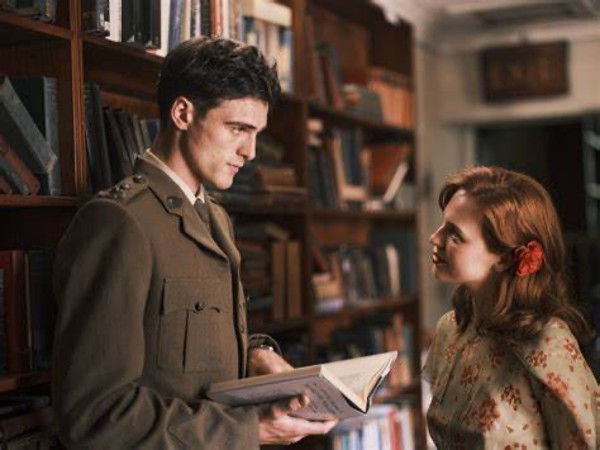
Unfortunately, the five-part Amazon Prime series is not as good as the novel. As is more typical of films and TV series, the producers and director chose to emphasize, to often depict, Dorrigo’s extra-marital affairs (his wife is Ella), especially with Amy, rather than the complexity of love and the significance of life, aging, death, and transcendence.
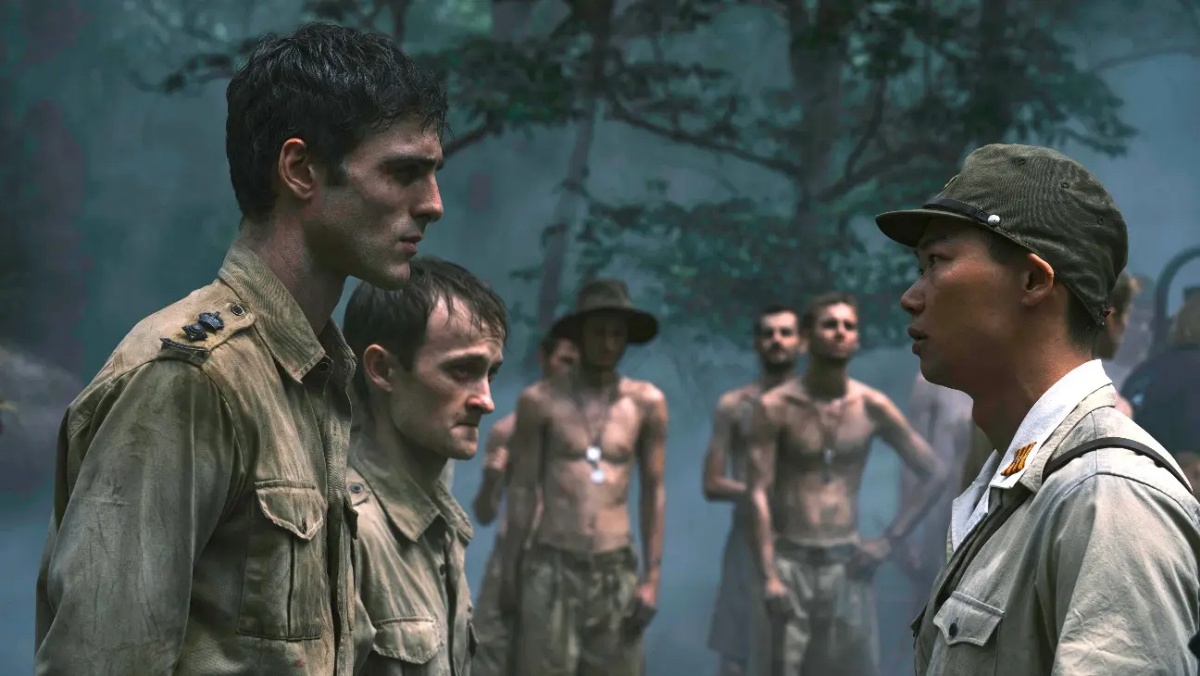
The series also spends much time depicting the plight of Dorrigo and other Aussies in a Japanese POW camp in Thailand. Their main job is carving out a track as part of a Thai–Burma Railway to aid the Japanese army in Burma—reminding us of similar POW work in the 1957 film The Bridge on the River Kwai.
The amount of cruelty inflicted upon the prisoners is excessive, especially in Episode 4 when a POW is beaten, blow after blow, to an obscene extent. Unlike the book, the TV series spends little time depicting—or even hinting at—transcendence. In my review of the book I wrote, “In the final pages Dorrigo goes outside in the camp and sees ‘a crimson flower. He leant down and shone his lantern on the small miracle. . . .’ [It] speaks to the transcendent power of beauty.” At the very end of the series, we see Dorrigo looking up at a crimson flower, but what the significance of this scene is will remain a puzzle to most viewers.
Nor, unlike the book, does the series hint at the transcendent power of goodness. Consider these post-WW2 lines from the book about Jimmy Bigelow, earlier one of the POWs under Dorrigo’s command: “What did [remain] was an irrevocable idea of human goodness, as undeniable as it was beautiful. At the age of ninety-four he was finally a free man. Thereafter he took great pleasure in wind, in the sound of rain. He marvelled at the feeling of dawn on a hot day. He exalted in the smiles of strangers. He worked at habits and friendship, seeing in them the only alternative to what he felt the alternative was...He would sometimes sit on a bench seat on his verandah for hours watching the birds feed, bathe, rest, preen and play. And in the mystery of their flight and beauty, in their inexplicable arrivals and departures, he felt he saw his life.”
If the series stints at depicting transcendence, it is more generous in treating the folly of most warfare. In Episode 5, Dorrigo gives a speech in which he says, “So many men's lives taken, for what? A railway? Of which now, little remains. . . . No one but those who lived it, will remember the immense suffering. The er constant sorrow. The pointlessness of it all.” (Series quotes are taken from the written script.)
Some Japanese officers try to justify the war by comparing it to what the British did in southeast Asia and seeing the Japanese as liberators. For example, “You are a part of the British Empire. Are you not, Lieutenant-Colonel [Dorrigo]? And do you not think that your Empire was built on death? Like my railway.Your Empire was built sleeper by sleeper, bridge by bridge, of non-freedom.” And “we are liberating Asia
from European colonisation and making Japan leader of a new order of Asian coexistence and prosperity.” The Japanese head of the camp also insists that the railway is being built “for the Emperor,” who, during the war, many Japanese considered divine.
Such rationalizations, however, are far outweighed by what novelist Ian McEwan wrote about World War II in Europe in his novel Black Dogs (1993): “He was struck by the recently concluded war not as a historical, geopolitical fact but as a multiplicity, a near-infinity of private sorrows, as a boundless grief minutely subdivided without diminishment among individuals who covered the continent like dust...For the first time he sensed the scale of the catastrophe in terms of feeling; all those unique and solitary deaths, all that consequent sorrow, unique and solitary too, which had no place in conferences, headlines, history, and which had quietly retired to houses, kitchens, unshared beds, and anguished memories.”
And outweighed by what Pope Francis wrote about “ideological Christianity”—which would also apply to the Japanese “ideological Shintoism,” which taught the emperor was divine. Such ideologies, stated Francis, are too “rigid, moralistic, ethical, but without kindness.”
The series also hints at the significance of Tennyson poem “Ulysses”—about which I have also devoted an essay. In my review of Flanagan’s novel I mention how “as a youth he [Dorrigo] ‘read and reread’ this poem by Tennyson, and on his death bed Dorrigo mumbles lines from it. ‘Every word [of the poem] now a revelation, as if it had been written for him, a poem his life and his life a poem...so totally now was the poem him.’” But, as with the crimson flower mentioned above, the series fails to elaborate on the importance of the poem to Dorrigo. (He does, however, read part of it to Amy, and later on briefly mentions it.)
All of the above criticism of the TV series is not meant to indicate that it is meritless. Just that compared to the novel it is based on, which won the prestigious 2014 Booker Prize, it is not as good. Particularly well done is the acting, especially that of Belfast actor Ciarán Hinds as the older Dorrigo (Jacob Elordi plays him as a younger man) and Australian actress Heather Mitchell, who plays wife Ella in her latter years.
