

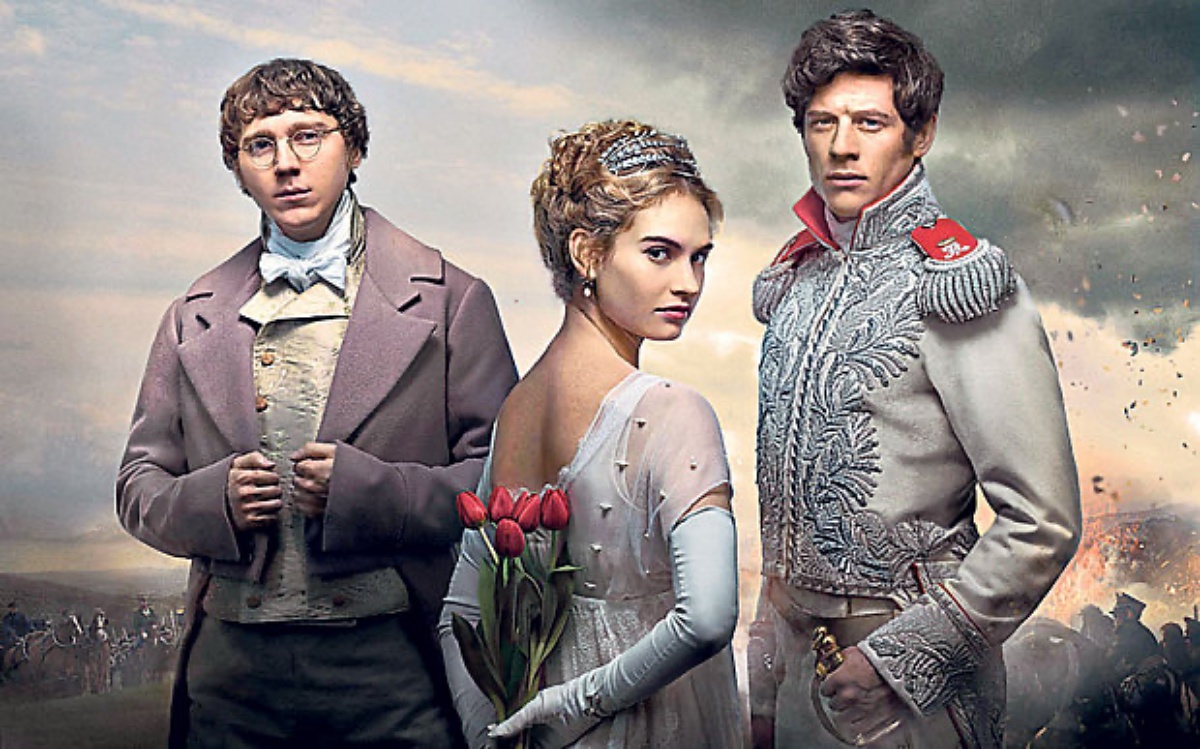

In the TV series, as in the original novel, there is much content that can interest people of various ages and interests, from romances to war.
Any of your readers out there ever tell yourself that some day you were going to read Leo Tolstoy’s War and Peace but never got around to it? Maybe the almost 1200 pages (in my Norton edition) scared you away. Whatever the reason, you Amazon Prime subscribers can now accomplish something that at least approximates that goal–you can watch the excellent 8-part (42 or 43 minutes per episode), British-made War and Peace TV series, which is about as faithful to the novel as a TV production of less than six hours can be. (Although the series first appeared in Great Britain in 2016, it did not become free to Prime viewers until more recently.)
Its excellent cast, mainly British, has many faces familiar to U. S. viewers. In the three main roles, that of Natasha, Prince Andrei, and Pierre, we have Lily James, James Norton, and Paul Dano. Lily James was Pam in the 2022 Hulu series Pam and Tommy and earlier Lady Rose in the long-running Downton Abbey. Norton played a vicar in the first several seasons of Grantchester. (Both the Downton Abbey and Grantchester series were originally British productions, but in the USA aired on PBS.) Dano is a U. S. actor, recently playing the father of the main character in The Fabelmans, who is loosely based on director Steven Spielberg.
The large supporting cast is also first-rate. To name just a few, there is Irish actress and singer Jessie Buckley as Andrei’s sister Marya; Jim Broadbent as his father, Prince Nikolai; Greta Scacchi as Natasha’s mother, Countess Rostova; and Scottish actor Brian Cox, the father in the award-winning TV series Succession, as General Kutuzov
In the TV series, as in the original novel, there is much content that can interest people of various ages and interests, from romances to war. What moved me most when I first read the book–and is still dealt with in the series–is perhaps Tolstoy’s main interest throughout his long life as a writer. And that is, “How should one live one’s life?” Indeed, what question can be more important? And, as we shall see, it is one with which Pierre especially grapples.
As to be expected in a TV series–even one that first appeared on the BBC–there is more in the episodes about romantic love than all of Tolstoy’s musings about history, great men, and war, of which there is plenty in the novel. But that is not just because the people who run the BBC were catering to their imagined audience’s taste for romance–although I’m guessing that was a factor–but also because the great writer’s ideas on topics like history were harder to film, whether for TV or movies.
And in the novel there are two chief romances, both involving Count Rostov’s children. There’s that of the young Natasha Rostov (in the novel she is 16 in 1809) and various men, including two of the main characters, Prince Andrei and Pierre; and then there’s of her brother Nikolai Rostov and his cousin Sonya and later Prince Andrei’s sister, Marya. And the romances are convoluted, and the complications still resonate today.
At first, Prince Andrei is married to Lise, but she dies in childbirth, though providing Andrei with a son. After some time as a military officer in the war against Napoleon, Andrei falls in love with Natasha and she with him. Before they can marry, however, his father tells him that he must wait a year before he can marry. Andrei tells Natasha of that and that he has some business he must conduct in Switzerland. Besides he says it will be a good test of their love. She agrees to wait.
But before the year is up, a certain Anatole Kuragin, son of a prince and a military officer, infatuates Natasha, telling her that he loves her. In the novel she explains, “Whatever he orders I shall do. You don’t understand that. What can I do?” These words are not repeated in the TV series, but Anatole is presented as a seducer who is used to having his way with women, he is the classical charming, dangerous rogue, not the kind, good man whom mothers would choose for their daughters to marry.
Pierre, who is a good friend to Prince Andrei, finds out about Anatole’s seductive actions toward Natasha, tells him “wherever you are, there's depravity
and evil!” and orders him to leave Moscow. He does, though Natasha still desires him. Meanwhile, Prince Andrei who has heard about Natasha’s dealings with Anatole, returns to Russia and tells Pierre that he cannot and won’t forgive her.
Anatole also happens to be the brother of Helene, who earlier in the series had married Pierre. But before describing Pierre’s love life, some words about his character are necessary.
When we are introduced to him in Episode 1, he is at a lavish party in a multi-splendored palace in St. Petersburg. It’s 1805, and Napoleon has crossed into the Austrian Empire, an ally of Russia’s in a coalition against him. Pierre talks to his friend Prince Andrei, who asks him if he’s “getting a taste of high society?” Pierre responds, “Yes, making a fool of myself, as usual.” (All quotes, unless otherwise indicated, are from the series script.)
Immediately after this, Anatole and sister Helene come up to the friends. Anatole says to Pierre, “Come round for a drink tonight. We'll make a night of it.” As Helene passes by, Pierre says to Andrei, “She's ravishing. No hope for me, though. I see her every day and she hardly notices I'm there.”
That, however, was before Pierre’s father dies, as he soon does, and leaves him great wealth. Flash forward to Episode 2 and an almost incestuous scene (not in the novel) of Anatole snuggling up in bed with sister Helene. He tells her that their father wants to marry them both off, her to the newly-wealthy Pierre. Although Anatole tells her to think of all Pierre’s money and the jewels she could buy and she responds that it’s easy for him to say because he won’t have to sleep with Pierre, she becomes convinced of the many advantages of marrying a man of great wealth. And so they’re soon married.
But back to Pierre’s earlier comment that he’d been “making a fool” of himself, “as usual.” It’s true that in the high society in which he circulated, he appeared socially awkward. And unlike his friend the handsome Prince Andrei, most women did not consider him handsome. Although not “fat”–as he is described in Tolstoy’s novel–he always wears glasses, often seems ill at ease, and frequently blurts out words that his listeners find inappropriate.
Like many young men circulating in high society, however, he liked to drink and appreciated attractive women. And both in the novel and in the TV series, Helene is presented as a good-looking, sexy woman with few moral scruples. As might be imagined, her marriage to Pierre is not a loving one, and she soon cheats on him, which leads to a duel, in which he seriously wounds one of her lovers.
As suggested earlier, Pierre also knows the young Natasha and is fond of her, but once his friend Prince Andrei planned to marry her, Pierre never let on to his own feelings. But, so as not to reveal any “spoilers,” I’ll write no more about the interrelations of War and Peace’s three main characters.
At the center of the other chief romance is Natasha’s brother Nikolai (Scottish actor Jack Lowdon). Like Prince Andrei, he is an officer in the army fighting against Napoleon during the 1805-1807 phase, which would end with the Treaty of Tilsit in 1807, only to be renewed with the invasion of Russia by Napoleon in 1812.
While home on leave, still in the war’s first phase, Nikolai looses at cards a great deal of money, which his father pays, jeopardizing the family’s finances. Up until this loss, Nikolai had been romantically involved with cousin Sonya (British actress Aisling Loftus). But his great gambling loss eventually leads him into the arms of a woman with a great deal of money, Andrei’s pious and good-hearted sister Marya, who inherits much as a result of the death of her and Andrei’s father.
The romances outlined above still resonate today. Do we still not see women falling for assured seducers like Anatole, especially when separated for a long time from their boyfriends? And how about men being attracted to seductive, but shallow, women? Or women (or men) being influenced by the amount of money a potential boyfriend or girlfriend has? And are not socially awkward individuals like Pierre still disadvantaged when it comes to romances?
And those entanglements are far from alone in still seeming relevant. So too are wars and all the suffering, needless deaths, and family worries and sorrows that come from them. Considering the War and Peace title, the series does not display a excessive amount of war scenes, but enough to make us cringe as artillery shells dismember body parts and kill young men.
About one battle Tolstoy wrote, “Why was the battle of Borodino fought? There was not the least sense in it, for either the French or the Russians.” Yet the combined casualties (dead and wounded) in this 1812 bloodbath, less than 100 miles from Moscow, numbered at least 68,000. Both the novel and TV series zoom in on the battle’s effect on Prince Andrei and Anatole, who had enamoured Natasha, in a tent for the wounded and Anatole being shown his amputated leg. The sight leads Andrei to feel great pity for his former rival.
So as not to provide too many spoilers, I will only reveal one more death (that of Helene late in the series) in addition to the three already mentioned–Pierre’s father, that of the Prince Andrei’s wife, Lise, and his and Marya’s father. But as in all times, whether in war or peace, the death of loved ones often occasions a difficult struggle. After Lise’s death, Andrei says, “Since Lise died, I've been wracked with remorse. I treated her unkindly and now she's gone. Disappeared into nowhere. No way for me to make amends.”
Although the impacts of romances, wars, and deaths bare similarities to their impacts today, other occurrences are more distinctly characteristic of the nineteenth century.
Although the impacts of romances, wars, and deaths bare similarities to their impacts today, other occurrences are more distinctly characteristic of the nineteenth century. One, as with Prince Andrei’s wife, Lise, was the high death rate. Even at the end of the century, among the Russian and Orthodox population more than a quarter of the population died before their first birthday. Although the rate was greater among peasants than upper-class individuals like most of Tolstoy’s fictional characters, even in his personal situation, he and his wife, Sonya, grieved the deaths of three of their young children in the mid 1870s.
Medical treatments (like the amputation of Anatole Kuragin’s leg) in the early 1800s–this was before the use of anesthetics–also often seemed almost unbearable or at least outdated. One case of the latter was the use of blood-sucking leeches applied to Natasha’s arms on an occasion when she fell ill (although later shunned for a long time the selective use of leeches has recently been making a comeback).
Also mainly a thing of the past is the type of duel that Pierre engaged in with one of his wife’s lovers. But in the early nineteenth century they were still common. Two of Russia’s greatest poets–Alexander Pushkin (1799-1837) and Mikhail Lermontov (1814-1841)–died in duels, the former (like Pierre) with a man suspected of amorous relations with his wife. (In 1804, one of the U. S. “Founding Fathers,” Alexander Hamilton, also was killed in a duel.)
In addition to all the still relevant or now outdated occurrences detailed above, one more of the former still needs further clarification. And, as suggested earlier, that is “How should one live one’s life?” It was a question that Tolstoy often wrestled with in his long life of 82 years. And it produced such titles as “What Shall We Do?” and What Men Live By, and Other Tales. Indeed, what question can be more important? And in War and Peace it is one with which Pierre is especially concerned.
At the story’s beginning (both in the novel and TV series), before his father’s death, Pierre confesses to Prince Andrei that he still doesn’t know what to do with his life. “But I do think I could make something of my life, do something extraordinary, even.” Yet, he admits that he wastes his nights. Andrei tells him that “Anatole Kuragin and that gang. That sort of debauchery doesn't suit you.” To which Pierre responds, “Oh, but the women . . .The women and the wine but, yes, no, you're right, I've been thinking that myself, I should stop going round there. I will stop. There.”
But what the next scene of the TV series displays is not Pierre stopping, but partying at Kuragin’s with a debauched crowd of men and women, and the next morning he awakens with a hangover. (In the novel at Kuragin’s a drunken Pierre also dances with a bear.)
Later on, while the first stage (1805-07) of Russia’s Napoleonic war is still occurring, Pierre confesses that he does not believe in God. He tells this to a Freemason he meets at a post station (akin to an inn where one could change horses). The Mason tells him, “You don't believe in God because you don't know him. And that's why you are so unhappy.” Pierre admits to being unhappy and hating his life and asks, “what am to do about it?” The Mason tells him that by being so dissatisfied he has already taken the first step.
Soon afterwards, Pierre is initiated as a Freemason–although the vast mass of Russian peasants considered themselves Orthodox Christians, Freemasonry was quite popular among the nobles (about two percent of the Russian Empire’s population) and among some of the upper crust of the small urban population. After his initiation, Pierre sets out to improve the lives of the serfs on the estates he inherited from his father–although serfs generally shared the ethnicity of their masters and were not their personal property, in many other ways their lives were comparable to U. S. slaves.
Pierre also seems more satisfied with himself, and not long after becoming a Mason he tells Prince Andrei, “Since I became a Mason and started to live a good life, I feel capable of anything. We must live. You know, we must love. And we must believe that there's more to it all than our lives on this scrap of earth. There's something else out there, it is true, Andrei. You must believe it.” (Although the TV series has Pierre display fairly consistent Masonic views after his initiation, the novel details more confusion and some backsliding.)
The next major development in Pierre’s evolution occurs in 1812, after the Battle of Borodino and the French occupation of Moscow. Pierre is captured by the French, marched to a place of execution, and (like Dostoevsky in 1849) thought he was going to be shot. But instead he was marched away with other prisoners as the French retreated from Moscow. And in that retreat he met a Russian peasant named Platon Karataev.
From this point on, the TV series abbreviates hundreds of pages in the novel, including two epilogues in which Tolstoy discusses such topics as the meaning of history and of free will. But toward the end of the last TV episode, Pierre tells Natasha about Platon Karataev. “He was such an extraordinary little man. He was just a peasant. You know, but he seemed to have grasped the secret of how to live.
He never worried. He took pleasure in the good things, and endured the bad things cheerfully. And his little dog. How he loved her....So now I'm trying to live like him, is that ridiculous?”
Tolstoy completed War and Peace in 1869, and it wasn’t until the end of the 1870s that he had almost completed going through a spiritual crisis that would transform the thinking of his last 30 years. During that later period his writings became more didactic, reflecting his religiosity, pacifism, non-violent anarchism, and admiration for the simple ways of Russian peasants. (A LA Progressive essay I wrote a decade ago touches on some of those views.) But that period of his life is a whole other story.
