


The Streaming TV Biz 2024


An AI “Created” Series and Decreasing Quantity Meets Declining Quality
Last year’s retrenchment in the world of streaming TV is continuing with Netflix holding even on bankrolling series at $17 billion but with all the other streamers cutting back. The big money players are searching for, as one studio exec put it emphasizing this downsizing trend, the “right show shot in a cost effective location,” where “it is possible to make a whole series for the cost of an indie film.”
The industry way of portraying these cutbacks, seeing the glass half full, is there is now an emphasis on “quality over quantity,” but when one observes what is coming down the pike, it’s hard not to see these cutbacks as simply less quantity amid decreasing quality. The new emphasis on safe investments translated to an ever more increased concentration on what the industry terms IP, intellectual property, that is going with what has already been established either in another medium (books, films, music) or television itself.
One look at the low end of production, that is the TV network pilot season, is a scary reminder of what this trend entails. CBS is chiming in with: Matlock, perhaps with an AI Andy Griffith; a Young Sheldon spinoff with the original, itself a spinoff of Big Bang Theory, having just ended; a Young Sheldon version of NCIS titled NCIS Origins with Mark Harmon’s narration (like Sheldon’s in Young Sheldon) of his on-screen younger self; and Watson, a Sherlock Holmes series without Sherlock and with the good doctor taking up the crimefighting duties. Fox, in an even less daring move, is reviving the sexist Baywatch and NBC besides Suits: L.A., a spinoff of the cable series, is dressing up its revivals as St. Denis Medical could easily be St. Elsewhere and Dr. Wolf’s gruff medical practitioner is supposed to remind viewers of House.
The high end of this lack of originality was on display in a Max (Warner Bros) presentation which trumpeted Season 2 of Game of Thrones, The Penguin from the DC Batman franchise and a series based on the Harry Potter books and films. All three of these fall into the blockbuster category, that is the streamers copying the Hollywood studio format that began in the ‘70s while shelving original series, which were what brought Max subsidiary HBO to prominence in the first place, as recounted in Peter Biskind’s new book Pandora’s Box: How Guts, Guile and Greed upended TV.
As more and more series rely more and more on IP or already proven material, what was once a “Golden Age” of originality begins to skew close to the now partially abandoned Hollywood studio format of sequels and comic book adaptations, a format that is working less and less for the movie studios as audiences decline based on the lack of creativity.
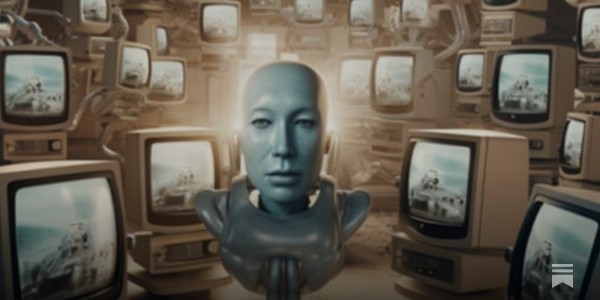
The other major trend, which has creators terrified and investors and studio executives “excited” is the rapidly expanding use in every phase of the business of artificial intelligence, AI. Perhaps the scariest projection of the technology, described by one longtime independent film assistant director as “nothing but plagiarizing software,” is a new gameshow on Korean TV titled Gone Producer. In this nightmare gameshow scenario, the entire series is cast, directed, and produced by AI, which also judges the videos contestants submit in a competition. According to the studio, “The fun factor ‘is not only that the show is produced by AI, it is also the contestants getting confused and bewildered confronting the AI.” In other words, the show not only uses the service to replace jobs, it also makes a virtue of the fact that, as everyone knows, AI often “hallucinates,” that is returns incomprehensible information and opinions. The contestants and the viewers are asked then, as the media critic Theodore Adorno put it, to participate in their own demise. Korea is well-known for its game show formats, having produced a “spin off” of the Emmy-winning fictional series Squid Game and Gone Producer has already been sold to Sweden and Norway.
Less Is More?
These observations about the business come from two recent French TV festivals, Lille’s Series Mania, one of the largest of its kind in the world, and Cannes’ MIPTV, with this year’s meeting of buyers and distributors ending the convention’s 61-year run. The latter had 130 companies represented but was still a shell of its former self, a sacrifice to the new austerity where, because of the entry fee and the Cannes boardwalk prices, buyers consolidated by going to a February conference in London or to the larger MIPTV conference in October. Walking through what was once production house stalls and was now an empty space that looked like a parking garage, one former attendee mourned the passing of a place in which she said she had spent many years.
The streamers and television magnates in general are attempting to combat churn (subscribers signing in watching the few creative series on the streamer then signing out), the fact that working class audiences have less to spend because of continuing inflation, and the streamer’s own raising of their subscription rates.
The way they are choosing to combat this situation, though, betrays a lack of imagination, with the same assistant director suggesting that instead of AI replacing writers and actors, the technology might better be used to replace CEOs and studio executives. At the Series Mania Forum, discussing the business of television, it was reported that with “Peak TV” over, since in the U.S. the number of series declined from almost 600 two years ago to 516 last year, in Europe not only are the number of series declining, but almost the number of episodes by an average of one episode per series over the last few years and also the length of each episode, now cut by almost 10 minutes. One of the original promises of streaming TV was both would be determined by what was needed to tell the story and that priority is vanishing.
 Isabelle Adjani, The Story of Adele H.
There is also more monetization of back catalogues, using former material to create series and selling off of catalogue entries so that subscribers who are looking for a show on their service because, for example, it was produced by Disney may find the show has been sold to another service. European series are trying to nab viewers by bringing to television now more faded film stars, a trick that was formerly used on American TV. In France Isabelle Adjani (The Story of Adele H.) is starring in a series about family secrets and in the Netherlands Famke Janssen (Golden Eye) heads a cast in a series on the Amsterdam marijuana scene.
Another way of monetizing content without the peril of trying something new and original is selling the format to a different market as the BBC has done with Ghosts, a hit on CBS in the U.S., harking back to, or trivializing, Hawthorne and the New England horror tradition and now being developed in a German version which commercializes the Romantic tradition in that country.
Sony TV’s Wayne Garvie explained to the Series Mania forum audience that the answer to the end of peak TV, “the boom,” is not necessarily “a bust” but rather just fewer shows with more quality. He almost immediately contradicted himself by then citing the superhero series The Boys, which he said with its spinoffs “will go on for years,” while in the same vein he noted that the problem with single season series, which have often been some of the most creative and awarded (think Chernobyl) is that “you can’t build a business on mini-series.”
The result of this cost-cutting and budgetary as well as creative retrenching, described at the Forum as the industry “looking for more reassuring content,” plus a demand on Wall Street that streamers show a profit, is that streaming audiences are declining to the point where the S&P accounting firm recently downgraded Paramount’s debt to “junk.” The race is now on to see who will buy the streamer or if it will simply go under since any buyer is now saddled with the company’s debt. In Europe the French streamer Salto is now defunct, while the Scandinavian Viaplay, which was expanding into the U.S. and Britain, has had to cease that effort and return to its local audience.
Here Come The Machines
A main topic of both events was AI, which, as in other industries, is being touted as a money-saving, cost cutting entity. The “buzz” at the more-industry oriented MIPTV centered around what the technology could do for producers and studio profit margins. Pre-conference The Hollywood Reporter ran a full page on AI’s “Buried Perils” without mentioning the thrust of its creators toward job destruction and nowhere was there a conversation about how the lost jobs will be replaced. The Series Mania Forum did more thoroughly debate the issue but began with an opening presentation from two shills for the practice who showed articles from the business press, including Bloomberg News, “proving” that AI was a boon to job creation. In The Future of Work, the French theorist Bernard Stiegler, citing an Oxford study predicting an ultimate 50 percent loss of employees when the technology was fully developed, decried the development as “the negation of know-how itself,” inducing “a functional stupidity.”
Shoshana Zuboff in Surveillance Capitalism described the technological solution so dreamed of by producers and studio executives, which offers the illusion of “omniscience, control, and certainty,” but where “the idea is not to heal instability—the corrosion of social trust and its broken bonds of reciprocity, dangerous extremes of inequality, regimes of exclusion—but to exploit the vulnerabilities produced by these conditions.”
The Series Mania Forum day was titled benignly “AI: The Technology We’d Love to Like” with one panel called “Past the Sideration,” a French word that the panel defined as “fascination” but which equally, and in this case more accurately, means “disturbance.”
A YouTube representative, a company owned by Google, which is a leader in the race to dominate the field, proclaimed AI would allow “unprecedented speed” and its use would be “bold and responsible.”
Clearly, the implementing of AI is one part of a studio attempt to curb, in the wake of last summer’s writer’s and actor’s strikes, the growing power of the unions. Kate Ballard from the U.S. Writer’s Guild in acknowledging that AI is moving faster than any limits either contractually or legislatively can be imposed on it, said that the Guild had done the best they could to ensure that AI be a tool for writers not a way of getting rid of them and that they would revisit the situation again in two and a half years, when the current contract expires. One of the claims for AI in job creation is that the machines need “prompters,” since it is crucial that what is fed into them be specific and limited, but the host of one of the panels revealed that she had just read an article stating that AI creators were now working on machines that could learn to prompt, thus eliminating the most fruitful arena for jobs.
 Cotton Club
At MIPTV, one developer, who claimed that AI could be used in every phase of film and television production listed, for example, programs such as Storyfit designed to predict whether a story will be commercially successful, Storyboarder, which produces storyboards for shooting, and SORA, which creates synthetic images, that is drawn from AI itself, and which produced an intriguing image of a smoky 1920s nightclub but which claimed that The Cotton Club, the title of the film, was in Chicago, not in New York’s Harlem. A scarier development was that another CEO had trained AI to identify the predominant emotion of each scene (happy, sad, fearful, joyful) in a film or series and select clips aimed at enticing particular audiences. The ultimate goal one CEO claimed was “to be able to make a complete film from your bedroom.”
Craig Peters, from Getty Images, stated that the answer to controlling the device was not in legislation such as the recently passed first-of-its-kind European Union Artificial Intelligence Act, but rather through “all of us putting our collective minds together.” The solution sounds naïve and potentially a way of warding off legislation in the U.S., but what Peters did explain was that with the drive to feed more and more data into the machines to train them, the IP of books, movies, films, songs would soon be exhausted and the current drive is to feed as much personal data into the machines as possible, that is, to turn each of our individual experiences into training vehicles and to “harvest” this “personal IP.”
It wasn’t long ago that the major catch phrase in the information industry was “big data” used for its predictive capabilities but now that has been replaced by the quest for synthetic creation, which might someday eliminate the human element entirely and which would be a next level up in current cost cutting. Instead of, as the writer and showrunner Frank Lipsitz (X-Files, The Man in the High Castle) put it, making “us as writers, better, faster, smarter” studio heads envision, as the trade press put it, ‘using AI to ‘scale’ creativity,” that is to simply produce more, faster. The battle is on to see whether AI in the film and television industry as everywhere else, simply becomes a cost-cutting tool fostering mass unemployment or an enhancement to creators in the industry enabling leaps in original and relevant content.
