


Science does not answer all questions, and it is not a panacea for all ills that we suffer; but when it is done right, it can be wondrous indeed.
At a time when science is “under siege,” Netflix’s film “Joy” (2024) is especially appropriate. For this is a time when six former “U.S. surgeons general appointed by every Republican and Democratic president since George H.W. Bush” feel “compelled to speak with one voice to say that the actions of [Donald Trump’s] Health and Human Services Secretary Robert F. Kennedy Jr. are endangering the health of the nation.” It is a time when two scientists–Peter Hotez, a doctor and medical researcher, and Michael Mann, a climatologist–can produce a book entitled Science Under Siege: How to Fight the Five Most Powerful Forces that Threaten Our World. And it is a time when the president of M. I. T. , Sally Kornbluth, can reject a Trump administration proposal that was inconsistent with M. I. T.’s “belief that scientific funding should be based on scientific merit alone.”
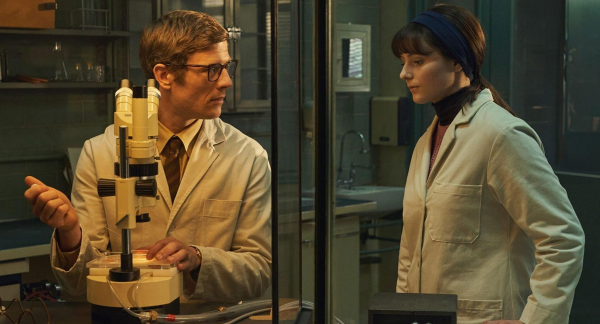 James Norton and Thomasin McKenzie
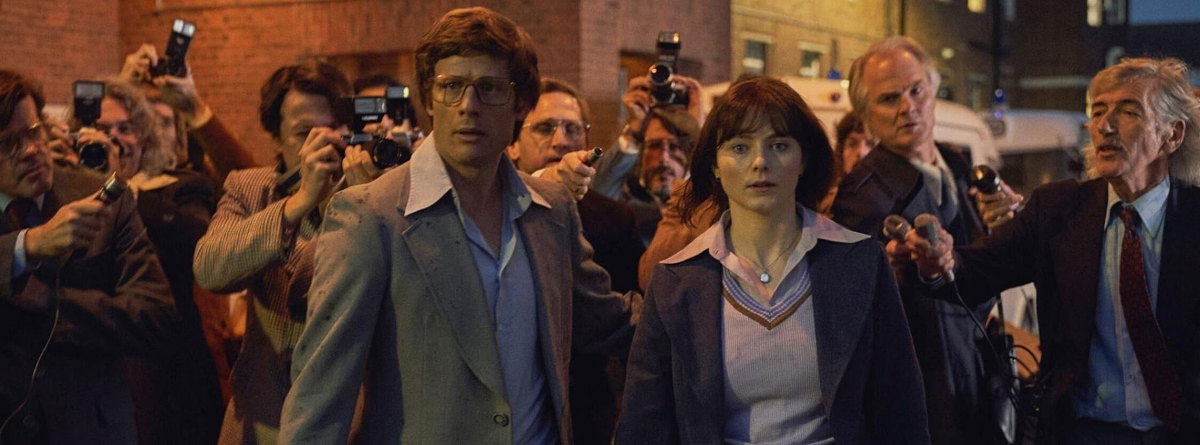
Science does not answer all questions, and it is not a panacea for all ills that we suffer; but when it is done right, it can be wondrous indeed. One of science and technology’s greatest triumphs has been in the medical field, where the two have greatly expanded the human life span–“in 1900, the average life expectancy of a newborn was 32 years. By 2021 this had more than doubled to 71 years.” And the film “Joy” depicts scientific research being done the way it should–provided one does not oppose it on religious grounds. The story zeroes in on three medical researchers: Cambridge biologist Robert [Bob] Edwards, Ph.D. (James Norton), obstetrician Dr. Patrick Steptoe (Bill Nighy), and embryologist nurse Jean Purdy (Thomasin McKenzie).
I have written previously of Norton and Nighy, and they are two of my favorite actors. McKenzie was new to me, but she was also excellent in “Joy.” And, as Bob says in the film, “without her [Jean], none of this would've been possible. She made the unbearable bearable.” (Film quotes are taken from the filmscript, which accurately reflects film dialogue.)
The film begins in mid 1968, with Jean applying for a job with Bob, and soon afterward they meet Patrick at an English Royal Society lecture. For the next decade the three of them experiment with in vitro fertilization (IVF), sometimes making mistakes, but eventually correcting them.
During the decade that the three of them collaborate, words at the end of the film tell us they treat “282 women resulting in 5 pregnancies and 2 live births.” The first birth, on 25 July 1978, is of Louise Brown. The scientific trio is asked to come up with a middle name, and they agree on “Joy.” Film words also relate that since 1978 “more than 12 million IVF babies have been born worldwide.”
According to the Mayo Clinic site, IVF involves “a complex series of procedures that can lead to a pregnancy. It's a treatment for infertility...[and] also can be used to prevent passing on genetic problems to a child.” During IVF, mature “eggs are collected from ovaries and fertilized by sperm in a lab. Then a procedure is done to place one or more of the fertilized eggs, called embryos, in a uterus, which is where babies develop. One full cycle of IVF takes about 2 to 3 weeks...In vitro fertilization is the most effective type of fertility treatment that involves the handling of eggs or embryos and sperm...Your chances of having a healthy baby using IVF depend on many factors, such as your age and the cause of infertility. What's more, IVF involves getting procedures that can be time-consuming, expensive and invasive.”
 Bill Nighy
The three researchers each feel passionately about their work. On a TV show Bob says, “Our care for our patients is absolute...Having children is not everything. I know that. Some people lead very happy lives childless. But that should be a choice. It's nature's choice!...If you knew the pain of infertility for these women, then you would understand...I believe that everyone who wants one deserves the right to have a child.”
Patrick tells Jean, “The bit I most dislike about this job is having to decide who will get help and who will not. Hundreds of letters...where women beg for the opportunity to be on our program. And you read through their notes...you can feel their eyes on the back of your head. And we see ourselves as the great possibility. We can make the infertile fertile. But there are still so many women we won't ...we won't be able to help. And I can't help thinking that, for them, our existence ...is just another source of pain.”
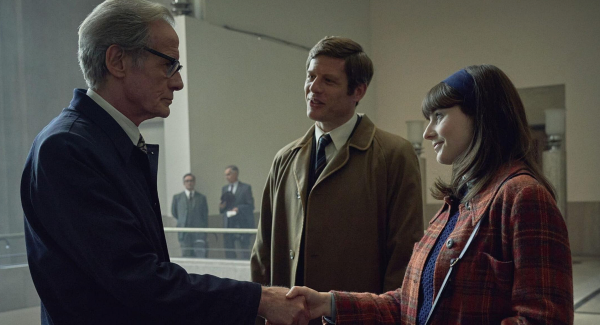 Bill Nighy, James Norton, and Thomasin McKenzie
And Jean, who cannot have a baby because of endometriosis, tells Patrick, “Women presume we can have children. We're told so. There is a biological and social expectation. Nothing can make the pain of that absence worse. But we have the possibility of making it better.” And she adds that she says these words even though she knows that their research cannot help her personally.
And Jean, who is so likeable and brave in “Joy,” suffers the most from her work. Her mother, who is dying (and dies part way through the film), is a staunch Anglican and thinks that Jean is sinning by engaging in her IVF research. She tells her daughter, “But you can't play God with this.” Jean’s questions–“How do you feel about spectacles and false teeth? You'd rather people be blind or unable to eat anything but soup? That's what God wants, is it?”–receive only the response that the newspaper says Dr. Patrick Steptoe is an abortionist. For a while, her mother refuses Jean’s visits and Jean stops going to church, and she says, “I've lost my church and my mum.”
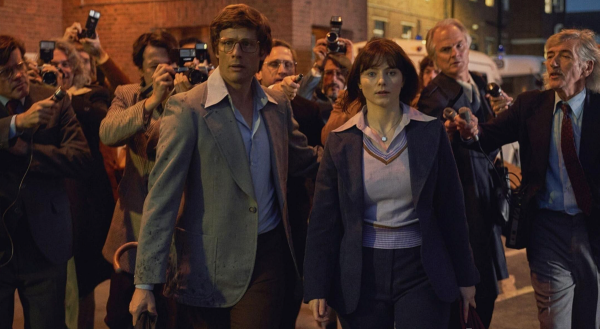 James Norton and Thomasin McKenzie
Like Galileo in the early 17th century being tried by the Catholic Inquisition for advocating that the earth revolves around the sun, IVF was at first condemned by the Anglican Church. (It has since become more favorable toward it, but the Catholic Church is still opposed.)
Speaking of religion, some words that appear on the screen at the end of the film lead us to scratch our heads and hurl a question out to God or to some other great Unknown. These words tell us that at age 39 the lovable Jean died of cancer. Our question is “Why?” Why would the life of such a good and caring person be cut off and ended at such an early age? Our puzzlement over the question being just one of many signs that we humans need a healthy dose of humility.
