


The Eaton Fire destroyed homes. The compounding effects of trauma are still unfolding—and our journalism has to tell that story, too. Content warning: This article discusses suicide and suicidal thoughts.
I've forgotten a lot of phone calls.
You do enough live radio, and they begin to blend. Some are thoughtful. Some are angry. Some stay with you for a day or two.
I don't think I'll ever forget this one.
A father called my program.
He wasn't asking about insurance. He wasn't asking about rebuilding permits. He wasn't asking about Southern California Edison.
He asked me about the compounding effects of trauma.
Then he told me why.
One of his children had begun self-harming after the Eaton Fire. Four of the five members of his family, he said, were already in therapy. The kid that wasn't– now is.
When the call ended, I found myself sitting there with a question I couldn't answer. Not because I didn't know enough, but because I suddenly realized I had been faithfully documenting one recovery story while another one had been quietly unfolding beside it.
I looked down at my notes: permits, insurance claims, debris removal, public meetings, lawsuits, another rebuilding update. Page after page of things I could measure.
Nowhere in those notes was there a place to write down what that father had just entrusted to us.
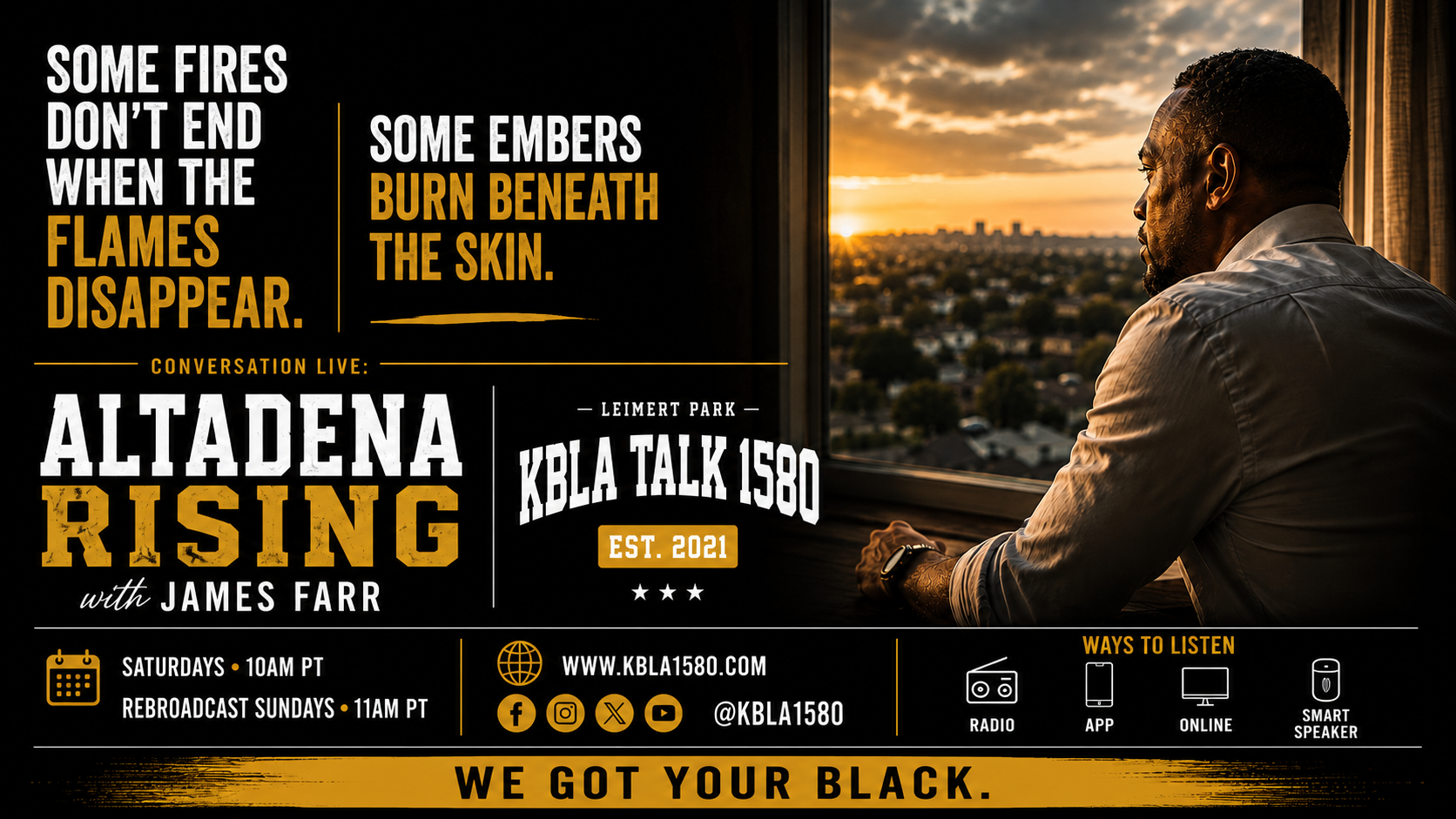
For the last 18 months, I've had the responsibility of documenting Altadena's recovery through “Conversation Live: Altadena Rising" on KBLA Talk 1580. Week after week, we've chronicled the 19 souls who perished in the Eaton Fire. We've followed the emergency response, the debris removal, the insurance battles, the lawsuits, the rebuilding, the promises, and the setbacks.
Every one of those stories deserved to be told.
Everyone still does.
But somewhere between another press conference and another construction update, I started noticing something.
The paperwork kept getting thicker for folks still figuring it out. The conversations kept getting quieter.
Every week, there seems to be another meeting. Another update. Another chart. Another announcement about progress.
Then a father called asking why his child was hurting.
I couldn't find that answer in any of my notes.
A few days later, the community learned that Eaton Fire survivor Eric Rodriguez had died by suicide. According to his family, the weight of trying to rebuild had become too much to carry. Reading about the note he left behind, I kept thinking about that father's phone call.
Two different families.
One question.
What are the compounding effects of trauma?
That's the question I've been carrying ever since.
It's no secret I'm a crack trauma journalist. Long before the Eaton Fire, I came to understand trauma by reporting on state-sanctioned violence—when police show up as violence workers. Today, I continue that work through my weekly program. I thought I understood what trauma looked like. Perhaps, I better understand how
Corporate negligence is escalating into economic terror and violence.
The Eaton Fire taught me there was another chapter.
Journalists know how to cover disasters. We know how to count the dead. We know how to document destruction. We know how to follow the money, question elected officials, challenge utilities, and measure rebuilding.
We're supposed to.
But somewhere along the way, I began wondering what happens after the cameras leave and the grief stays.
Who documents that?
Some fires don't end when the flames disappear.
Some embers stay underneath the skin.
That wasn't a line I wrote because it sounded good.
It was something I kept seeing. Why, I live and exist inside the burn scare zone. My algorithm won’t divert fire and desire on my feed.
I've sat across from survivors who apologized before crying. I've listened to people talk about rebuilding a house while quietly wondering whether they could rebuild their family. I've watched people celebrate getting their keys back while carrying something they couldn't quite put into words.
I mean, really, just yesterday afternoon, I was invited to witness and pray with a family that completed their rebuild in under 10 months. The pastors blessed every window, doorway, and crack of that family's house.
That's a story, too.
Maybe it's the story.
It certainly does not fit neatly into a government spreadsheet or a rebuilding app dashboard.
Those numbers tell us how many homes have been framed. They don't tell us who still can't sleep when the wind picks up. They don't tell us which parent is wondering if their child is okay. They don't tell us who's pretending to be strong because everyone expects them to be.
I don't think the father called to change my journalism. He called because he needed an answer. He needed a safe space to say the quiet part out loud. Help. But after we hung up, I realized I needed one, too.
I realized the program couldn't just document the rebuilding of Altadena. It also had to care for the people doing the rebuilding. Physically and mentally.
That's why we're launching Ask the Therapist with Dr. Eshele Williams.
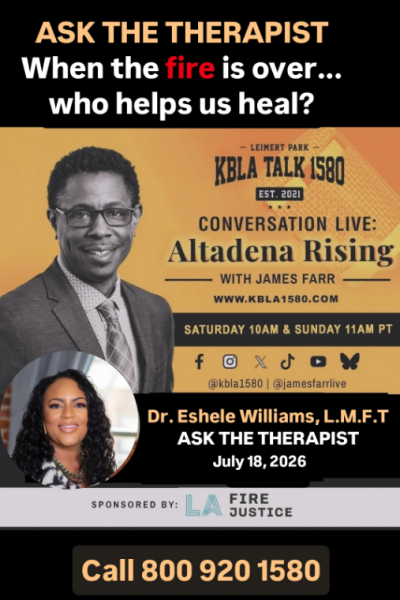
Not because radio can replace therapy. It can't.
Not because one conversation solves trauma. It won't.
But because sometimes healing begins with permission. Permission to ask the question. Permission to say, "Something doesn't feel right." Permission to realize you're not the only one carrying it.
If we've spent the last year and a half documenting how a community rebuilds after a fire, then we also have a responsibility to ask how that same community is living with what the fire left behind.
The flames are only one chapter. Recovery is another. And somewhere inside recovery are the stories we rarely tell.
The father who called my program probably has no idea what he started. But he changed the question I've been asking ever since.
Not how many homes have been rebuilt.
How are the people inside those homes doing?
To me, that may be the most important recovery story of all.
Mental Health Resources
If you or someone you know is struggling with emotional distress, thoughts of suicide, or another mental health crisis, help is available. Call or text 988 to reach the 988 Suicide & Crisis Lifeline. If someone is in immediate danger or experiencing a medical emergency, call 911 immediately.
Seeking help is not a sign of weakness. Sometimes the strongest thing we can do is let someone else help carry the weight.
