

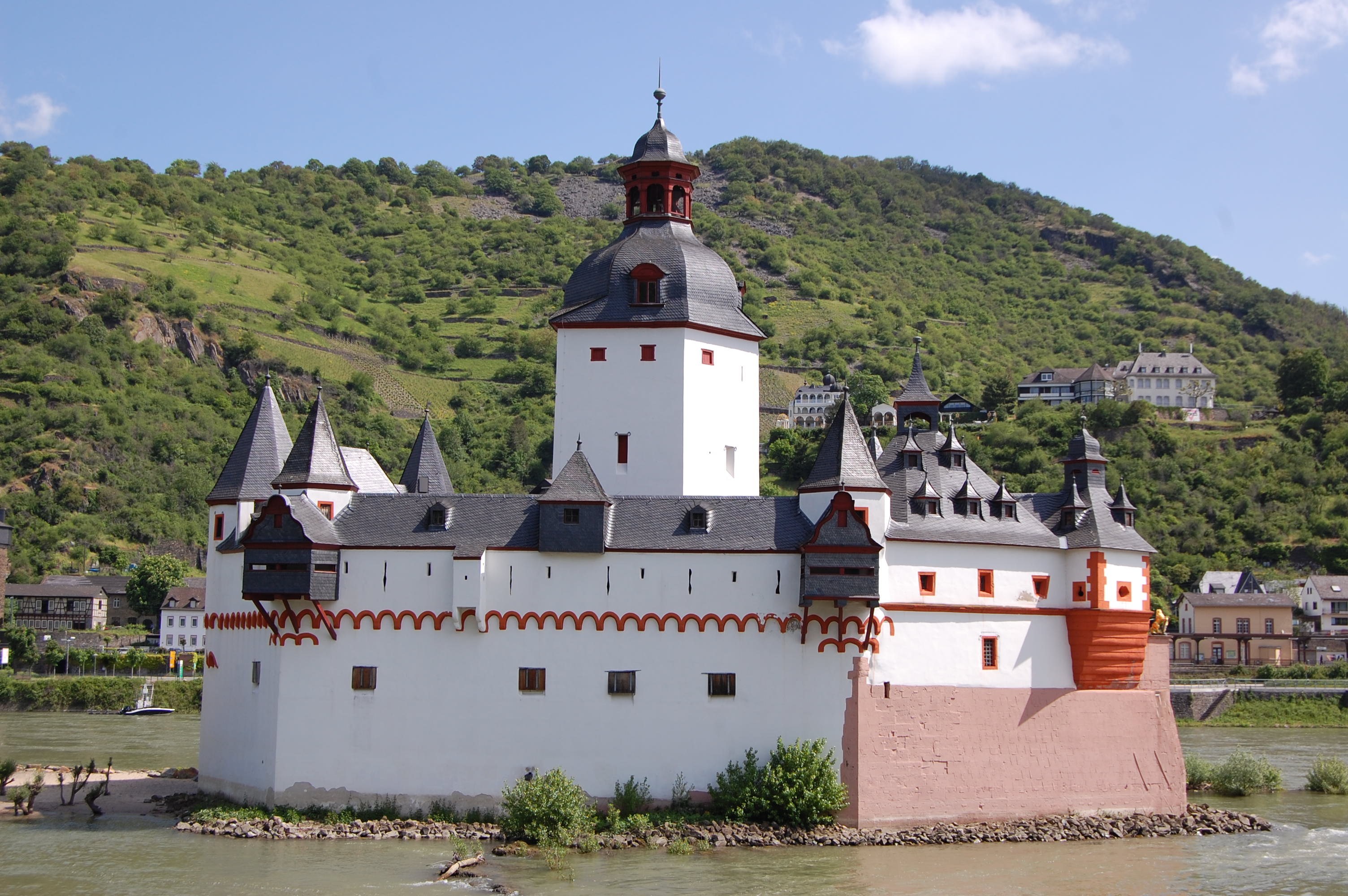


No less than literally 40 castles are perched on hills, islets, riverbanks, at this UNESCO World Heritage Site.
PART VII: CASTLES GALORE, MARKSBURG & MORE
Palace-Palooza on the Upper Middle Rhine
Along the 40-mile stretch of the Upper Middle Rhine, from Bingen to Koblenz (where Europe’s largest fortress is located), no less than literally 40 castles are perched on hills, islets, riverbanks, at this UNESCO World Heritage Site. It is a veritable “palace-palooza,” the Woodstock or Coachella of castles. Leisurely cruising up the Rhine aboard our trusty schooner Skirner, amidst the ruins and splendor of medieval citadels, many amongst vineyards, is riveting, nothing less than truly enchanting. It’s as if we’ve joined Mr. Peabody and Sherman and the Skirner is the “Wayback Machine,” taking us back in time to nearly thousand-year-old architectural relics and wonders.
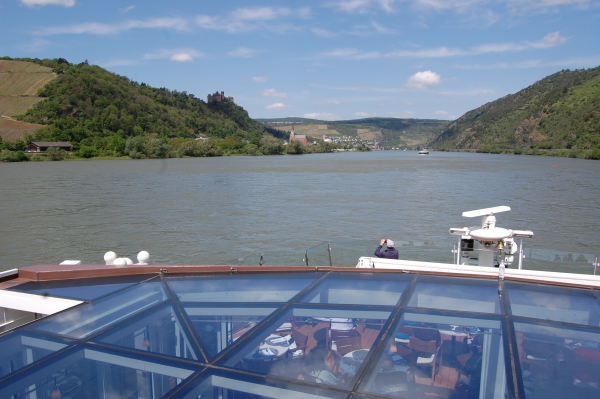 A view from the upper deck of Viking's Skirner of the Upper Middle Rhine with Marksburg in the distance.
 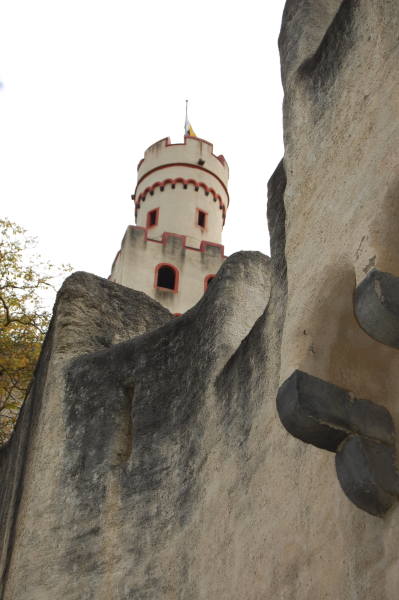 The castle keep at Marksburg, a castle dating back to the 13th century.
Gazing portside or starboard, every mile or so another castle is revealed just around the bend, for 40 miles. Watching the dazzling vistas unfold from atop the Skirner’s sundeck on a sunny spring day, wafting serenely atop sparkling water, is a once-in-a-lifetime spellbinding experience, a “Lucy-in-the-Sky-with-Diamonds” extravaganza without having to drop psychedelics. In addition to their beauty, these bastions served practical purposes for their feudal lords, enabling them to defend their fiefdoms, monitor trade, collect tolls. La creme de la crème, the best part of our voyage is an extraordinary, unforgettable shore excursion to the 13th century Romanesque Marksburg Castle, located above the town of Braubach in Rhineland-Palatinate, with its stately, graceful keep, originally built in 1239, used by patricians as a watchtower to oversee their Rhine domain.
Marksburg Marks the Spot
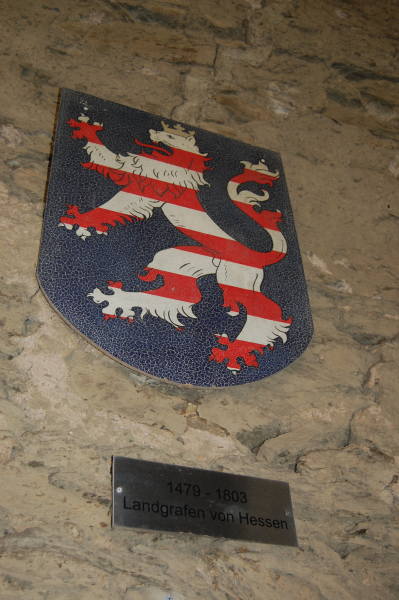 A lion-themed Coat of Arms for a lord of the manor at Marksburg Castle.
 Originally built by the powerful Lords of Eppstein, egress to Marksburg Castle was carefully guarded; those wishing to enter (some on horseback) would have to pass through no less than four entryways, starting with the drawbridge gate. Using a headphone linked to our listening devices slung around our necks with earpieces, tour guide Tisza, a university student majoring in history and English, then leads our merry band of Viking passengers past two batteries fortified with artillery, including a replica of a 15th century cannon. With 6-pounders and 12-pounders, the Landgraves of Hesse were able to hold sway over their stretch of the Rhine Valley. Like a blast from the past, Tisza shows various interiors, explaining to us peons about courtly life, how ye noble residents and their servants lived here centuries ago, tending to their earthly and ethereal needs.
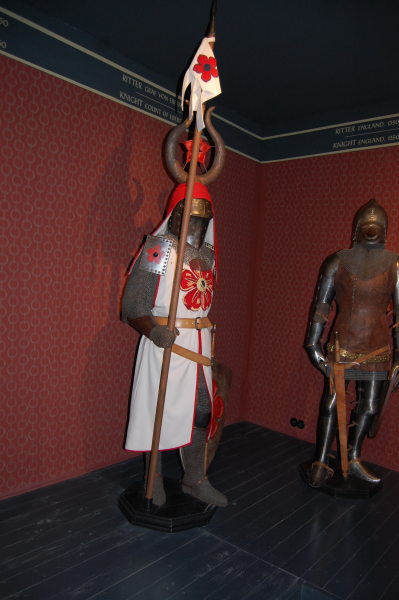 Mannequins display the suits of armor knights wore in days of your at Marksburg's Gimbel Collection.
The Gothic Hall Building’s kitchen, with its fireplace, pots, pans and cooking utensils, was built in 1435. The bed chamber features a canopied four poster bed, with a nook by the window for reading illuminated manuscripts and, perhaps, working on one’s tan. The Great Hall was used for dining, as well as playing chess or musical performances by strolling minstrels and chanteuses passing through, and connects to a privy (yes, even aristocrats had to…). Fresco murals, which haven’t faded away after all these years, yet adorn the vaulted ceiling and walls of a 14th century chapel. A workshop carved out of the rock displays where blacksmiths plied their trade. And of course, no self-respecting Germanic castle would be complete without a wine cellar for the fruit of those abundant Rhine vines, as well as their very own coat-of-arms.
Marksburg also boasts an astonishing armory, which exhibits medieval weapons, including maces, spears, axes, pikes, plus a dozen life-sized helmeted figures clad in suits of armor from various periods, grasping lances, swords, shields and muskets from an 1880 Gimbel Collection. To modern eyes it’s a surprising, thrilling glimpse of days of yore: Gadzooks, Galahad!
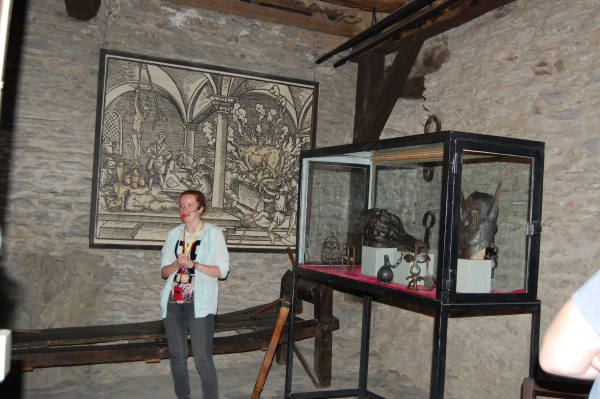 Tisza stands in front of a terrifying tapestry in Marksburg's torture chamber, which includes medieval instruments of pain, including a rack behind our tour guide.
Nerve-Racking
But Marksburg’s piece de resistance is its eye-popping (literally!) torture chamber! Situated in the castle’s oldest section inside what had been the horses’ stable in the basement of the Romanesque Palas, a variety of medieval instruments of torture are displayed here, along with a rather grim tapestry apparently depicting a “brazen bull"—a hollow, bull-shaped statue that victims were locked in, then roasted over a fire—plus various other devices of torment. They include a head crusher, thumbscrews, stocks and something that reminds me of what Inner Party apparatchik O’Brien threatened to put on Winston Smith’s face in the Ministry of Love’s Room 101 in George Orwell’s 1984: A “fencing mask”-like object attached to “an oblong wire cage” holding hungry rats, blocked by a small door which O’Brien could open by pressing a lever.
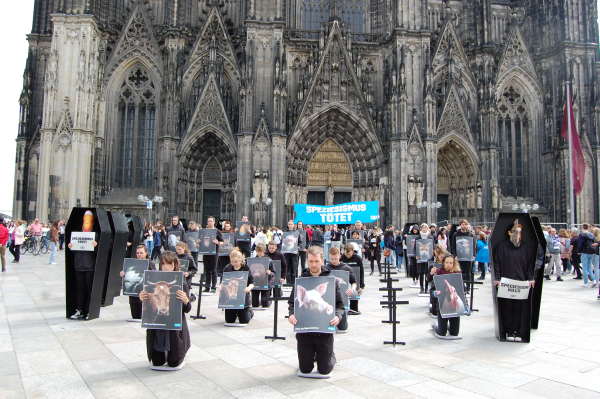 PETA activists stage a well-organized protest in front of Cologne's 14th century, 515-high cathedral.
 According to Tisza, torturing prisoners was intended to elicit confessions of one’s wrongdoings. Of course, this was a fool’s errand—faced with such massive inflictions of pain, most would likely confess to anything just to make the cruelty stop: Talk about “the tortured truth.” As Tisza prepares to lead us out of Marksburg Castle’s torture chamber, I notice a wooden frame that looks like a bed without a mattress behind her, below the tapestry. “What’s that?” I ask. Turning around our guide glances at the rectangular instrument of torture, used to excruciatingly stretch victims, and nonchalantly adds, “Oh yeah—that’s the rack! Now, follow me, the giftshop is this way…” There are no construct-a-rack kits sold along with other souvenirs, but I did buy fridge magnets of mini-knights in shining armor.
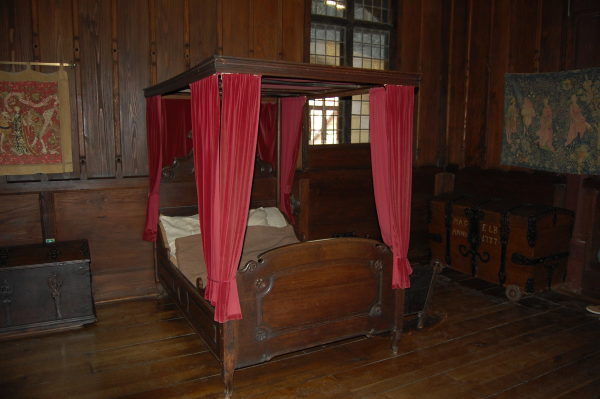 Ye noble bed, canopy and all, at Marksburg Castle.
Back aboard ship, Viking’s Skirner plied on, passing in the dead of night Remagen, where a fierce WWII battle was fought, as dramatized in Richard Attenborough’s 1977 epic A Bridge Too Far, starring Sean Connery, Ryan O’Neal, Michael Caine and Laurence Olivier. By morning we dock at the bustling, crowded, modern city of Cologne, birthplace of that eponymous fragrance and dominated by a gigantic 14th century cathedral. Sprawling out on the plaza in front of its Gothic 515-foot-high twin spires is a large, well-organized animal rights demonstration staged by People for the Ethical Treatment of Animals. The PETA activists hold photos and wear masks of slain animals, kneel and stand in front of a series of homemade crosses, coffins and startled tourists, demanding kind treatment for all creatures, great and small.
Having just visited Marksburg Castle’s chilling chamber of horrors, I thought of sci fi writer Robert A. Heinlein’s quote from 1967’s The Past Through Tomorrow: “No amount of force can control a free man, whose mind is free. No, not the rack, nor the atomic bomb, not anything. You can’t conquer a free man; the most you can do is kill him.”
VIKING:
For reservations or information, call a Viking Expert at:
- 1-800-2-VIKING (1-800-284-5464) or see your Travel Advisor | viking.com Reservation Hours (Pacific Time) Sun–Sat 5:00 a.m–7:00 p.m.
DESTINATIONS:
