


A guided walkabout through Wertheim in East Franconia and back to the Middle Ages reveals the Germanic charms we’ve become accustomed to
PART VI: Wandering to Wertheim
Back to the Past
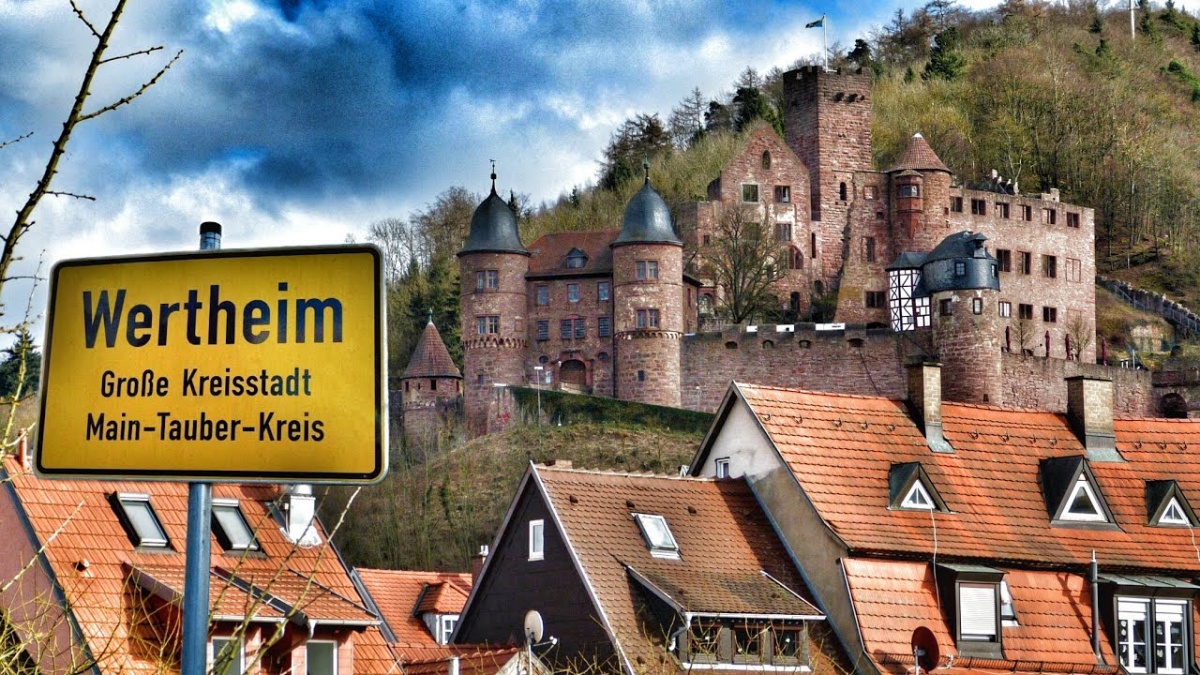
Continuing our Rhine Viking River cruise up the Rhine it seems like another day, another medieval enclave, as we embark on one of the optional tours that passengers are offered at all of our ports of call. A guided walkabout through Wertheim in East Franconia and back to the Middle Ages reveals the Germanic charms we’ve become accustomed to–picturesque half-timbered homes; chapels; clock towers; decorative wrought iron emblems demarcating shops; etc. One of those overhead trade signs features an axe and cleaver–you don’t have to speak German to understand that the painted word “metzgerei,” hanging from what may be a metallic bird’s beak, means “butcher shop” in this medieval Madison Avenue mass marketing medium.
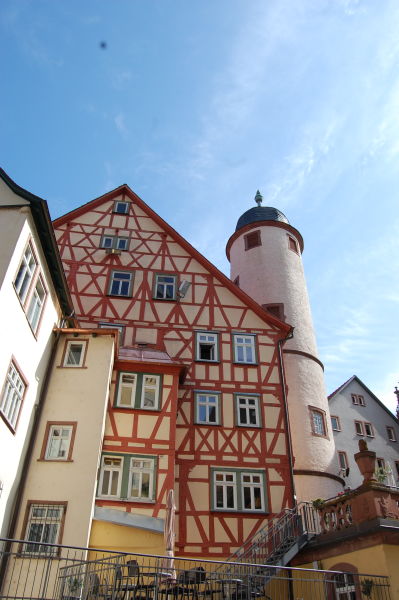 The leaning tower of Wertheim, "Spitzer Turm ."
And you don’t have to travel to Pisa to marvel at a leaning tower, as Wertheim has its own 800-year-old off-kilter skyscraper, thanks to centuries of surging floods. Built at the confluence of the Tauber and Main Rivers, the town had a strategic importance, which is revealed by Burg Wertheim, a sandstone castle first constructed starting in the 12th century, perched upon a hill overlooking the well-situated domain. Today, during summers, the castle’s ruins serve as the site for an open-air cinema, which I suppose could have been described to 14th century Wertheimers as “moving tapestries.”
Like a Stumbling Stone
But this being Germany, beneath the medieval aesthetic’s allure lurks a grim history. There are, of course, markers denoting how high the floodwaters of the converging twin rivers reached in the township. As well as markers indicating manmade disasters. Our guide, Ursula, who, like our other local tour leaders, speaks excellent English and is very knowledgeable, points out “Stolpersteine,” the “stumbling stones” inserted into streets, concrete cubes with brass plates bearing the engraved names and birth and death dates of Holocaust victims, in front of their last known residence before they were rounded up and shipped out to the concentration camps. How sad that some of their descendants, in a sort of Stockholm Syndrome frenzy reignited by the October 7, 2023 massacre of Israelis, are wreaking retribution in the form of collective punishment on Palestinians, including thousands of children, hellbent on turning the entire Gaza Strip into one big Stolperstein…
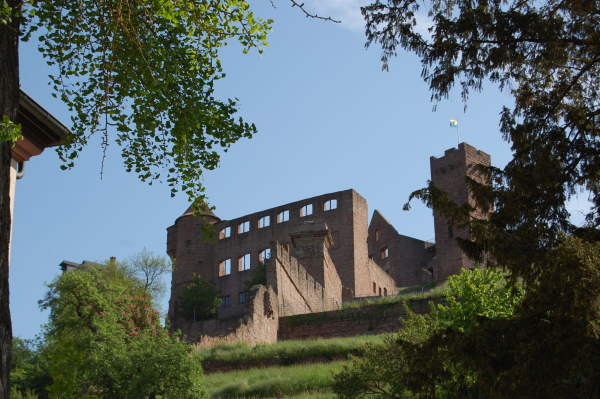 The ruins of Burg Wertheim, the village's 600 year old castle.
In any case, antisemitism did not start in Wertheim with Hitler’s “Final Solution to the Jewish question.” Ursula explains that it goes at least as far back as 1215 AD, when the pope stipulated that Jewish people must wear black hats and yellow dots—an eerie forerunner to the yellow stars of David Jews were forced to emblazon their jackets with about 700 years later. In keeping with Viking’s policy of displaying sensitivity regarding the Shoah, Ursula—who says the Holocaust wasn’t taught in (West) Germany until 1978—details the history of Wertheim’s Jewish population through the WWII era. Much of it is heartbreaking, but to be fair, there’s a glimmer of hope here and there: For instance, under Napoleon, a Jew was elected the town’s vice-mayor.
Home from the Hill
As her historic tour of Wertheim—revealing what’s beneath its beautiful surface—ends, Ursula offers Viking passengers an extra-added bonus feature: A visit to the Jewish cemetery. Our erstwhile guide has only three takers: Myself and what are apparently our voyage’s only other Jewish sojourners, a mother and daughter. We follow Ursula to the steep, 700-year-old graveyard at the edge of the village, where she opens a creaky metal gate with a key. Wending our way through the ancient tombstones on a hillside, for about an hour we commune with our ancestors, amidst a mournful silence more eloquent than any words could ever convey. Fortunately, this burial site was somehow spared from vandalism and destruction during the Nazi onslaught. As we part company with our German guide, Ursula repeats a quote she attributes to Elie Weisel: “You do not inherit guilt, but you inherit responsibility.”
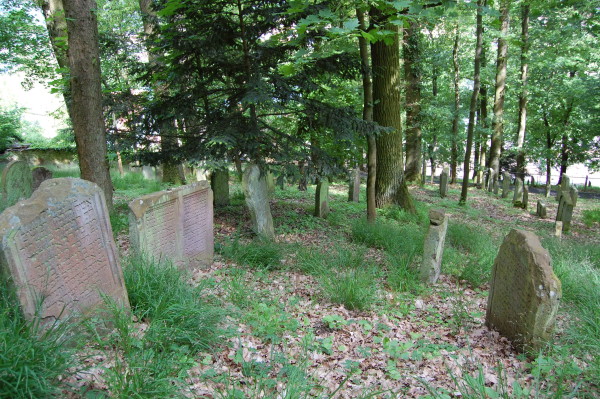 Jews lived - and died - in Wertheim for centuries, as Wertheim's 700-year-old Jewish cemetery attests to.
I flashback to words I read almost half a century ago atop another hill, far, far away. Engraved on a brass plaque on Robert Louis Stevenson’s tomb at Mt. Vaea, Samoa, is his poem Requiem, which became RLS’ epitaph:
“Under the wide and starry sky,
Dig the grave and let me lie…
This be the verse you grave for me:
Here he lies where he longed to be;
Home is the sailor, home from sea,
And the hunter home from the hill.”
Back aboard the Skirner, that night we enjoy a special feast, “Taste of Germany,” with our staffers garbed in their Bavarian best to serve up a traditional Germanic repast including pretzels, sausage, cheeses, mustard, sauerkraut, rich pastries and much more (but no matzoh balls, I muse). Schnapps and Kölsch beer, which originated in Cologne, are served, as Viking’s longship heads toward the city where that titular fragrance was created. But first our ship must traverse the most spectacular leg of our river odyssey.
VIKING:
For reservations or information, call a Viking Expert at:
- 1-800-2-VIKING (1-800-284-5464) or see your Travel Advisor | viking.com Reservation Hours (Pacific Time) Sun–Sat 5:00 a.m–7:00 p.m.
DESTINATIONS:
