



Macron urges calm as French "Freedom Convoys" approach Paris.
A deep anxiety pervades France and the rest of Europe, a disturbing fear that regional conflicts—Russia-Ukraine and, now Israel-Hamas—will spread the way brushfires ignite vast wildfires. It has happened. European regional “conflicts”—a finely honed euphemism—have spawned world-engulfing conflagrations. Twice. A third looms, this time with nukes. They say third time’s the charm.
“World War” isn’t just a click-bait headline here. It’s living memory. People walking local streets still hear echoes of the baying of the dogs of war. Some passersby bear mental and physical scars, small, coarse nuggets of experience, inoperable bits of actual or psychological shrapnel, indelible memories of traumas seen and suffered around which cysts have formed.
In the streets people pass by who lived through land, naval, and aerial bombardments; through block-by-block and house-to-house battles surging through European cities; through occupations by cruel, once-human beings transformed into dead-eyed specters mechanically obeying inhuman orders. Passersby carry imperfectly healed wounds that have left them with life-long physical and psychological limps. Witnesses are elderly now—their numbers diminish daily—but for younger generations their existence lends substance to their stories of the horrors of war.
Physical damage from both world wars is still present, deliberately preserved as memorials and reminders: In places the stitching from machine guns embroiders the facades of older buildings both private and public. War is not just a classroom topic here; people have seen and suffered its efficient, modernized, motorized manifestation, methodically planned, remorselessly executed, have listened to its booming, long-range-artillery symphonies of destruction, deprivation, and death.
France bans all pro-Palestinian protests
This is not evidence of French support for Israel. Rather, France’s banning of pro-Palestinian protests is an act of defensive panic, an attempt to avert violent emanations of sympathy rooted in decades of simmering Muslim resentment. The bills for French colonialism are coming due, the third world sending invoices for the wealth France extracted from, and the misery France imposed on, its colonies.
North Africa is a few hundred kilometers south of the sunny Côte d'Azur where I’m sitting on a terrace overlooking the Mediterranean. Festering misery and anger induced by first world predation—France is not alone in its colonialist adventuring—generates third world pressures that, like earthquakes and volcanoes, cannot be indefinitely contained. In a time when “unprecedented” is part of every other headline, World War III threatens a nuclear conflagration of unprecedented carnage.
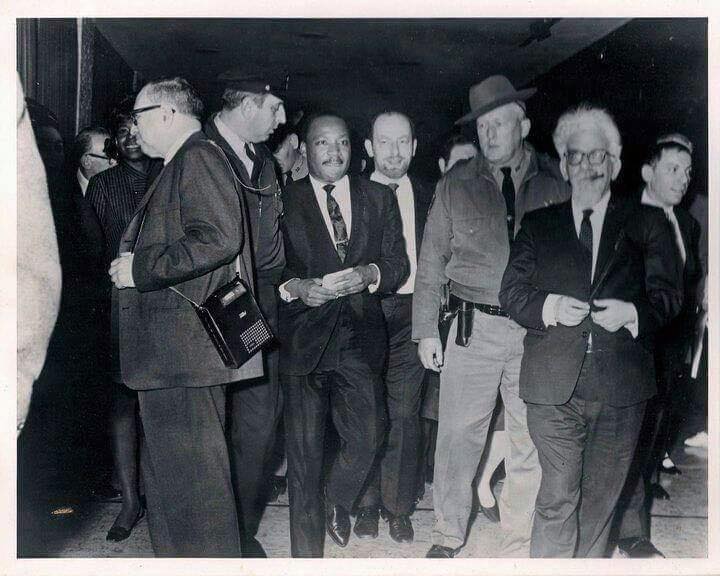
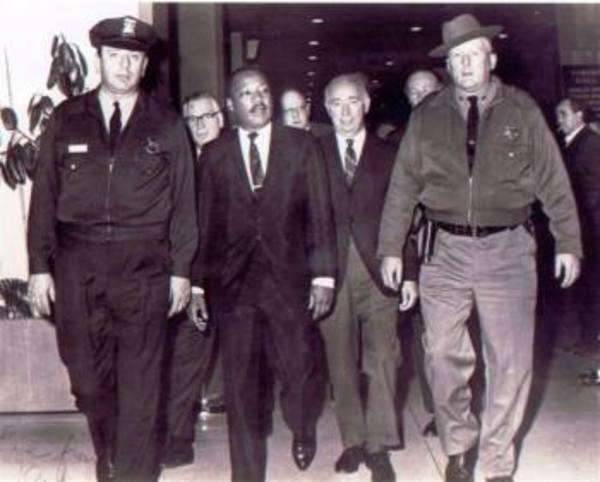 First from left, my father, Big Sid Karasik, escorting Dr. King at the Concord Hotel on March 25, 1968. Dr. King will be assassinated 10 days later.
I come by my love of France dishonestly, having inherited it from my father, Big Sid Karasik. Big Sid was a sergeant in the Army Corps of Engineers. He and his fellow combat engineers landed on Omaha Beach during the Normandy invasion; they were tasked with breaching, clearing, and bridging obstacles, not only barbed wire, bollards, and mines, but also buried flame-throwers activated remotely by Nazis on the clifftops. The obstacles had to be cleared to allow huge numbers of combat troops and their equipment to get beyond the beaches and into the countryside.
The Nazis had fortified the English channel, but it was a vast distance for an army fighting on multiple fronts, and they were spread thin. Big Sid and his fellow engineers blew up the obstacles, then built ramps and bridges over the Nazi’s extensive trenches so that tanks and other equipment could move inland. Wounded while clearing the beach’s defenses, Big Sid bore, and limped from, a piece of shrapnel the rest of his life; when a family doctor suggested he have it removed, he said that he wanted to keep it there to refresh his memory of who he’d fought and why.
In the first wave of Allied troops to enter Paris, he picked up another souvenir: a lady’s grooming set—comb, mirror, hair brush, nail buffer, and other manicure implements—of exquisitely decorated silver. Among his proudest possessions, he kept it gleaming. I admired it every day and thought it sublimely beautiful; it was unlike anything else we owned or that I saw around me in the small, predominantly Jewish village where I grew up and went to high school. When I asked how he’d acquired it, he would change the subject, but one day he told me: After liberating Paris, he and other troops had looted Le Bon Marché and he had liberated the grooming set. So that’s why I say I come by my love of France dishonestly.
A life-long Zionist, Big Sid flew to Israel frequently, particularly in its early days. He had law-enforcement credentials, and each time he flew in, he smuggled hand guns in his luggage. Though this was well before terrorism had soared into the stratosphere—before D. B. Cooper, politically motivated jetliner hijackings, and, ultimately, 9/11—El Al had very tight security, but Israeli friends in high places made sure his pistol-packed bags were waved through.
When I was 12, Big Sid moved us from New York to the Catskills, the Yiddish Alps. A workaholic—he sometimes held three different jobs at once—among the jobs he took was as a security guard at night at the Concord Hotel, located in the hamlet of Kiamesha Lake. Like a 6’3” troll guarding a bridge, Big Sid presided over the hotel’s main gate at night. There he sorted the paying guests from gate-crashers trying to sneak in to see the famous entertainers—Buddy Hackett, Tony Bennett, Milton Berle, Barbra Streisand, Judy Garland, Jack Benny—who performed in the Imperial Room, the hotel’s 3000-seat nightclub, or their far raunchier encores in the smaller Night Owl lounge.
One night at the main gate a belligerent non-guest said that if Big Sid didn’t move out of the way of his car, he—the non-guest—was going to run him down. Big Sid—another of whose jobs was as a constable for the local township—carried a gun. When the non-guest started moving his car forward, Big Sid drew his gun and shot a hole in the front tire. Then, because the spare tire had been removed to make room for the two formally-dressed, fur-clad women hidden in the trunk, he called a tow truck to haul it away.
A would-be comedian and tummeler, Big Sid kept a mental store of jokes he liberated from the A-list comics who worked the Concord and other Borscht Belt hotels. He told those liberated jokes to anyone he could collar. I mean this literally: In restaurants he’d get up, go over to a table of strangers, and start telling jokes. His favorite comic to liberate jokes from was the former rabbi Jackie Mason, but Big Sid wasn’t above channeling Don Rickles or any of the other comics who honed their craft in the Catskills, a rite of comedy passage dramatized in the second season of the marvelous The Marvelous Mrs. Maisel. Lenny Bruce— my own tragi-comedy god, and an important, recurring character in Maisel—spent a couple of summers as an MC and tummeler at Kramer’s Hotel in the hamlet of Hurleyville; the comedian Jerry Lewis—a comedy god in France—appeared often at Brown’s Hotel in the hamlet of Loch Sheldrake.
But Big Sid didn’t restrict himself to liberating one-liners from comedians. One of his favorites came from Israel’s fourth prime minister, Golda Meir, who once said, “Let me tell you something that we Israelis have against Moses. He took us 40 years through the desert in order to bring us to the one spot in the Middle East that has no oil.”
Though deprived of oil, Israel has been wildly successful at extracting, refining, and flourishing from another resource: The world’s collective guilt over the Holocaust (not to mention a couple of millennia of straight-up Western European persecution of Jews.)
Victimization as a source of cultural capital is on my mind now not only because of Hamas’s surprise attack on Israel, but also because during yesterday evening’s brief (and I’m told rare) blackout along a section of the Promenade des Anglais, I was chatting with an elderly neighbor—I will call her Madeleine—across our darkened, Mediterranean-facing terraces, and she told me of her concern for the safety of her husband, who when Hamas attacked was visiting family in Jerusalem. (I had already known she was Jewish by the mezuzah on her apartment door.)
Fear of Antisemitism resonates differently here than in Los Angeles, where proclamations of Jewishness sound strident and self-conscious if for no other reason than at home Jews are considered White. But not here: Within deeply-Catholic France’s long history of virulent Antisemitism, the roots of Jewish fear reach deeper. The source of that fear is the same skin-head-adjacent Euro-Whiteness that France’s Muslim people must feel riding trams or walking down streets with their families, the Muslim women wearing hijabs. I imagine—how could I know—that the fear felt by non-Whites here is akin to that felt by Black people at home: an ever-present awareness that a man or woman sitting across from them on public transit or walking by them at the mall hates them, harboring dark and violent fantasies of violence against them and their families. How horrible to have to live with a sense that beneath an apparently civilized surface some man or woman passerby was thinking that the body politic would be healthier without me, someone who might be in a mental space where acting on that was plausible.
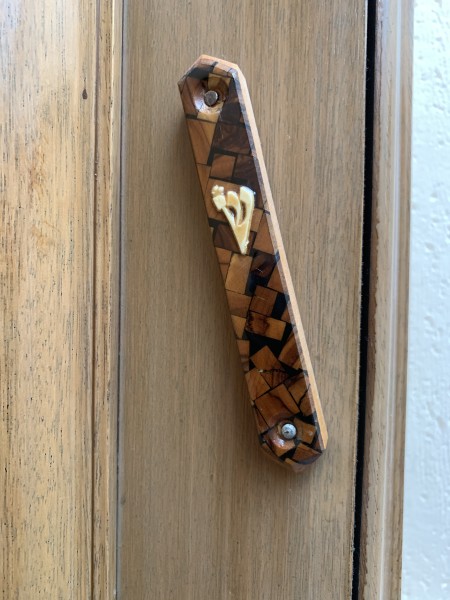 Madeleine's mezuzah.
In my lame French I both sympathized and empathized with Madeleine; her anguish is real, her husband and his family in real danger. But I spared her what I believe about the rogue state of Israel: That it has over decades sown the seeds of this “conflict” in order to advance its expansionist aims, to solidify its hold on its already expanded territories, and to justify its racist policies.
It is critical to stress the difference between “Israel” and “Jewish.” They are not the same. Though successive Israeli governments have since Israel's establishment done their best to elide the two—and largely succeeded—it’s rhetorical bullying: It is not Antisemitism to be against the fascist policies of an Israeli government that unashamedly manipulates guilt over past persecution of Jews, using that past persecution as an excuse for present and future persecution of non-Jews. I am not—nor is anyone else—a “self-hating Jew” for objecting to and opposing decades of Israeli brutality toward non-Jews. I don’t and won’t accept it, and nor should anyone else.
Much like in the United States, the right wing in Israel has spent decades preparing for and building a political and rhetorical infrastructure, a rationale for supporting its decoupling of government and democracy. Israel early on abandoned its once-professed pluralistic ideals—assuming that stance was ever more than a pose—substituting a political pretext inside which it could, under the aegis of self-defense, cleanse itself of impurity, “impurity” here meaning non-Jews (and even some Jews that religious extremists here deem insufficiently Jewish).
This stance is a manifestation of the same impulse that drives all fascism, religious or no, the same impulse that has driven purification campaigns—including the Nazi’s—throughout history: Nothing—not people, not ideas, not art—of whom or of which the ruling majority disapproves may remain visible. What our own right wing camouflages in fringe rhetoric and aims to accomplish via packing our Supreme Court, the Netanyahu government camouflages in self-defense rhetoric and aims to accomplish via undermining the Israeli judiciary. This is something dictatorships have always done.
The Israeli right has slowly, steadily advanced its territorial agenda, effectively crushing criticism via slick manipulation of Jewish victimhood. The world has seemingly given Israel carte blanche, treating Israel’s repeated over-reactions, brutalities, and atrocities as above reproach. The world’s failure to call this out has enabled further Israeli over-reactions, brutalities, and atrocities.
The tenor of main-stream reporting of the Hamas-Israeli conflict is overwhelmingly and uncritically sympathetic to Israel and heavily critical of Hamas, characterizing Hamas’s (re)action as dastardly and dishonorable, a surprise attack comparable to Pearl Harbor and 9/11. Wholly absent over the past five decades has been any sympathetic, main-stream coverage of Israel’s continual violence against, attacks on, and repression of Palestinians.
The main-stream media somehow considers Israel’s five decades-long strangulation of Palestinians to be necessary and justifiable while it deems this latest explosion of Palestinian anger as reprehensible and unprovoked. Palestinians are expected and required to be patient, not be uppity, and ever fight back. Does that sound familiar?
Calling in “self-defense,” Israel brutalizes Palestinians, self-justifying a “stand your ground”—or more appropriately a “line in the sand”—policy, but on a national scale: “They want to push us into the sea. We have a right to defend ourselves.” Israel’s killing of Palestinians is, according to Israel, justifiable homicide, again on a national scale. The world, manipulated and cowed, turns a blind eye; yet rarely mentioned—virtually never in main-stream media—is that Israel’s permanent state of war and never-let-up self-defense (toward which the US contributes substantially) is in large part the result of relentless, remorseless, and vicious persecution of Palestinians.
And of Palestinians’ predictable, inevitable reaction to being brutalized, on which the Israeli government has been counting because it provides a rationale for invasion, displacement of Palestinians it does not kill, and building more Israeli settlements on more land that was originally Palestinian.
Israel says it doesn’t plan long-term control of Gaza
It’s a lie, and France and all the rest of the world will pay a dear price for helping Israel accrue more real estate.
