

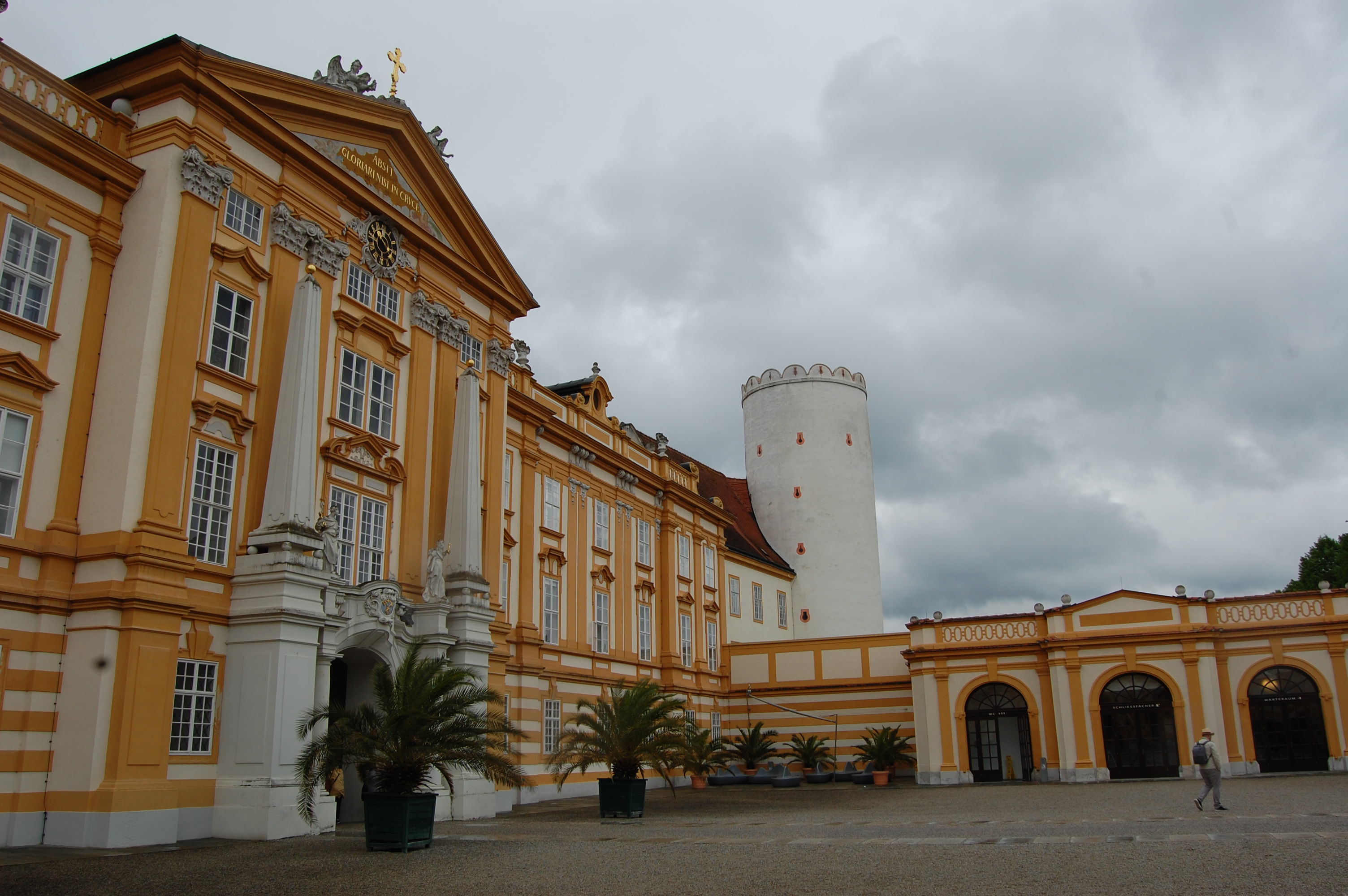


Entering this medieval monastery is like time traveling past the Enlightenment back to the Middle Ages
III: FROM AUSTRIA TO GERMANY: MELK AND PASSAU
The Melk-y Way
Viking’s Modi carries on its Grand European Tour, leisurely cruising the Danube to Austria’s Wachau Valley, dominated by the hilltop Melk Abbey, a 900-year-old Benedictine place of worship, learning and reflection. The imposing walled compound stretches for more than 1,000 feet, and includes the Imperial Corridor, a 650-foot interior walkway that almost spans the abbey’s entire Southern Wing and is punctuated by portraits of Austrian royals The baroque complex has 365 windows – one for every day of the year. The oldest part of this complex is a tower derived from the castle built by the House of Babenberg during the Middle Ages, a noble dynasty which ruled from 976 to 1246, is.
Melk’s gemstone is the twin towered Baroque Abbey Church, which is decorated with four pounds of gold leaf and was reconstructed in 1701 per architect Jakob Prandtauer’s designs. Amidst the glorious stucco, marble, gold leaf and 200-foot-high fresco murals in the dome are relics that strike me as downright creepy counterpoints. Left of St. Michael’s Altar in a glass sarcophagus are the remains of a catacombs saint called St. Coloman or Clemens. An altar to the right is dedicated to St. Benedict, but the sarcophagus is empty. At John the Baptist’s altar is a glass sarcophagus with the skeleton of an unknown catacombs saint – a gift of Empress Maria Theresa. Also on the macabre side are reusable coffins – the bottom could open allowing the corpse to fall out and for the recycling casket to be used again. (Fortunately, this technical innovation was abolished in three months.) The reliquary’s oldest treasure is far more aesthetically pleasing, an 6th century ivory carving box made from a walrus tooth.
Entering this medieval monastery is like time traveling past the Enlightenment back to the Middle Ages, when religion (a particular variant of Christianity) dominated every aspect of daily life. The artwork depicts biblical scenes and figures. Melk’s motto is: “Absit gloriari nisi in cruce,” which seems to come from a passage in Galatians 6:14 that translates as: “But God forbid that I should glory, save in the cross of our Lord Jesus Christ, by whom the world is crucified unto me, and I unto the world.” The Melk Cross contains a relic, the jawbone from an Irish missionary martyred by the local populace.
 The ancient tower is visible from Melk's courtyard.
For this non-believer’s florins, ducats and doubloons, the jewel in Melk’s crown is its breathtaking library, which dates back to 1735 (imagine how much late/lost book fees would be if one had to pay them today?!). The three-floor, 12-room Melk Abbey Library now holds 100,000-plus books dating back to the 9th century, including 1,800 manuscripts and 750 incunabula (early books printed prior to 1501 by Gutenberg printing presses that used metal type). The library’s ceilings are crowned with frescoes by Paul Troger and Johann Wenzel Bergl. The main and an adjoining room are open to visitors; a spiral staircase connects the ground and main floors. The inscription on the library’s Western entrance expresses literary reverence: “Ex litteris immortalitas” (Immortality Through Books).
It’s tempting to view this voluminous depository of volumes as a touchstone of the Age of Reason and a rarefied receptacle of wisdom, but it also illustrates how finite civilization’s knowledge was: A 300-year-old globe depicts California as an island and dubs Australia “New Holland.” In another 300 years, in the post-AI era, who knows what humans (and robots) of tomorrow will know that we 21st century denizens think we do, but don’t? Be that as it may, anyone who values learning and reading can’t help but be impressed by Melk Abbey Library, as was Umberto Eco who, in his novel The Name of the Rose, named one of the protagonists “Adso of Melk” to pay homage to the abbey and its famous library.
The wide-ranging grounds include an extensive park, where Bergl painted allegorical frescoes adorning Melk Abbey’s Garden pavilion in 1763/64 before he daubed landscapes at Schönbrunn Palace. Benedictine monks continue to live and work at Melk’s monastery, as they have since 1089. The public is welcome to participate in worship and prayer with the monks. Believe it or not, the longest operating school in what is now Austria – founded back in the 12th century as a medieval monastic school – is Stiftsgymnasium Melk; the teachers of the 900 students of the Melk Abbey Secondary School are now publicly funded.
With its many components, the multi-faceted Melk Abbey is a serene sanctuary with spaces for faith; contemplation; spirituality; devotion; study; and communing with nature. It is a unique self-contained galaxy unto itself – call it the Melk-y Way.
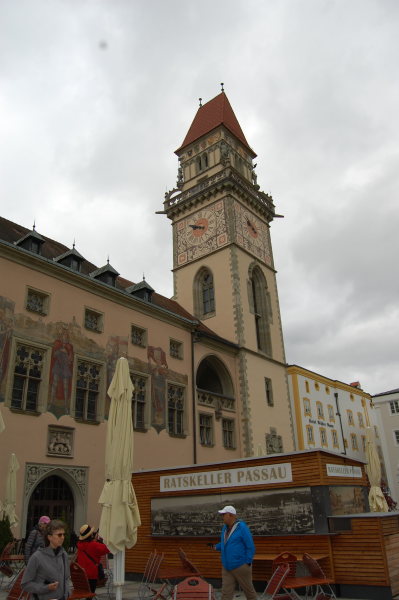 Passau's colorful Old Town Hall.
City of Three Rivers: All Things Must Passau
Forging on, Viking’s Modi crosses the Austrian border into Germany where our first stop is Passau in Lower Bavaria, where three rivers converge: The Inn, Ilz and Danube. Due to this confluence of waters a flotilla of touristic and holidayer-oriented boats is afloat in this quaint town with lovely gothic, rococo and baroque architecture that somehow escaped being destroyed by two world wars and countless floods, an endless threat. Throughout the walking tour down the winding, cobblestoned streets of the old city, our guide Heike points out markings on walls that demarcate how high the waters rose and in what year.
The Aryan equivalent to Homer’s Odyssey is the Nibelungenlied, Germanic myths by an unknown 12th century auteur who is believed to have been from Passau. These iconic legends about Attila the Hun, Queen Brunhild, Kriemhild and the heroic Siegfried – an Achilles-like character of great strength and valor with one vulnerable spot – have inspired some of Europe’s greatest creative geniuses. Composer Richard Wagner put the lore lyrically to music in his epic operas “The Ring Cycle,” while Fritz Lang directed the silent screen Die Nibelungen: Siegfried, more than half a century before Francis Ford Coppola’s Vietnam War chopper raid was set to Wagner’s “Ride of the Valkyries” in 1979’s Apocalypse Now.
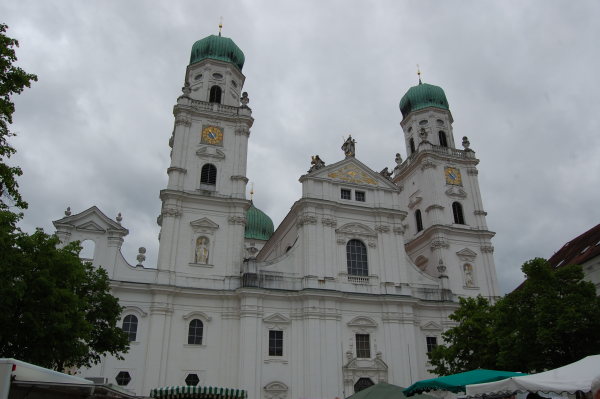
During the Renaissance, Passau was a major manufacturing center for blades (sword, not helicopter). The town’s most substantial structures but of course signify church and state. The onion-domed, twin-towered St. Stephen’s Cathedral, completed in 1693, once boasted the world’s largest organ, and to this day, it still has Europe’s biggest church organ, with 17,774 pipes. A statue of King Maximilian I of Bavaria is perched atop a pedestal atop a flight of steps in the square before the cathedral.
The 14 th century Altes Rathaus or Old Town Hall, the seat of local government, is adorned with murals of men in suits of armor, while the interior is painted with scenes of the town, its history plus fables on walls and ceilings; there are also stained glass windows. The square in front offers outdoor cafes.
But these buildings are overshadowed by Veste Oberhaus, located across the Danube on the left bank, perched 344 feet up on a mountain, which according to Passau’s website, is “one of the largest and most powerful castle complexes in Europe.” Starting in 1219 with the first Prince-Bishop of Passau, Ulrich II, these absolutists who combined religious and secular power ruled over their domain from this fortress. According to our guide Heike, at one point in Passau’s history the people met in the Rathaus to defy the Prince-Bishop, who responded by firing a cannonball into the town hall, which quickly quelled the rebellion. I imagine that a cannon shot from Veste Oberhaus did the dirty deed.
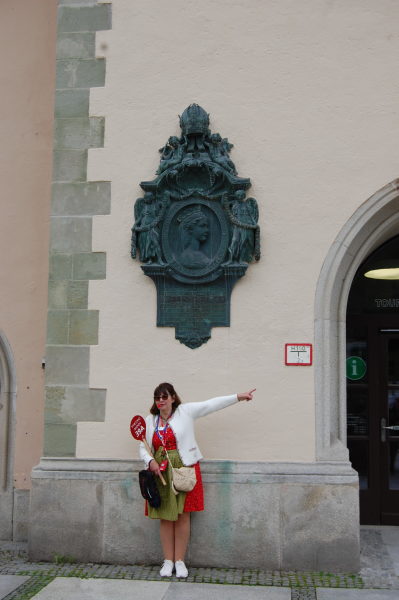 Tour guide Heike points at the sign indicating the high water mark in flood-prone Passau, which stands at the confluence of three rivers.
Unless one is a hardy mountaineer with lots of time to spare, buses stop in front of the town hall make the 10 or 15-minute drive over a bridge across the river and uphill to Veste Oberhaus, which can be translated as “the Upper Castle.” Straight out of a fairy tale, this 213,000-plus square foot citadel offers another “Wayback Machine-like” visit to the past. Within its regal confines are towers, parapets, walls, stately buildings, tunnels, an exterior wooden walkway, an observatory. Perhaps best of all are the splendid vistas found from on high of Passau and beyond. Through arrowslits that archers once shot at armored enemies from, one can gaze on Bavaria’s beauty stretched out beneath us. It reminded me of the Who song: “I Can See for Miles.”
The three rivers of Passau, also known as “Dreiflüssestadt” (City of Three Rivers), and where they converge are visible, as is Viking’s 443-foot-long Modi, moored to a dock, looking from afar like a child’s toy in a bathtub. It’s easy to imagine the ruler surveying his fortress and the realm beyond it and uttering: “It’s good to be the Prince-Bishop!”
As if to reinforce the sentiment, upon boarding the bus, one of our passengers, Brett, generously gives the driver a bunch of Euros, treating his shipmates to the ride back down to Passau. Noblesse oblige!
VIKING:
- For reservations or information, call a Viking Expert at:
- 1-800-2-VIKING (1-800-284-5464) or see your Travel Advisor | viking.com
- Reservation Hours (Pacific Time) Sun–Sat 5:00 a.m–7:00 p.m.
DESTINATIONS:
