


This relaxing sensation of being one with the cosmos is merely momentary, as all-too-soon we dock at Austria’s capital by early evening, and I’m swept away again into the cruise’s hurly-burly.
II: “VIENNA WAITS FOR YOU”: WOLFGANG, WELLES, WEALTHY EMPIRE’S EDIFICES
Viking’s Modi Moseys Through Slovakia
Continuing our cross-continental river trek, Viking’s Modi disembarks from Hungary and moseys along the Danube. In the morning, after a sumptuous buffet breakfast with omelettes cooked to order by a droll Filipino chef named Marlon, we find ourselves floating through Bratislava. Atop the Modi’s sundeck I languorously view Slovakia’s capital, with its architecture stretched out along the Danube and across the centuries, including an aesthetic medieval castle, utilitarian Stalinist apartment houses and a modern skyline. Unfortunately, we don’t stop in this city which had, until 1993, been part of Czechoslovakia, when the post-Soviet so-called “Velvet Divorce” divided that country into two nations, Slovakia and the Czech Republic. Bratislava is the only capital city to border two sovereign states, Hungary and Austria, where we soon arrive.
Ensconced in a comfy deck chair on the third floor of Viking’s 443-foot Modi (named after the son of the Norse god/MCU superhero Thor) as we waft down the Danube, this “crazy child… slows down,” as Billy Joel sang in “Vienna.” I experience that languid, tranquil, transcendental sense of flowing with the river of life. But this relaxing sensation of being one with the cosmos is merely momentary, as all-too-soon we dock at Austria’s capital by early evening, and I’m swept away again into the cruise’s hurly-burly.
The musicians, singer (in blue gown) and dancers (in white dress and tuxedo) receive a round of applause at Vienna's Palais Auersperg.
A Little Night Music
After supper I’m whisked off to a concert – but instead of rock ballads by Billy Joel, who crooned “Vienna waits for you,” we’re regaled, but of course, by classical music at Palais Auersperg. This early 18th century palace is resplendent with marble facades, nude statuettes, low hanging chandeliers and up a dazzling double staircase, a hall that seats about 200, with a small stage crowned by ornate music stands for five musicians strumming stringed instruments plus one pianist, who from time to time accompany opera singers and dancers, hoofing with comical panache.
This being the land of Wolfgang Amadeus’ birth, Mozart’s “The Marriage of Figaro,” “Eine Kleine Nachtmusik” and “The Turkish March” are performed, enchanting us. A concerto from Vivaldi’s “Four Seasons” is played and, as we’re in Vienna, the beguiling concert obligatorily ends with Johann Strauss’ “Waltz of the Blue Danube.” (BTW, Strauss should be sued for false advertising – the Danube never seems blue during our entire sojourn.) The serene sounds could soothe savage souls and the musicians, singers and dancers receive enthusiastic ovations.
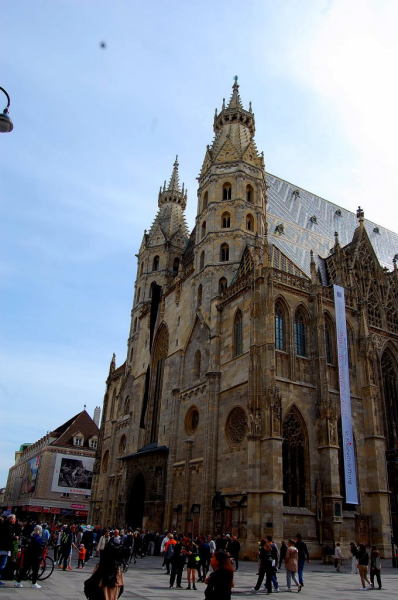 Construction on Vienna's St. Stephen's Cathedral began in 1339.
Panoramic Vienna and The Third Man
In the morning, passengers board buses for a “Panoramic Vienna” excursion that is – unlike the concert, which is an optional extra – included as part of Viking’s voyage. We drive around the historic Ringstrasse or Ring Road, pass the MuseumsQuartier, Strauss’ home, the State Opera, Parliament Building and so on of the capital that had, until 1918, co-presided with Budapest over the Austro-Hungarian Empire. The three-and-a-half-hour jaunt around this metropolis of about 3 million inhabitants is now largely a blur, a sort of “If-it’s-Tuesday-it-must-be-Belgium” whirlwind, a sightseeing introduction to appetizers that require much more time to absorb during possible future visits.
But we did see something that, much to my amazement, I actually recognized: The Grand Ferris Wheel from Prater Park, where a harrowing scene full of menace from the chilling classic, The Third Man, was shot in 1949 along with lots of other postwar Vienna locations. In this film noir masterpiece, bad guy Harry Lime (Orson Welles), who is supposedly dead, reappears and takes a Ferris wheel ride with his goody two-shoes pal Holly Martins (Joseph Cotton); Lime might toss him out of the cabin to ensure Harry’s faked death isn’t revealed. At this sequence’s end Welles wryly delivers one of cinema’s immortal monologues: “In Italy for 30 years under the Borgias they had warfare, terror, murder, and bloodshed, but they produced Michelangelo, Leonardo da Vinci, and the Renaissance. In Switzerland they had brotherly love – they had 500 years of democracy and peace, and what did that produce? The cuckoo clock.”
At the end of our guided tour, we’re dropped off near St. Stephen’s Cathedral for an hour-plus of free time on foot. After visiting the 700-year-old gothic-style house of worship I finally exchange dollars for euros at a nearby money changer (as Hungary has its own currency) and buy a cap emblazoned with a Gustav Klimt image in one of Stephanplatz’s souvenir shops at this favorite tourist attraction.
Schönbrunn: It’s Good to be the Emperor!
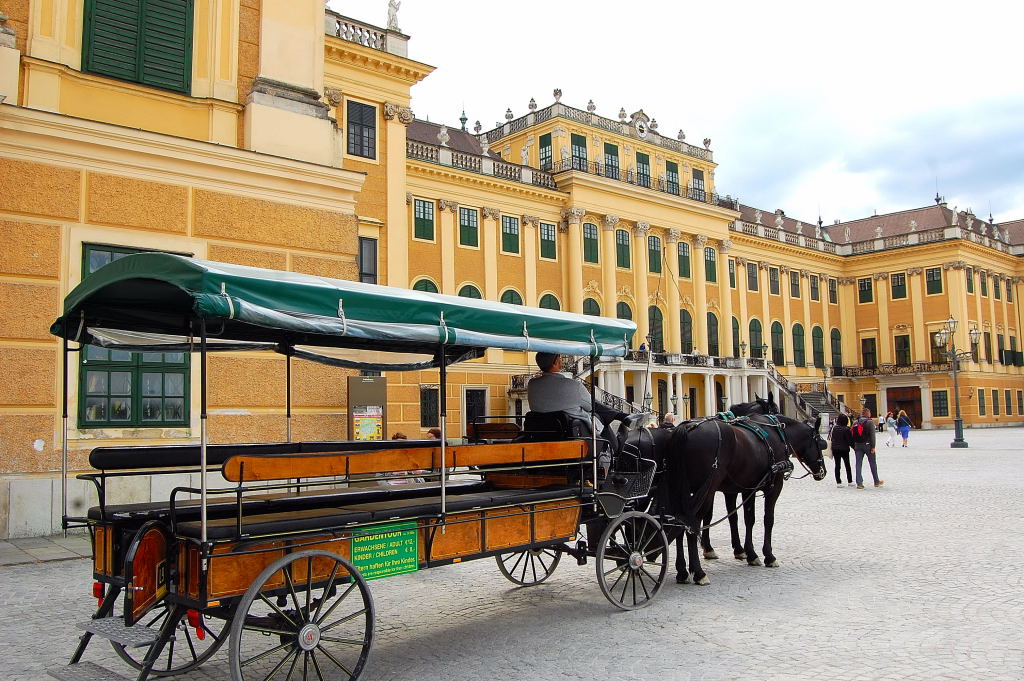
If the morning’s city tour offers a swirling potpourri, the afternoon’s optional excursion is a spectacular close-up, highlighting Schönbrunn, Austria’s colossal imperial palatial complex, located about four miles from Vienna. This simply stunning, sumptuous estate stretches across 400 acres, with its origins going all the way back to the Middle Ages. (Although Viking’s visit lasts around three hours, this still isn’t enough time, alas, to also fully explore the royal compound’s gardens and maze.) The manor house and grounds came into the possession of the Hapsburgs (AKA Habsburgs) in 1569, when Holy Roman Emperor Maximilian II acquired it. A who’s who of that dynasty – and even one of its most implacable foes, Napoleon Bonaparte, who encamped at Schönbrunn when his forces occupied Vienna! – lived here over the centuries, as the Rococo and Baroque buildings, deer park and gardens, that required1,000 courtiers to maintain, grew and evolved as the summer retreat fit for emperors and empresses.
A mere 45 of the jaw-dropping complex’s 1,441 rooms are open to the public at Schönbrunn, which translates as “beautiful spring.” The optically opulent, extremely extravagant exclusive enclave includes the Hall of Mirrors, its walls and ceiling decorated with gilt rocaille (elaborate ornamentation of shells and pebbles) in between tall crystal mirrors. It is believed six-year-old Mozart tickled the ivories of a well-tempered harpsichord for Maria Theresa there in 1762, afterwards leaping onto the Empress’ lap and, according to his father Leopold, Wolfgang “clasped her around the neck and kissed her heartily.”
Also in the 1760s, Maria Theresa – arguably the Hapsburgs’ top Schönbrunn influencer – commissioned artist Joseph Rosa to paint 15 large landscapes set in the walls of the three Rosa Rooms. By 1777, Maria Theresa also commissioned floor-to-ceiling murals of exotic landscapes painted by the Bohemian Johann Wenzel Bergl on the walls of three ground floor apartments. A room with gold and white panels and light fixtures made of Bohemian glass named after the empress’ daughter, Marie Antoinette, was the family dining room. Perhaps Maria Theresa let her child eat cake there, before she was shipped off to marry King Louis XVI in France, where Marie Antoinette ultimately met her fate.
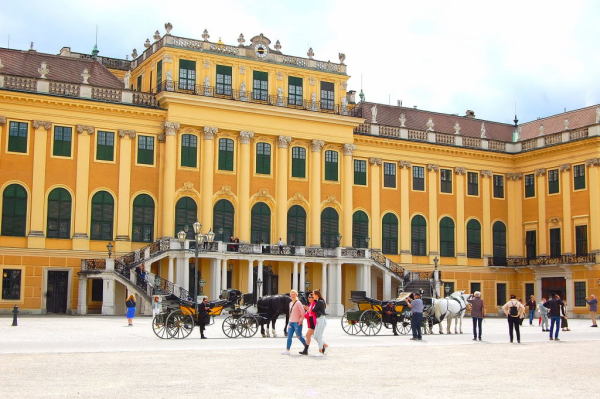 Some arrive in style at Vienna's posh Schnbrunn Palace in horse drawn carriages.
“Orientalism” was a vogue in the 18th century and the East Asian Cabinets feature lacquer panels painted with scenes of nature, porcelain vases and figures, silk wall hangings imported all the way from Japan and China, etc. The Blue Chinese Salon in Schönbrunn’s East Wing is decorated with Chinese rice-paper wall hangings acquired during the mid-1700s and hung in 1806. The Porcelain Room, which Maria Theresa used for card playing and as a study, also evinces Asia’s influence over Austria. White and blue wooden framework cleverly imitates porcelain in this chamber that also has Chinese type parasols and 200-plus ink drawings featuring China scenes. The penchant for exotica also extends to the Millions Room, with panels made from rosewood which contain 17th century Indo-Persian miniatures.
Balls, banquets and receptions were held in the Great Gallery, where tall crystal glass mirrors are amidst florid white and gold stucco decoration, which were illumined with candlelight in overhead chandeliers and candleholders on the wall (since 1901, 1,100 lightbulbs have lit the 1,351 square foot space). Above, the Great Gallery is crowned by Italian master Gregorio Guglielmi’s fresco murals on the ceiling in this capacious hall completed in 1761. Exactly 200 years later, on June 3, 1961, President John F. Kennedy met Soviet Premier Nikita Khrushchev to discuss the Berlin Crisis, Laos and more in the Great Gallery. One can imagine the communist leader, son of poor peasants, wondering about the common folk who paid for the palace with their blood, sweat, tears and taxes so that the royals could rollick and frolic?
All this and more “waits for you” at Vienna, as Billy Joel sang. It’s true that today, Schönbrunn may make us ponder “what price grandeur?” Nevertheless, there’s no doubt that the eye-popping splendor of this spectacle, now a UNESCO World Heritage Site, is an unforgettable, must-see relic of Austria’s patrimony from an age of absolutism when imperial heads of state, surveying their royal realm, could, paraphrasing Mel Brooks, gleefully gush: “It’s good to be the emperor/empress!”
VIKING:
For reservations or information, call a Viking Expert at:
1-800-2-VIKING (1-800-284-5464) or see your Travel Advisor | viking.com
Reservation Hours (Pacific Time) Sun–Sat 5:00 a.m–7:00 p.m.
DESTINATIONS:
