

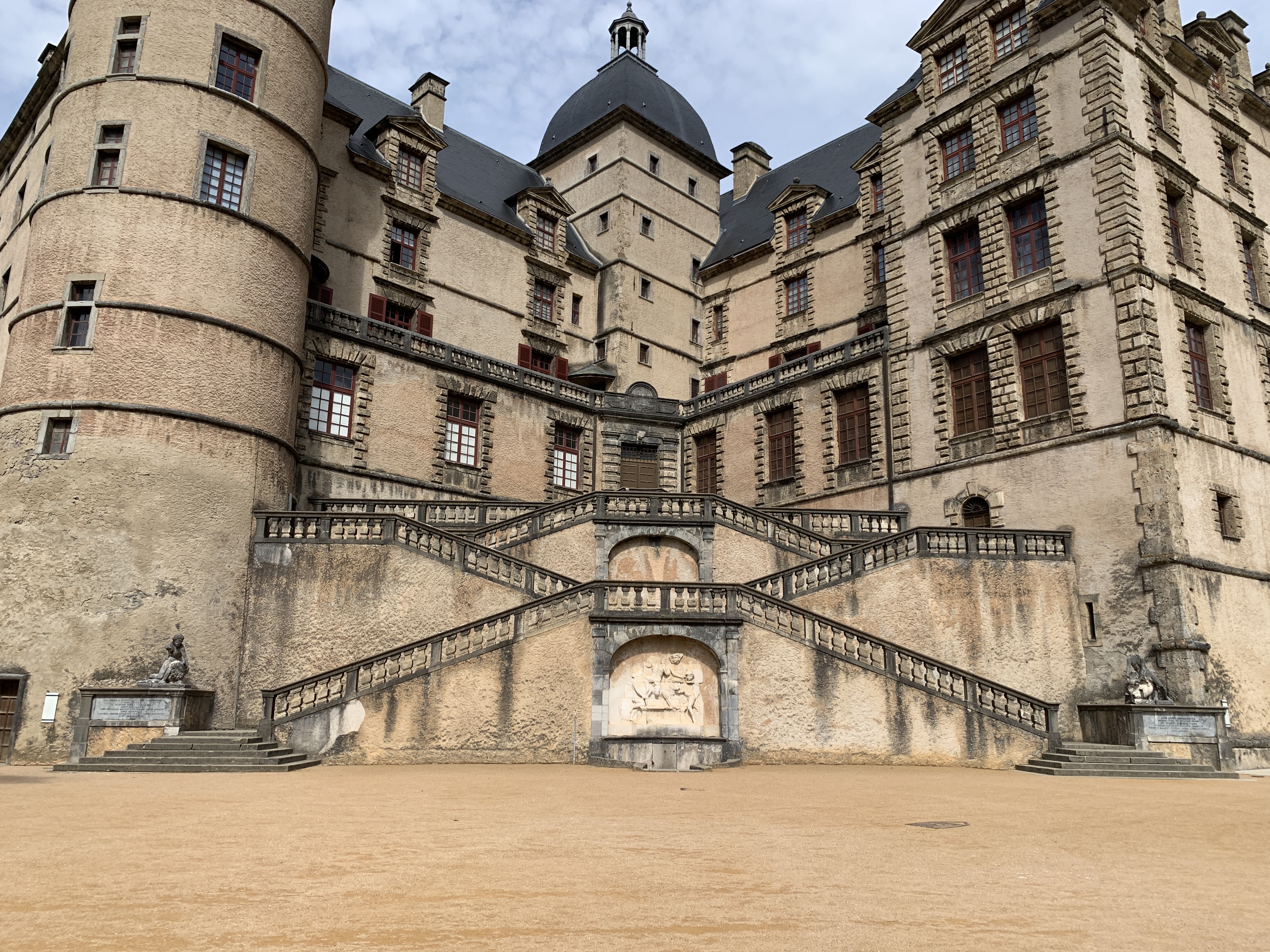


The difference between my cringe-worthy MDOA (Melt Down On Arrival) and now is an intervening visit to the small city of Vizille, a short distance from Grenoble.
It’s 23:30 on our first night in Nice. Gobsmacked by 20 hours of travel, Karen the Navigator and I are camped in the lobby of La Tanagra, a Mediterranean-fronting apartment building on the top floor of which our Airbnb rental is supposed to be located. We are unable to find that apartment, much less access it. Obviously we can’t camp in the lobby all night, so we’re discussing going to a hotel, although the logistics of moving us and our copious luggage this late at night are daunting, particularly in a place where I have only a minimal grasp of the language. And that’s assuming we can find a hotel room. Not only is this the height of the season in one of the world’s major tourist destinations, but also Nice is among the cities hosting the 2023 Rugby World Cup. Rugby fans—team-jersied, face-painted, testosterone-fueled, and loud—have swarmed here from all over Europe.
I’m depressed, stymied, out of options. Then the door to the darkened elevator landing opens, and a young man steps out. Prepared for a “Non” I ask, “Parles-tu anglais?” Nodding, he says, “Oui, yes,” then walks past us and exits the lobby’s sliding glass doors. We watch him descend the steps and leave through the green, wrought iron gate to the sidewalk. We look at each other. What just happened?
But a moment later he returns carrying a pizza. Frenchly but clearly he asks, “You need help?” Showing him my phone with our host’s directions, I tell him that the apartment to which our directions lead has the wrong keypad. He reads, nods, then points. “These are written relative to the main elevator”—he then points to the Hors de Service sign—“which is broken. The elevator you took”—he points to the dark hallway—“is the service elevator. But it’s turned 90 degrees. So your directions must also be turned 90 degrees. Go up and look at the door to the right of the broken elevator.”
I reelevate, then position myself with my back to the dead elevator. The apartment door to my right has the correct keypad. I enter the code, the lock retracts, and the apartment door swings open. Leaving the door ajar—I’m afraid to relock it—I deelevate. Our savior—Daniel—his pizza cooling, is still there, keeping KtN company. I thank him, elevate KtN and the luggage, and just like that, we’re in.
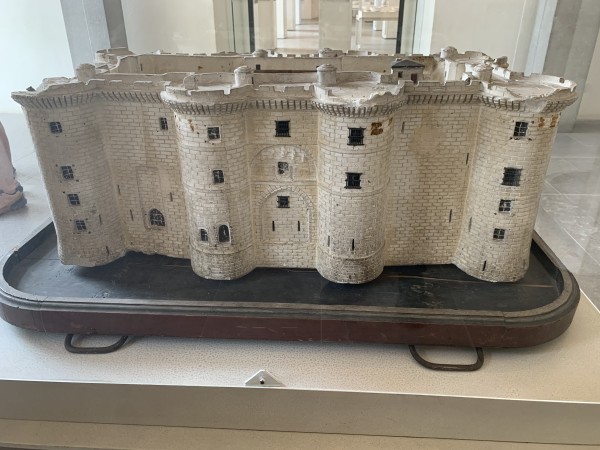 Model of the Bastille made from the crushed stones of the Bastille itself. It was often carried in parades in early celebrations of the revolution.
Several days later, I’m sitting on our 7th floor—8th as we count them in the US—apartment’s broad terrace. It’s a balmy, south of France afternoon. I’m facing an achingly azure sky, a warm, caressive breeze wafting by. In front of me, the Mediterranean, calm, dappled in as many distinct shades of blue as the Irish countryside and fields are dappled in distinct shades of green, reaches toward Africa. I’m ashamed. Yes, the Airbnb self-check-in was messed up, but I was losing my shit because, instead of getting frictionless access to a Côte d'Azur apartment, I was being forced to consider spending the night at a luxury hotel. Meanwhile, elsewhere in the world, unprecedented heat is hard-boiling Amazon dolphins, Russian missiles are blowing apartments out from under sleeping Ukrainians, and flash floods are washing people’s lives away.
It isn’t okay for me to be this clueless, privileged, and self-involved. The difference between my cringe-worthy MDOA (Melt Down On Arrival) and now is an intervening visit to the small city of Vizille, a short distance from Grenoble. A winding, 400 kilometer/250 mile drive through the Alps, Vizille, in the département of Isère, is the site of the Museum of the French Revolution.
I first read about the Musée de la Révolution française in Timothy Tackett’s The Coming of the Terror in the French Revolution. Tackett’s enthralling history—I can’t believe I’m using “enthralling” and “history” in the same sentence—accessibly illuminates the Reign of Terror, a post-French-revolution convulsion that flooded guillotine-equipped French city squares with blood. Basing his narrative on extracts from letters and diaries of witnesses and participants, Tackett describes the lead up to and conduct of the slaughter, a paroxysm of violence and blood-letting that erupted amid an intensifying climate of suspicion. Some of that suspicion was well-founded: Conservative aristocrats loyal to the overthrown king were plotting with revolution-fearing European monarchs to overthrow the overthrow. And some of it was unfounded, based on paranoia and revenge among different revolutionary factions dueling for power and accusing each other of undermining the cause, accusations framed as treason. The story Tackett tells resonates spookily with our own time of Trump-l’oeil, presaging the Manichaean and paranoid rhetoric of right-wing Republican extremists. Can anyone not easily imagine Matt Gaetz as Robespierre, albeit meaner and dumber?
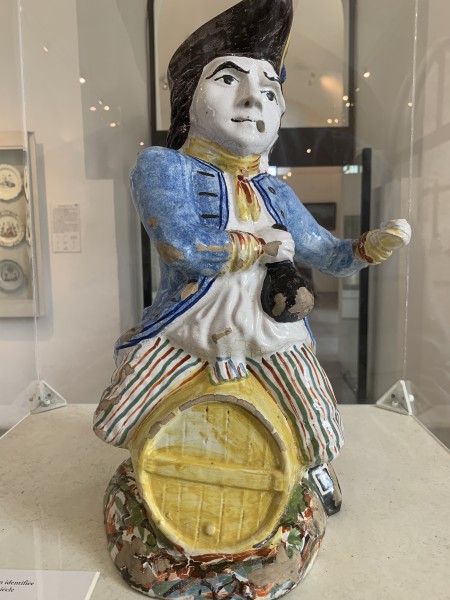 In the early days of the revolution, dishes and pottery were often decorated in patriotic themes.
My first question was, Why would the Musée de la Révolution française be in a small city in the middle of the country? Why not in Paris, where so much of the revolution’s story takes place? Or in Marseilles, namesake of La Marseillaise, France’s stirring revolutionary anthem? The answer lies in Vizille’s proximity to Grenoble. The museum is housed in the grand Château de Vizille, rebuilt in the seventeenth century by François de Bonne, duc de Lesdiguières, then purchased in 1780 by Claude-Nicolas Perier, a wealthy manufacturer. During pre-revolutionary turbulence—the French government was on the verge of bankruptcy and the national economy was in tatters—a national assembly was called and sited in Grenoble. When forbidden to convene in that city, representatives were welcomed at Vizille’s château where their deliberations opened a new chapter in French history.
Our visit to the museum was both illuminating and humbling. My American-centric view of France’s revolution has always been tinged with a condescending sense of our revolution as their model; I saw it as copy-catting. So wrong. Yes, our revolution came first, but the French threw off far heavier burdens—political, emotional, and psychological—than we. Where our revolution was fundamentally intellectual, theoretical, rhetorical, and administrative—more of a bunch of disgruntled businessmen promoting a governmental reorganization (albeit an extreme one)—France’s revolution was a deeply conflicted cultural earthquake, a radical transformation at the deepest levels of individual self-identity. Its shattering of a long-established, rigidly stratified society comprised
- peasants indoctrinated from birth to consider themselves deserving only of scraps left by their betters;
- intellectuals and political radicals;
- thoughtful, educated, and wealthy merchants;
- liberal aristocrats, many of whom supported the end of God-sanctioned, absolute monarchy but who sought to replace it with a constitutional monarchy;
- and an unaccountable and unrepentant clergy whose tentacles reached deeply into French culture.
All of these were ardently opposed by conservative, hereditary aristocrats. Powerful, connected, and armed, they saw clearly that profound social reorganization would cost them everything that defined their lives.
Where the American revolution was led by a homogenous cohort of white males who considered themselves loyal English citizens—at least at first—many members of France’s distinct castes, including many women, combined to throw off a thousand years of feudalism, serfdom, oppressive religiosity, self-abnegation, and an ossified, sclerotic hierarchy of privilege, arrogance, and wealth.
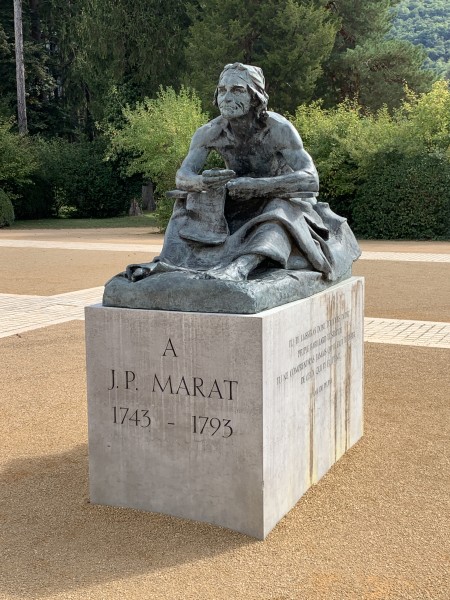 Bronze sculpture of Jean-Paul Marat situated outside the Museum of the French Revolution. Marat, a leader of the revolution, was assassinated by Charlotte Corday.
The Museum of the French Revolution reminded me that there is a paradigmatic difference between choosing among options I dislike and having no options; among luxury accommodations and having no place to go because your place has been blown, burned, or washed away; among pleasing places to stay and looking at a now-empty lot where your home used to be; among restaurants and not knowing where your and your family’s next meal is coming from. Or if it’s coming at all. A difference between sending pictures of the Côte d'Azur to family members and friends and not knowing where—or if—your family members and friends are.
The museum restored my sense of my own historical insignificance—for which I am grateful—but it also put into sharp historical perspective something I had previously treated merely as an interesting factoid: European aristocrats reserved for themselves the right to bear arms. (Thus the ceremonial swords they constantly carried as literal status symbols and why so many images present revolutionaries and insurrectionists armed with pitchforks and scythes; in retrospect, it’s clear why aristocrats didn’t want commoners they’d abused for millennia to own, train with, and carry weapons.)
An idea—a revolution—arises within historical context and takes shape relative to that era’s concrete realities; but the farther we get in time and distance from those realities, the more tenuous the connections to the idea’s –and the revolution’s—concrete causes. As was France’s revolution—as is any—America’s was a product of its time and the conditions in which those revolutionaries lived. Our Constitution and Bill of Rights were written so that rights formerly and formally limited to aristocrats were deliberately dispersed among newly elevated and empowered (white, male) citizens. France’s revolution was more concerned with a spirit of egalitarianism, while America’s was, in the main, a conscious disintegration of the concrete tradition that superiority was hereditary. In reaction, we replaced that noxious idea with merit.
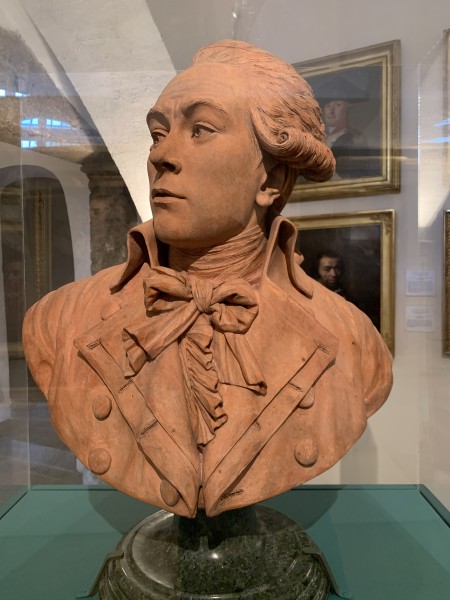 Bust of Maximilien Robespierre, a revolutionary leader who led the Reign of Terror until he too was caught up in it.
The museum’s reminding me of this produced a different frame for our strident 2nd Amendment debate. Despite the assumption on which rests the American right wing’s current, patriotism-infused, pro-gun panic, our 2nd Amendment was not included in our Bill of Rights because of our Founders’ serious concerns that if citizens were unarmed, our government might oppress us. (The idea is a dark and paranoid fantasy, and, ironically, the political faction most likely to use the government to oppress American citizens is comprised of the very right-wingers who claim to need weapons to prevent that happening.) Rather, as were other amendments in the Bill of Rights, the 2nd was included as a response to concrete reality, in this case European aristocrats’ limiting to themselves the right to keep and bear arms.
Our apartment is directly in NCE’s flight path. Sitting on the terrace, I’m watching jet after jet fly past spewing greenhouse gases and particulates, each one making the climate crisis a bit worse, each one contributing to more weather extremes occurring more frequently, extremes that have recently wiped away so many livelihoods and lives. And I’m thinking that the climate crisis is caused in no small degree by my country’s out of control consumer capitalism, which is marketed squarely at and, which feasts off, the self-indulgent narcissism of people like me.
